

Interaction Corrections and Finkel'stein Scaling
Electron interactions acquire singular low-energy corrections in a diffusive metal because particles revisit the same region for a long time. Exchange and screened Hartree processes suppress or enhance the tunnelling density of states and conductivity according to their singlet/triplet channel amplitudes, while the Finkel’stein sigma model evolves disorder and interaction parameters together. Adding an “interaction correction” to weak localization without a common convention double counts soft modes.
Required background. Weak localization supplies the noninteracting interference correction. The disorder sigma model supplies the diffusive field and conductance normalization.
Helpful background. Landau Fermi-liquid theory supplies the spin-symmetric and spin-antisymmetric interaction channels.
Diffusive interaction singularity
Section titled “Diffusive interaction singularity”In the window
the particle–hole propagator is diffusive rather than ballistic. A representative exchange contribution to the density of states has the structure
with the dynamically screened interaction . In two dimensions, diffusive momentum integration produces logarithms; an unscreened Coulomb tail can supply a second logarithm. The tunnelling zero-bias anomaly is therefore not a hard gap. Its coefficient and even some transport signs depend on screening, spin degeneracy, and triplet amplitude. Altshuler and Aronov 1979 established the singular density-of-states correction.
The following original diagram makes the shared origin visible. Inspect the branch after the field: weak localization and interaction corrections are different insertions into the same diffusive theory.
On a narrow screen, swipe or use the Left and Right arrow keys to pan across the figure. Home and End move to its edges. A full-size link is also available.
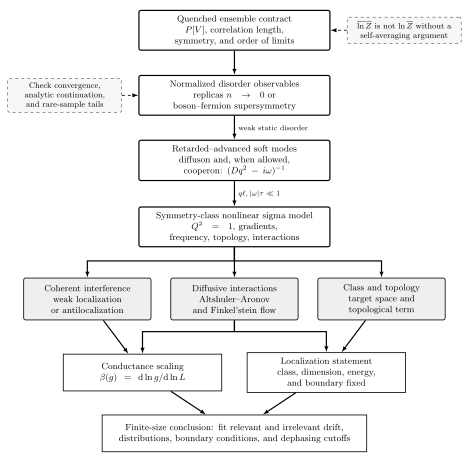
Interaction and interference corrections share diffusive modes. A consistent calculation fixes density of states, spin convention, screening, conductance units, and infrared cutoff once; the branches cannot be added from incompatible normalizations. The diagram is schematic and not to scale.
Text description of this diagram · Figure data (JSON)
From a correction to a coupled field theory
Section titled “From a correction to a coupled field theory”The noninteracting action is augmented by frequency and interaction operators. Schematically,
where renormalizes frequency, is the density singlet amplitude, and is the spin-triplet amplitude in an -symmetric problem. Ward identities tie and the conserved density vertex; long-range Coulomb interaction imposes an additional gauge constraint. The running variables may be expressed as resistance and dimensionless amplitudes .
At weak resistance the renormalization group has the form
The functions depend on symmetry, valley number, and interaction range; quoting one beta function without those choices is meaningless. A growing triplet amplitude may signal magnetic strong coupling, while an attractive Cooper channel can signal superconductivity. Neither endpoint is controlled merely because the initial flow was perturbative. Finkel’stein 1983 gives the coupled sigma-model construction, and Belitz and Kirkpatrick 1994, §§III–V reviews its symmetry and control structure.
Observable checks and failure boundaries
Section titled “Observable checks and failure boundaries”A tunnelling density of states, thermodynamic compressibility, and conductivity are distinct observables. The Einstein relation involves the renormalized compressibility and diffusion constant; a tunnelling anomaly cannot be inserted as a transport lifetime. Required checks include:
- the same total or per-spin and convention in every channel;
- screening appropriate to the gate geometry and dimensional crossover;
- for diffusive, rather than ballistic, corrections;
- dephasing and Zeeman/spin–orbit gaps in the triplet sector;
- a stop when , , or a competing susceptibility becomes order one.
The canonical disorder and glass claim test matrix separates a perturbative anomaly, a coupled RG trajectory, and a phase claim.
Exercise
Section titled “Exercise”Return-probability logarithm. In two dimensions the diffusion return probability is . Show that an interaction process weighted by is logarithmic.
Solution
Direct integration gives
The ultraviolet cutoff is the elastic time, where diffusion begins; temperature supplies the infrared cutoff in this simplified estimate. The prefactor and sign still require the exchange/Hartree channel calculation, so the return probability predicts the logarithm but not a universal coefficient.
References
Section titled “References”- Boris L. Altshuler and Arkady G. Aronov, “Zero Bias Anomaly in Tunnel Resistance and Electron–Electron Interaction,” Solid State Communications 30 (1979) 115–117. DOI
- Dietrich Belitz and Theodore R. Kirkpatrick, “The Anderson–Mott Transition,” Reviews of Modern Physics 66 (1994) 261–380. DOI
- Alexander M. Finkel’stein, “Influence of Coulomb Interaction on the Properties of Disordered Metals,” Soviet Physics JETP 57 (1983) 97–108. Open PDF