

Dirty Bosons and the Bose Glass
A Bose glass is a disorder-induced insulating phase with zero superfluid stiffness, no many-body gap, and generically nonzero compressibility. These three tests distinguish it from both a superfluid and a commensurate Mott insulator. Density inhomogeneity or loss of a condensate peak alone is insufficient, especially in a trap or a finite system.
Required background. The Bose–Hubbard model supplies the clean Hamiltonian and controlled limits. Quenched disorder supplies the ensemble and order of averages.
Helpful background. The superfluid–Mott transition supplies clean critical scaling.
Disordered Bose–Hubbard model
Section titled “Disordered Bose–Hubbard model”For random on-site energies , take
The distribution of , its spatial correlations, and whether it is bounded are model data. Diagonal disorder couples to density; random hopping is a different problem and can have additional particle–hole structure.
Let be the total free energy with a dimensionless boundary twist across a sample of linear size and volume . The three thermodynamic diagnostics are
Equivalently, if is the uniform phase gradient, then . These are the same definition; including both and an additional with total would be incorrect.
After thermodynamic and zero-temperature extrapolation, a superfluid has ; a Mott insulator has , , and ; a generic Bose glass has , , and . Fisher et al. 1989 established this dirty-boson framework.
The original validity diagram emphasizes why all three observables are needed. Inspect the rare-region branch: it can close the gap without establishing phase coherence.
On a narrow screen, swipe or use the Left and Right arrow keys to pan across the figure. Home and End move to its edges. A full-size link is also available.
Dirty-boson phase discrimination. The Bose-glass conclusion requires vanishing stiffness together with gaplessness and generic compressibility after size, temperature, disorder, and trap checks. Schematic, not a universal phase diagram.
Text description of this diagram · Figure data (JSON)
Replicated action and rare regions
Section titled “Replicated action and rare regions”For a continuum complex field with random chemical potential , Gaussian averaging produces
The double time integral is the signature of quenched disorder. Rare regions whose local chemical potential lies near a clean lobe edge admit arbitrarily low particle or hole excitations in a sufficiently large sample. For generic bounded diagonal disorder, the theorem of inclusions implies that a glassy region intervenes between Mott and superfluid phases rather than allowing a generic direct transition Pollet et al. 2009.
This statement has hypotheses. Special correlated disorder, exact particle–hole symmetry, random hopping, or long-range interactions can yield other glass regimes, including gapless but anomalously incompressible cases. A measured small at finite size is not proof of zero compressibility because the rare regions controlling it may exceed the sample.
Scaling, traps, and negative tests
Section titled “Scaling, traps, and negative tests”Near a continuous transition, one may test
but and must be inferred with corrections to scaling rather than fixed to a desired collapse.
Large-scale worm-algorithm calculations illustrate how stiffness and compressibility must be extrapolated together Prokof’ev and Svistunov 2004. In a harmonic trap, produces coexisting local regimes. Local-density analysis requires a trap length much larger than the correlation length and must be compared with the measured point-spread function.
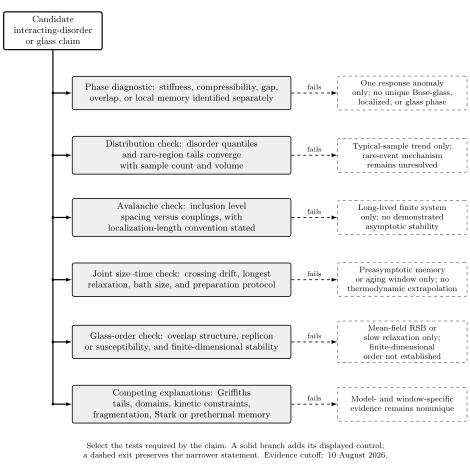
Negative tests include a finite-temperature normal fluid, an unresolved Mott gap, percolating but noncoherent puddles, and trap averaging. The disorder and glass claim test matrix keeps those alternatives adjacent to the phase criteria.
Exercise
Section titled “Exercise”Atomic-limit compressibility. Set , let be uniform on , and choose with so each site has either zero or one boson. Find the disorder-averaged density and compressibility.
Solution
A site is occupied when its local chemical potential is positive, or . Therefore
At the stiffness vanishes. The continuous distribution supplies sites arbitrarily close to their addition threshold, so the thermodynamic excitation gap is zero: this atomic limit already displays the three Bose-glass diagnostics.
References
Section titled “References”- Matthew P. A. Fisher, Peter B. Weichman, Gregory Grinstein, and Daniel S. Fisher, “Boson Localization and the Superfluid-Insulator Transition,” Physical Review B 40 (1989) 546–570. DOI
- Lode Pollet, Nikolay Prokof’ev, Boris Svistunov, and Matthias Troyer, “Absence of a Direct Superfluid to Mott Insulator Transition in Disordered Bose Systems,” Physical Review Letters 103 (2009) 140402. DOI
- Nikolay Prokof’ev and Boris Svistunov, “Superfluid–Insulator Transition in Commensurate Disordered Bosonic Systems: Large-Scale Worm Algorithm Simulations,” Physical Review Letters 92 (2004) 015703. DOI