

Functional RG for Competing Fermi-Surface Instabilities
Functional renormalization group (fRG) is useful when the same low-energy fermions can reinforce several candidate orders. It evolves one regulated many-body vertex while retaining the particle–particle and both particle–hole loop geometries, then projects the result onto pairing, magnetic, charge, and Fermi-surface-deformation responses. The reliable output is a tendency whose symmetry and ordering remain stable under declared refinements, together with the scale at which the normal-state approximation loses control. A large vertex entry, by itself, is neither a susceptibility nor proof of an ordered phase.
This page specializes to spin- lattice fermions in a translation-invariant normal state, with the two-dimensional weakly repulsive Hubbard model as the worked case. Frequencies are Euclidean Matsubara frequencies, the interaction is short-ranged, and the flow starts in weak coupling. Nesting and van Hove points are allowed as resolved features of the discretization, but they weaken the regular curved-surface estimates that justify a simple truncation. Strong bare coupling, a destroyed fermion pole, and the ordered state lie outside the controlled scope.
Required background. Fermi-surface patch scaling supplies the surface measure, patch weights, and weak-coupling channel kinematics. The general functional-RG construction supplies the effective average action and exact hierarchy. Helpful background. Functional-method validation organizes regulator, truncation, and benchmark tests.
A fermionic flow with a declared sign convention
Section titled “A fermionic flow with a declared sign convention”Let and add the quadratic regulator
For the exact functional identity, collect the independent Grassmann fields into the doubled vector . Let be the full left/right Hessian in this doubled space and let be the corresponding antisymmetric regulator matrix. With the regulator term subtracted in the definition of the effective average action,
The minus sign is the fermionic supertrace sign and the factor compensates the doubled field space; field-independent normalization terms have been omitted. At nonzero Grassmann background the and Hessian blocks need not vanish, so replacing the matrix Hessian by only is not the exact functional equation. The normal-state zero-field blocks may be reduced only after the functional derivatives that generate the vertex hierarchy have been taken. Choose so that fluctuations are frozen at the ultraviolet scale , set by the microscopic action, and lower until . The exact identity and its fermionic conventions are derived in Metzner et al. 2012, § II.B–C, Eqs. (35)–(52), pp. 306–310.
For a normal state, expand the scale-dependent action as
The labels include momentum, frequency, spin, and band or orbital indices. We take as incoming and as outgoing, so . The four-point vertex is antisymmetric under and separately under . The regulated dressed and single-scale propagators are
where differentiates the regulator at fixed self-energy. Consequently,
With the external-leg convention above, the self-energy contraction is
All sums include the appropriate momentum, Matsubara-frequency, and internal-index measure. Dropping closes the usual level-two hierarchy. For a bare two-body interaction it reproduces the four-point beta function through ; omitted six-point feedback begins at even though the closed equations resum selected terms to all orders. The Katanin substitution replaces by the total derivative inside the vertex loops. It therefore requires a computed self-energy flow. It adds a specific self-energy-insertion and higher-loop contribution and improves Ward-identity behavior, but it is not the full six-point vertex or a general proof of conservation Katanin 2004, pp. 3–4.
Three transfers, one reconstructed vertex
Section titled “Three transfers, one reconstructed vertex”Three bosonic transfers organize the one-loop contractions:
is the total momentum and frequency of the incoming pair; and are the two inequivalent particle–hole transfers. With the external-leg ordering fixed above, the exact four-point hierarchy has the structure
Here denotes the six-point contribution; the level-two truncation sets it to zero. To make the signs and crossings reproducible, introduce internal labels and define
where
, , and are respectively the particle–particle, direct particle–hole, and crossed particle–hole contractions in this leg ordering; their distinguished external transfers are , , and . The six-point remainder is . These formulas are the index form of Metzner et al. 2012, Eq. (52), pp. 309–310. In a Katanin flow, each in the quadratic-vertex terms is replaced by ; dummy-index symmetries and the explicitly exchanged terms account for the derivative placement on the partner line. Thus an enhancement first visible at an antiferromagnetic transfer is fed back into the Cooper and forward-scattering projections at the next step; the channels are not independent differential equations.
The exact parquet decomposition is
where is fully two-particle irreducible and each carries one reducible channel. Replacing by defines the first-order parquet approximation; it is not an exact identity for the Hubbard model. The diagrammatic assignment of a reducible diagram to particle–particle, direct particle–hole, or crossed particle–hole class is unique. What remains convention-dependent at finite resolution is the allocation of smooth remainders, the Fierz or bosonization basis, and the projection of unresolved momentum and frequency structure. Assign every differentiated diagram once, preserve antisymmetry and crossing, and reconstruct before computing observables. The channel construction and its residual parametrization ambiguity are explicit in Husemann and Salmhofer 2009, §§ 2–4, pp. 3–13.
The figure summarizes this coupled logic. In the upper panel, follow the common full vertex through all three loop transfers and back into its derivative. In the lower panel, follow projected responses through the refinement gates before reading the endpoint.
On a narrow screen, swipe or use the Left and Right arrow keys to pan across the figure. Home and End move to its edges. A full-size link is also available.
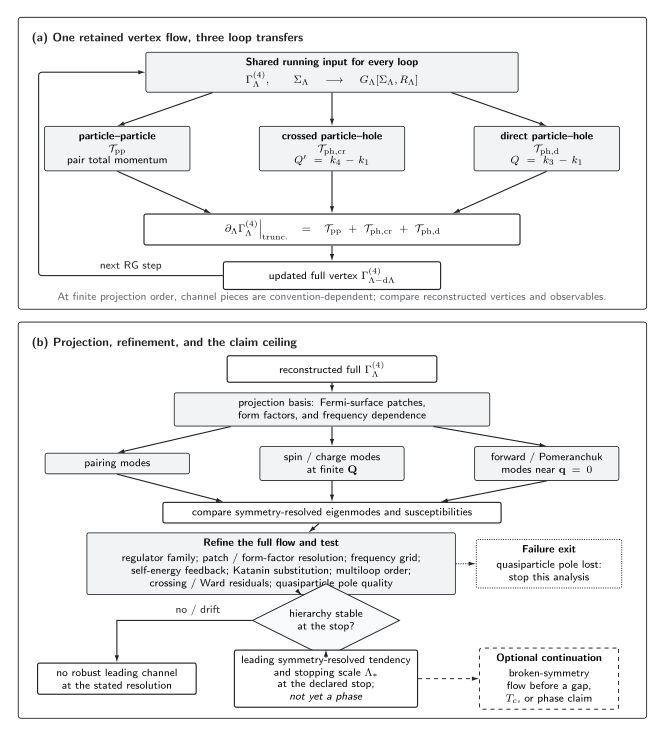
Coupled normal-state fRG workflow and its conclusion ceiling. The upper panel is schematic: particle–particle and the two particle–hole loop classes use the same reconstructed four-point vertex, while changes every internal . Reducibility classes are exact diagrammatic categories, but replacing the fully irreducible vertex by the bare interaction and projecting onto finite form-factor, frequency, or patch bases are approximations. The lower panel separates a stable leading response and approximation-dependent stopping scale from an unresolved hierarchy or a failed fermion-pole assumption. Neither branch proves an ordered phase; a gap, transition, or coexistence claim requires a controlled continuation below the symmetric-flow stop.
The downloadable SVG and machine-readable semantic record preserve the transfer definitions, arrow meanings, validation gates, and inference limits. This compact table supplies the same relations without requiring the image.
| Flow object | Resolved transfer or projection | Data that must be retained | Convergence question | Invalid inference |
|---|---|---|---|---|
| Particle–particle loop | Pair total | Relative momenta, frequencies, spin parity | Does the pairing eigenfunction stabilize? | One attractive entry proves superconductivity |
| Crossed particle–hole loop | Transfer | Spin/charge tensor and finite- structure | Do magnetic or density peaks survive refinement? | A large vertex component is a susceptibility |
| Direct particle–hole loop | Transfer | Forward and exchange limits, crossing partners | Are uniform and finite- limits separated? | Every forward enhancement is nematic order |
| Reconstructed | All three transfers | Smooth remainder and every retained basis coefficient | Are crossing and antisymmetry residuals small? | Channel pieces may be compared without reconstruction |
| Physical response | Source vertex or Bethe–Salpeter kernel | Bubble weights, operator normalization, and wave vector | Is the response hierarchy stable across admissible schemes? | is a transition temperature |
Patches, form factors, and frequency data
Section titled “Patches, form factors, and frequency data”On a regular Fermi surface, with finite nonzero and finite density of states, an -patch calculation replaces the surface by weighted cells. Reuse the per-species normalized measure from the patch-theory page,
and define
Patch values are quadrature data, not equally weighted angular samples. These formulas do not apply at a van Hove saddle, where and diverges. There, retain finite- or finite- momentum-and-energy cells and form the channel bubble directly, for example
with the particle–particle or particle–hole propagator product and its channel sign declared. This finite-shell quadrature, not normalization by , is the appropriate basis for the van-Hove benchmark.
On a regular surface, a point-group form-factor basis obeys
In a channel decomposition one writes, for example,
while keeping the bosonic transfer on a sufficiently fine grid. The fermionic radial and frequency variables must either remain explicit or be removed by a declared projection. “Static vertex on the Fermi surface” is a substantial approximation near a van Hove point or when self-energy structure develops; it is not a harmless change of notation.
For a singlet Cooper diagnostic on that regular surface, a convenient dimensionless weighted kernel is
The minus sign makes an attractive pairing direction positive in this convention. Do not multiply by the density of states twice: it is outside the normalized . Particle–hole kernels contain their own bubble and spin or charge factors, so their raw eigenvalues are not numerically comparable to . State each operator normalization and compare physical responses.
From a vertex to competing responses
Section titled “From a vertex to competing responses”Let be the number of lattice sites. Normalize the static Fourier operators by so that their connected susceptibilities are intensive:
is a general forward or Pomeranchuk probe. It is nematic only when belongs to a point-group-breaking representation such as or ; an extended- form factor preserves the lattice symmetry. probes commensurate antiferromagnetism, and probes zero-momentum pairing. Their connected susceptibility matrix is
For internal Matsubara loops, below means ; this convention must accompany any exported response data. There are two consistent routes. At conventional level two or one loop, one can flow the three-point source vertices and together with and . Their structure is
where is the chosen form factor, , and the channel definition absorbs the necessary fermion-loop, spin, and charge signs. Alternatively, one can solve a Bethe–Salpeter equation with , the vertex irreducible in channel . In a static Hermitian source basis, absorb the channel sign into and define
Then
An eigenvalue of this signals a response singularity within that convention and approximation. If post-processing instead uses the full channel vertex , contract it directly,
with the same declared signs; inserting into a second ladder equation would double count channel-reducible diagrams. The bubble , source vertices, transfer, temperature, and form-factor normalization are part of the observable. Halboth and Metzner derive explicit source-vertex and susceptibility flows in Halboth and Metzner 2000, § II.C, Eqs. (43)–(46), pp. 6–7. At multiloop convergence, flowing-source and post-processed response routes agree within the chosen parquet approximation only when the corresponding multiloop corrections to the fermion–boson vertex and susceptibility flow are included; inserting a multiloop into the displayed one-loop response equations is not sufficient Tagliavini et al. 2019, § 2.2, Eqs. (23)–(26).
A historical weak-coupling Hubbard benchmark
Section titled “A historical weak-coupling Hubbard benchmark”Consider
with
The van Hove level is in this convention. A calculation must state , , or density, , whether density or chemical potential is held fixed, the regulator and , patch weights or form factors, frequency and radial resolution, self-energy feedback, loop order, response operators, and the dimensionless stopping norm.
A useful historical comparison is the zero-temperature Wick-ordered flow of Halboth and Metzner 2000, §§ II–III, pp. 4–13. Their baseline used a sharp energy cutoff, , , a static four-point vertex projected onto 16 Fermi-surface points, and no self-energy feedback. In fixed-, no-self-energy runs, was labeled by the noninteracting-band density and gave a leading commensurate antiferromagnetic response; was labeled by and gave a leading pairing response. These are not self-consistently fixed interacting densities. This comparison tests qualitative channel ordering only: its Wick-ordered scheme is not identical to the 1PI flow developed above, and the paper does not specify a portable numerical fixture with the same stopping norm and patch-node map. Their separate van-Hove test at found that refining surface points changed the stopping scale but preserved the qualitative vertex and response behavior.
The sign-changing pairing tendency has a transparent check. For ,
If the reconstructed repulsive pairing interaction is concentrated at transfers near , the minus sign in the Cooper kernel combines with the sign reversal of to give a positive pairing eigenvalue. In a channel decomposition, one may observe the crossed particle–hole contribution generating this -wave Cooper projection. Calling antiferromagnetic fluctuations the “mediator” is then a useful but decomposition-dependent mechanism diagnosis; the invariant checks are the reconstructed vertex, the -wave response, and their behavior under refinement.
Modern validation must go beyond the historical fixture. Full frequency dependence, self-energy feedback, and increasing multiloop order test whether the response is regulator-independent within the first-order parquet approximation. Multiloop fRG supplies all parquet derivatives at loop convergence, but it still approximates the fully irreducible vertex by its chosen input and is not exact for the Hubbard model Kugler and von Delft 2018. In a half-filled benchmark, Tagliavini et al. found response and cutoff convergence through eight loops for the temperatures they studied; that is a method-control result, not permission to transfer the same error estimate to a lower-temperature strong-flow run Tagliavini et al. 2019, § 4.
Stop before the approximation chooses the answer
Section titled “Stop before the approximation chooses the answer”There is one coupled flow and therefore one earliest stop. Keep an amplitude stop distinct from a response-eigenvalue criterion. For the lattice problem, choose a fixed microscopic energy —for example or the noninteracting bandwidth—and a declared grid of independent external labels. A simple decomposition-independent monitor is
where is the fully reconstructed antisymmetrized vertex, not an individual channel component. This grid maximum is deliberately basis- and resolution-dependent, but at finite or it remains well-defined without division by the divergent van-Hove density of states, until the interaction itself reaches the stop. Choose conservatively, before the vertex leaves the declared weak-coupling window or the integrator and symmetry residuals fail, and define
Scan rather than reporting one arbitrary endpoint. The condition marks loss of the weak-vertex truncation, whereas concerns a specifically normalized Bethe–Salpeter response; the two numbers must not be interchanged. If the leading response changes during the threshold scan, or if two candidates are closer than the combined variation envelope, the hierarchy is unresolved. Separate this numerical stop from a physical infrared cutoff supplied by temperature, size, a gap, or imperfect nesting.
The stopping scale is regulator-, threshold-, basis-, and truncation-dependent at finite approximation. In asymptotically weak coupling, the exponential dependence may be much more robust than its order-one prefactor. In strict two dimensions with short-range interactions, finite-temperature bounds exclude conventional magnetic and superconducting long-range order in the Hubbard setting Koma and Tasaki 1992. A superconducting branch can instead require a Berezinskii–Kosterlitz–Thouless analysis of phase stiffness and vortices Kosterlitz and Thouless 1973. Hence a symmetric-flow is neither a finite- Néel temperature nor automatically .
A practical validation sequence
Section titled “A practical validation sequence”Change one layer at a time at fixed Hamiltonian and thermodynamic control variables. Changing , filling, or temperature is physics; changing the regulator or mesh at the same parameters is a numerical or truncation test.
| Test | Minimum comparison | Pass condition | If it fails |
|---|---|---|---|
| Regulator | Two admissible frequency or energy regulators | Same leading response and compatible variation envelope | Scheme dependence is unresolved |
| Surface resolution | Refine patches or form factors with correct weights | Eigenfunction, susceptibility ratios, and stabilize | Increase resolution; inspect hot spots and van Hove cells |
| Radial and frequency data | Static projection versus a systematic grid | Retained modes and hierarchy agree within tolerance | Static approximation is not controlled |
| Self-energy resolution | None, static shift, then momentum- and frequency-dependent | Fermi-surface shift, , and response order stabilize | Recompute at fixed density or stop if the pole fails |
| Internal-line derivative | Single-scale versus Katanin , using the same computed | The response hierarchy is stable and Ward residuals improve | Higher-order feedback matters |
| Loop hierarchy | One loop, then increasing multiloop order at fixed self-energy approximation | Responses converge with loop order | Parquet completion is not reached |
| Symmetries | Antisymmetry, crossing, and relevant Ward residuals | Residuals decrease under refinement | Repair projection or reject the run |
| Response route | Flowing sources versus post-processing | Matched susceptibilities within the approximation | Source or vertex contraction is incomplete |
| Independent benchmark | Weak-coupling expansion, parquet solver, determinant QMC, or another controlled method in an overlapping regime | Same normalized observable after finite-size and convention matching | Keep the disagreement as part of the result |
Multiloop convergence removes regulator dependence only within the adopted parquet, frequency, momentum, and self-energy approximations. It does not replace self-energy and frequency-momentum resolution tests, symmetry checks, multiloop-consistent response reconstruction, or comparison with an independent benchmark. Likewise, a small crossing residual does not prove that omitted frequencies or six-point information are negligible.
The chapter comparison records the exact input, observable, and falsifying signature for an fRG leading-channel statement.
What the flow can support
Section titled “What the flow can support”| Observed evidence | Strongest warranted statement |
|---|---|
| One vertex entry grows | That component is enhanced in the chosen representation |
| A normalized kernel has a stable eigenfunction | The approximation selects a symmetry-resolved interaction mode |
| A physical susceptibility leads under mesh and regulator refinement | The normal-state calculation supports a leading response tendency |
| The hierarchy also survives frequency, self-energy, and loop refinement | The tendency is robust within the declared truncation envelope |
| The fermion pole fails before strong response growth | The Fermi-surface truncation has lost its starting point |
| Two modes exchange order under an admissible refinement | No leading tendency is resolved |
| A broken-symmetry continuation controls the infrared | Gap, stiffness, coexistence, or transition claims may then be tested |
This ladder is intentionally asymmetric: more checks can strengthen a method-conditional tendency, but no amount of symmetric normal-state vertex growth substitutes for the ordered-state calculation.
Common pitfalls
Section titled “Common pitfalls”Comparing raw channel entries. Pairing, spin, charge, and nematic operators carry different bubble, spin, and normalization factors. Compare consistently normalized susceptibilities or Bethe–Salpeter eigenvalues, not the largest number stored in each channel array.
Counting a diagram twice. A transfer parametrization may distribute smooth remainders in several ways, but every differentiated diagram must enter one reducibility class once. Reconstruct the antisymmetric full vertex and test crossing before projection.
Calling Katanin “two loop.” The substitution includes a useful subset of higher-order feedback. It does not equal the full two-loop hierarchy or multiloop parquet completion.
Treating parameter dependence as error. A change in or filling legitimately changes nesting and the Hamiltonian. Reordering under patch, regulator, or feedback variation at fixed physical parameters is instead evidence that the approximation has not resolved the competition.
Naming as . The stop marks the failure of the symmetric truncation. In two dimensions, magnetic long-range order and superconducting phase coherence obey additional exact infrared constraints.
Exercises
Section titled “Exercises”Track the three transfers. For , define , , and . Show how they transform when the outgoing legs are exchanged, , and explain the corresponding crossing check.
Solution
is unchanged. The exchange swaps and because the new is and the new is . Fermionic antisymmetry also changes the sign of . A projected representation therefore passes this crossing check only if exchanging the two particle–hole transfer arguments and the outgoing spin labels reproduces the negative of the original reconstructed vertex.
Derive the Katanin identity. Starting from , differentiate and identify .
Solution
Differentiating the identity gives
The first term is , hence
Replacing by this total derivative in the vertex loops adds the displayed self-energy-insertion contribution, but it does not reconstruct every omitted six-point term.
Check the -wave sign. Prove that for . Why can a repulsive interaction concentrated near favor this mode in the convention ?
Solution
Since and likewise for ,
The kernel contributes an overall minus sign. Scattering through samples a gap value of the opposite sign, so the two minus signs produce a positive contribution to the -wave eigenvalue. This verifies the sign mechanism, not the numerical dominance of the mode; the weighted integral over the full surface and the competing loops still have to be solved.
Decide whether a leader exists. At fixed , suppose patch refinement changes from to , while adding self-energy feedback gives . A second regulator gives . What is the strongest reportable conclusion?
Solution
Both antiferromagnetic and -wave responses are enhanced, but their ordering changes under admissible resolution, self-energy, and regulator variations. The calculation therefore resolves competition, not a leading channel. One should report an overlap envelope, refine the momentum and frequency basis, increase loop order, and compare the matched susceptibilities with an independent method. Choosing the largest value from one run would hide the main uncertainty.
Continue
Section titled “Continue”Pomeranchuk and density-wave instabilities separate a uniform Fermi-surface deformation from finite-wavevector charge or spin order. The Cooper instability and pairing develops the ordered branch that a normal-state pairing tendency does not determine. For the strong-coupling lattice regime, continue to the Hubbard model and the Mott regime.
References
Section titled “References”- Christoph J. Halboth and Walter Metzner, “Renormalization-Group Analysis of the Two-Dimensional Hubbard Model,” Physical Review B 61 (2000) 7364–7377, doi:10.1103/PhysRevB.61.7364, Open PDF.
- Christoph Husemann and Manfred Salmhofer, “Efficient Parametrization of the Vertex Function, Scheme, and the Hubbard Model at Van Hove Filling,” Physical Review B 79 (2009) 195125, doi:10.1103/PhysRevB.79.195125, Open PDF.
- Andrey A. Katanin, “Fulfillment of Ward Identities in the Functional Renormalization Group Approach,” Physical Review B 70 (2004) 115109, doi:10.1103/PhysRevB.70.115109, Open PDF.
- Tohru Koma and Hal Tasaki, “Decay of Superconducting and Magnetic Correlations in One- and Two-Dimensional Hubbard Models,” Physical Review Letters 68 (1992) 3248–3251, doi:10.1103/PhysRevLett.68.3248, Open PDF.
- J. Michael Kosterlitz and David J. Thouless, “Ordering, Metastability and Phase Transitions in Two-Dimensional Systems,” Journal of Physics C: Solid State Physics 6 (1973) 1181–1203, doi:10.1088/0022-3719/6/7/010.
- Fabian B. Kugler and Jan von Delft, “Multiloop Functional Renormalization Group That Sums Up All Parquet Diagrams,” Physical Review Letters 120 (2018) 057403, doi:10.1103/PhysRevLett.120.057403, Open PDF.
- Walter Metzner, Manfred Salmhofer, Carsten Honerkamp, Volker Meden, and Kurt Schönhammer, “Functional Renormalization Group Approach to Correlated Fermion Systems,” Reviews of Modern Physics 84 (2012) 299–352, doi:10.1103/RevModPhys.84.299, Open PDF.
- Agnese Tagliavini, Cornelia Hille, Fabian B. Kugler, Sabine Andergassen, Alessandro Toschi, and Carsten Honerkamp, “Multiloop Functional Renormalization Group for the Two-Dimensional Hubbard Model: Loop Convergence of the Response Functions,” SciPost Physics 6 (2019) 009, doi:10.21468/SciPostPhys.6.1.009, Open PDF.