

Kondo Lattices, RKKY Competition, and the Doniach Regime
A Kondo lattice places a local moment in every unit cell, so single-impurity screening competes with intermoment exchange and must eventually develop lattice coherence. Perturbatively, the same exchange generates an oscillatory RKKY interaction of scale , whereas the single-impurity Kondo scale is exponentially small, for the per-spin density of states and spin-density convention used here. Comparing these scales is a useful organizing estimate, not a universal phase diagram or a proof of one direct transition.
Required background. Anderson-to-Kondo matching supplies and its cutoff.
Helpful background. Kondo RG supplies ; effective spin Hamiltonians supplies magnetic exchange.
Kondo-lattice Hamiltonian
Section titled “Kondo-lattice Hamiltonian”A minimal model is
may include direct superexchange in addition to conduction-mediated exchange. The lattice problem is not a set of independent impurities: each site draws screening weight from the same finite conduction sea, translational coherence can reconstruct bands, and magnetic correlations feed back on the bath.
At second order in , integrating out conduction electrons produces
up to the sign convention used for . In an isotropic metal, oscillates at and decays algebraically. Consequently the sign and ordering wavevector depend on band geometry and moment positions; replacing it by one positive number discards frustration and incommensurability. Ruderman and Kittel 1954, pp. 99–102 derives the original conduction-electron-mediated exchange.
The parametric scale is
where both and depend on conventions and the band. Doniach 1977 used their crossing to organize magnetically ordered and Kondo-screened tendencies.
What the Doniach comparison can establish
Section titled “What the Doniach comparison can establish”At small , the algebraic RKKY scale usually exceeds the exponential Kondo scale, favoring intermoment correlations. At larger , screening and a paramagnetic heavy Fermi liquid can become favorable. This comparison predicts neither the order of a transition nor that only those two phases occur.
Required qualifications include:
- frustration can suppress magnetic order without producing Kondo coherence;
- low carrier density can create exhaustion and separate impurity screening from a lower lattice coherence scale;
- crystal-field multiplets, valence fluctuations, and several bands change both scales;
- disorder produces distributions of local Kondo temperatures and magnetic couplings;
- the ordered phase may retain substantial Kondo hybridization; and
- small-Fermi-surface paramagnets require fractionalization or other physics absent from the two-scale cartoon.
The controlled RKKY result is perturbative in above its ordering scale. The controlled single-impurity logarithm applies before lattice coherence. Their numerical crossing lies precisely where neither asymptotic limit alone determines the ground state; it must be solved or measured.
The Kondo-lattice branch of the broader validity map marks the correct inference boundary: passing the scale comparison together with filling, frustration, dimensionality, and coherence checks supports a lattice interpretation; failing those controls leaves only an organizing scale estimate.
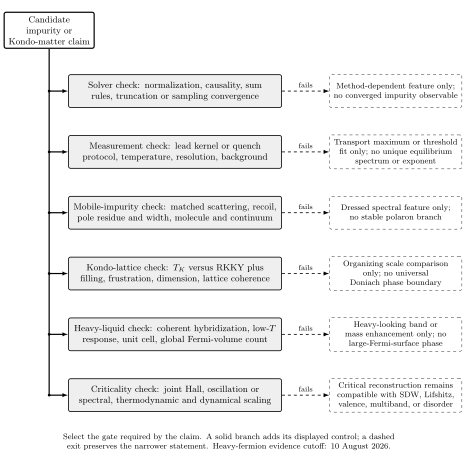
The Kondo-lattice gate is one independent branch of the broader map, not a plot of overlapping scales. The Doniach comparison organizes competing tendencies, but the intermediate regime requires a lattice calculation with the actual band, moment geometry, carrier density, frustration, and coherence diagnostics. Original schematic, not to scale.
The impurity claim test matrix records the scale definitions and failure cases.
Exercise
Section titled “Exercise”Compare asymptotics. With , constant per-spin , and small , compare with as .
Solution
The exponential vanishes faster than every power, so . Thus the RKKY tendency dominates parametrically at asymptotically weak coupling. The location of a finite- crossing depends on the omitted prefactors and cannot be inferred universally from this limit.
References
Section titled “References”- Doniach, S. (1977). “The Kondo lattice and weak antiferromagnetism.” Physica B+C 91, 231–234. doi:10.1016/0378-4363(77)90190-5.
- Ruderman, M. A., and Kittel, C. (1954). “Indirect exchange coupling of nuclear magnetic moments by conduction electrons.” Physical Review 96, 99–102. doi:10.1103/PhysRev.96.99.