

Quantum Monte Carlo Formulations and Phase Inference
Quantum Monte Carlo replaces a quantum partition function or projector by a stochastic ensemble and estimates observables with statistical errors. In sign-free formulations, controlled equilibration, autocorrelation, finite-size scaling, and discretization limits can make static conclusions exceptionally precise. The method is not automatically unbiased: the sampled representation, estimator, sign or phase, analytic continuation, and scaling ansatz determine which phase claim is licensed.
Required background. The measurement-to-claim map supplies covariance and limits of interpretation. Markov-chain sampling, autocorrelation times, covariance and resampling, and complete error budgets supply the statistical workflow.
Helpful background. Algorithm validation and provenance, chain diagnostics, and sign-problem severity provide decisive implementation checks.
Evidence cutoff. This method and evidence account covers primary and official sources available through 10 August 2026. Later algorithms, benchmarks, corrections, and changing assessments belong in the dated Quantum Matter and Emergence Research synthesis.
Representation, estimator, and sign
Section titled “Representation, estimator, and sign”Worldline, stochastic-series-expansion, auxiliary-field, determinant, continuous-time, path-integral, projector, and diffusion QMC sample different representations and may carry different systematic errors; Sandvik 2010 gives a detailed spin-system comparison. In a generic signed ensemble,
The average sign obeys
so relative variance is generically exponential in spacetime volume. A sign-free symmetry is a property of a specified decoupling, basis, parameter region, and boundary condition; it cannot be inferred from a positive answer on small lattices. The general sign problem is computationally hard Troyer and Wiese 2005.
The chapter’s validity map places QMC beside, not above, experiment and other numerical methods. Inspect the representation branch: statistical exactness within one positive ensemble does not prove that the modeled Hamiltonian describes a material.
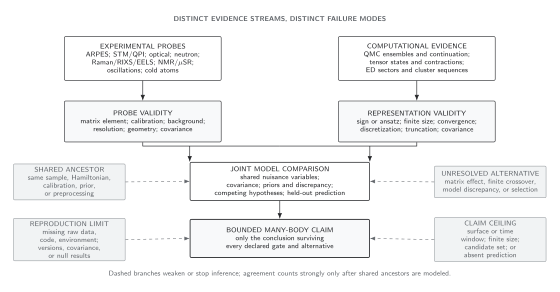
QMC evidence within a multi-method comparison. Ensemble identity, sign, autocorrelation, discretization, size, temperature, continuation, and model discrepancy accompany every observable and phase inference. Schematic.
Correlated estimates and scaling limits
Section titled “Correlated estimates and scaling limits”For a stationary chain, the variance of the sample mean is enlarged by the integrated autocorrelation time,
Equilibration, topological or winding-sector freezing, replica agreement, and update-specific slow modes must be tested per observable. Blocking or resampling should preserve cross-observable covariance. Improved estimators reduce variance only after their normalization and applicability are independently verified.
Near a continuous quantum critical point, a dimensionless ratio may obey
Crossing drift, aspect ratio, irrelevant fields, covariance, and uncertainty in belong in the fit. Vary the minimum size, expansion order, and temperature protocol; test held-out sizes. A visually good collapse is not a likelihood comparison.
Imaginary time and analytic continuation
Section titled “Imaginary time and analytic continuation”Imaginary-time data obey an integral equation such as
The kernel damps high-frequency singular directions, so many spectra fit the same noisy . Maximum entropy, stochastic continuation, sparse modeling, and parametric fits impose different regularization or priors. Validate on synthetic spectra passed through the measured covariance; publish imaginary-time data and kernel; and phrase robust integrated features more strongly than prior-sensitive peak counts. Jarrell and Gubernatis 1996 explains this ill-conditioning.
Portable implementations and benchmark data, such as the ALPS 2.0 framework of Bauer et al. 2011, can expose cross-code errors, but a library result still needs model- and estimator-specific validation. The probe and computation claim test matrix keeps sign, chain diagnostics, continuum or Trotter limit, finite-size drift, and continuation sensitivity adjacent to the conclusion.
Exercise
Section titled “Exercise”Average-sign cost. If and the numerator variance stays order one, how must the number of independent samples scale to keep the relative error of a reweighted estimate fixed?
Solution
The signal in the reweighting denominator is , while its standard error scales as . Fixed relative error requires
so . Autocorrelation and numerator–denominator covariance can change the prefactor, not the generic exponential barrier.
References
Section titled “References”- B. Bauer, L. D. Carr, H. G. Evertz, A. Feiguin, J. Freire, S. Fuchs, L. Gamper, J. Gukelberger, E. Gull, S. Guertler, A. Hehn, R. Igarashi, S. V. Isakov, D. Koop, P. N. Ma, P. Mates, H. Matsuo, O. Parcollet, G. Pawlowski, J. D. Picon, L. Pollet, E. Santos, V. W. Scarola, U. Schollwöck, C. Silva, B. Surer, S. Todo, S. Trebst, M. Troyer, M. L. Wall, P. Werner, and S. Wessel, “The ALPS Project Release 2.0: Open Source Software for Strongly Correlated Systems,” Journal of Statistical Mechanics (2011) P05001. DOI
- Mark Jarrell and J. E. Gubernatis, “Bayesian Inference and the Analytic Continuation of Imaginary-Time Quantum Monte Carlo Data,” Physics Reports 269 (1996) 133–195. DOI
- Anders W. Sandvik, “Computational Studies of Quantum Spin Systems,” AIP Conference Proceedings 1297 (2010) 135–338. DOI
- Matthias Troyer and Uwe-Jens Wiese, “Computational Complexity and Fundamental Limitations to Fermionic Quantum Monte Carlo Simulations,” Physical Review Letters 94 (2005) 170201. DOI