

Sound, Shear, and Charge Modes
Linearized ideal hydrodynamics contains two propagating sound modes and nondissipative zero-frequency sectors associated with transverse momentum and entropy/charge rearrangement. The sound speed is an adiabatic thermodynamic derivative; the zero modes are not decaying shear or charge diffusion until first-order transport is added.
Required background. Ideal Relativistic Hydrodynamics supplies the nonlinear conservation equations. Partition Functions and Thermodynamic Response supplies the susceptibility and stability data.
Helpful background. Relativistic Dissipative Hydrodynamics shows how viscosity and conductivity lift the ideal zero-mode degeneracies.
Linearized charged-fluid matrix
Section titled “Linearized charged-fluid matrix”Choose a homogeneous equilibrium in flat spacetime,
and perturb with . Let . The scalar conservation equations are
where
Up to a nonzero overall normalization, the determinant factorizes as
with
The equality to the derivative at fixed entropy per particle follows because the propagating eigenvector obeys , which is precisely the linearized adiabatic constraint.
Sound eigenvectors
Section titled “Sound eigenvectors”For ,
The two signs describe waves moving parallel and antiparallel to . Their frequencies are real at ideal order. Thermodynamic stability must make the relevant susceptibility quadratic form positive and ; relativistic causality further requires .
The pole residue in a particular correlator is not determined by alone. It depends on which source excites the eigenvector and on the susceptibility matrix
A negative eigenvalue of signals a static instability even if an algebraic manipulation produces a real .
The scalar zero mode
Section titled “The scalar zero mode”The third scalar eigenvalue is
For , its eigenvector has and
It is an entropy/composition rearrangement that produces no pressure gradient at ideal order. With charge conduction and viscosity, it becomes a diffusive heat/charge mode. At with charge-conjugation symmetry, energy and charge decouple and the zero mode can be chosen as a pure charge-density fluctuation.
Calling this mode “charge diffusion” in the ideal theory is incorrect: its frequency is exactly zero because no dissipative constitutive current has been supplied.
Transverse momentum
Section titled “Transverse momentum”For each of the two velocity components orthogonal to ,
Thus
There is no transverse restoring force in an ideal isotropic fluid. Shear viscosity later gives
The ideal zero is therefore the symmetry-protected origin of shear diffusion, not evidence of an instability.
Mode count and missing fields
Section titled “Mode count and missing fields”For one charged normal fluid in dimensions, the five hydrodynamic variables give:
- two sound modes;
- two transverse momentum zero modes;
- one entropy/charge zero mode.
The count changes when the slow-variable set changes. A superfluid adds a Goldstone phase and second-sound-type modes. Magnetohydrodynamics includes dynamical field degrees of freedom and Alfvén/magnetosonic branches. A critical slow mode or quasihydrodynamic relaxation variable adds another pole. Failure of the five-mode description can therefore diagnose an incomplete field content rather than a wrong transport coefficient.
The characteristic interpretation and relativistic sound-mode count in the normal-fluid sector are given in Rezzolla and Zanotti 2013, §§2.5–2.6.
The full construction is summarized below. Read its rightmost box as the endpoint of the ideal-order calculation: the two sound roots, two transverse zero modes, and one scalar charge/entropy zero mode just counted.
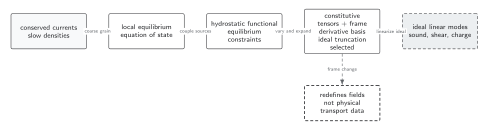
After the slow variables and equation of state are fixed, the ideal-order constitutive tensors close the linearized conservation equations. Their five normal-fluid variables yield two propagating sound modes and three zero-frequency sectors before dissipation is restored. The diagram is schematic; it does not display eigenvector multiplicities or attenuation coefficients.
In text: conservation fixes the linear matrix, thermodynamics fixes its longitudinal restoring force, and diagonalization gives the sound pair plus transverse and scalar zero modes. Frame redefinitions change the coordinates used for that matrix but not its physical pole locations through the retained order.
Thermodynamic check in variables
Section titled “Thermodynamic check in (T,μ)(T,\mu)(T,μ) variables”One can independently build the linear matrix using
When the susceptibility matrix is invertible, transforming this matrix to reproduces the same . This round trip catches held-fixed-variable errors and singular thermodynamic coordinates. Kovtun performs the corresponding neutral and charged mode analysis and relates it to retarded correlators Kovtun 2012, §§2.2–2.4, pp. 22–31, Open PDF.
The next schematic previews why ideal poles are only one diagnostic. Inspect the independent pole branch from the declared theory and compare it with the separate characteristic, transient, and asymptotic branches: a linear mode calculation supplies none of them automatically.
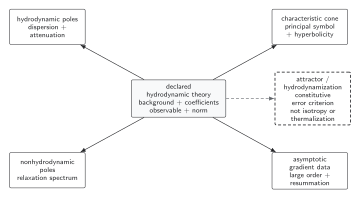
The ideal poles derived here determine the infrared mode content about one equilibrium state. Characteristics, transient relaxation scales, large-order gradient information, and attractor evidence are independent later outputs requiring a declared completion, background, observable, and norm. The diagram is a logical map rather than a temporal sequence.
In text: first determine the low- poles and eigenvectors; then, for a specified dissipative completion, analyze the principal symbol and every nonhydrodynamic branch independently. Only a nonlinear time-dependent problem can support an attractor or hydrodynamization claim, and neither claim alone implies isotropy or thermal equilibrium.
Exercise
Section titled “Exercise”At in a charge-conjugation-symmetric state, show that charge decouples from sound.
Solution
Charge conjugation makes and even in . Hence at the background when expressed in nonsingular variables, and . The sound speed reduces to
The charge equation is , independent of . It supplies the scalar zero mode, while energy and longitudinal momentum supply the two sound modes.
Common pitfalls
Section titled “Common pitfalls”Using the wrong thermodynamic derivative. At finite charge, is not generally ; the propagating constraint adds .
Interpreting a zero eigenvalue as decay. Ideal shear and composition sectors are stationary at this derivative order. Their diffusive rates require transport.
Checking only eigenvalues. Susceptibility positivity, eigenvector completeness, and the completeness of the slow-variable set are separate conditions.
Where this leads
Section titled “Where this leads”Relativistic Dissipative Hydrodynamics lifts the transverse and scalar zero modes and attenuates sound. A reproducible calculation can reconstruct the dispersion and frame checks, but numerical output does not replace a causality theorem.