

Diffusion, Conductivity, and Susceptibility
For one isolated conserved density, diffusion, conductivity, and static susceptibility obey the Einstein relation . For coupled charge and heat sectors the correct statement is matrix-valued: after the current basis, thermodynamic variables, magnetization subtraction, circuit condition, and momentum overlap have been fixed. Its diffusion eigenvalues are observable; the entries of , , and depend on the chosen density basis.
Required background. Sources, linear response, and Kubo formulae fixes complete current response. Ideal linear modes supplies the conserved-mode analysis, and relativistic dissipative hydrodynamics supplies constitutive currents. Helpful background. Contact terms, magnetization currents, and order of limits separates transport currents from equilibrium circulation.
The scalar Einstein relation
Section titled “The scalar Einstein relation”Let be a conserved density and its conjugate source. At fixed values of all other thermodynamic variables,
Using gives
For the mode is . Stability requires , which follows from and thermodynamic stability . The relation fails as written if another conserved density mixes with , if the current includes magnetization, or if an exactly conserved momentum gives a Drude contribution.
The scalar and coupled hydrodynamic derivations are treated systematically in Forster 1995, chs. 4–5 and Kovtun 2012, §§2.3–2.4, Open PDF.
Coupled densities and basis-invariant rates
Section titled “Coupled densities and basis-invariant rates”For densities, write column vectors and and define
Continuity gives
Although need not be symmetric in the ordinary Euclidean inner product, it is similar to
If is positive definite and the symmetric dissipative part of is positive semidefinite, the diffusion eigenvalues are real and nonnegative in a time-reversal-even sector. Antisymmetric Hall pieces generate nondissipative mixing and require a separate analysis. Under an invertible change of density basis, transforms by similarity, so its eigenvalues are invariant even though its entries change.
For two densities the rates are
The associated eigenvectors identify which linear combinations actually diffuse. Applying separately to diagonal entries discards precisely this mixing.
Thermoelectric response and circuit conditions
Section titled “Thermoelectric response and circuit conditions”For electric and heat currents, one convenient convention is
is the thermal conductivity at zero electric field. In an open circuit, instead, and the measured thermal conductivity is the Schur complement
At zero magnetic field and with the appropriate time-reversal parities, Onsager reciprocity gives . In a magnetic field the relation reverses the field. Each matrix must be built from transport currents after magnetization subtraction Cooper, Halperin, and Ruzin 1997, §§II–IV.
For a relativistic fluid with one charge, in the laboratory frame. Susceptibilities must state whether , , pressure, or another set is held fixed. Changing that thermodynamic basis changes matrix entries but not correctly computed mode poles.
Momentum overlap and incoherent transport
Section titled “Momentum overlap and incoherent transport”In a translation-invariant state at nonzero density, the electric current overlaps momentum. A constant electric field then accelerates the fluid, giving an exact Drude delta function rather than a finite ordinary dc conductivity. Weak translation breaking produces a narrow momentum-relaxation peak; taking the breaking strength to zero before or after gives different answers.
One can instead form a current orthogonal to momentum. In a relativistic one-charge fluid, a convenient unnormalized choice is
Because and , . Its regular conductivity can remain finite even when the electric conductivity contains a delta function. The normalization of is conventional, but physical response constructed from it is frame invariant Davison, Goutéraux, and Hartnoll 2015, §§2–3, Open PDF.
The transport-extraction covariance reference records the density basis, circuit condition, magnetization subtraction, Drude treatment, covariance, and mode-resolution window.
Checks and limitations
Section titled “Checks and limitations”Check the static susceptibility against a thermodynamic Hessian, the pole residues against Ward identities, and the inferred against direct small- mode fits. Positive diagonal conductivities do not alone guarantee that a nonsymmetric coupled matrix has physically acceptable modes; use the entropy-production quadratic form and the susceptibility metric.
Hydrodynamics licenses the small- poles, not an arbitrary extrapolation to microscopic momenta. Coulomb forces can convert charge diffusion into a plasmon or screened relaxation mode. Dynamical electromagnetism, superfluid order, anomalies, and additional nearly conserved variables require the enlarged slow sector developed elsewhere in this volume.
The final box below deliberately says “coefficient or combination.” Inspect that wording for coupled diffusion: the identifiable object can be a basis-invariant eigenvalue of or an open-circuit Schur complement, not a raw conductivity entry.
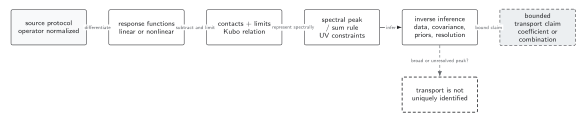
Diffusion follows from a matched conductivity matrix and susceptibility matrix after exact momentum overlap and the measurement’s circuit condition are handled. The data may constrain diffusion eigenvalues or a projected conductivity combination rather than individual matrix elements. The diagram is schematic and does not display basis changes, thermoelectric blocks, or hydrodynamic residues.
In text: normalize all density sources, measure and the dissipative matrix in the same basis, project conserved ballistic overlap, impose open- or closed-circuit conditions, and diagonalize . Propagate their joint covariance to the reported invariant combination.
Exercise: basis independence
Section titled “Exercise: basis independence”Let for an invertible constant matrix . Show that the diffusion eigenvalues are unchanged.
Solution
The diffusion equation transforms as
Thus . Similar matrices have the same characteristic polynomial and hence the same eigenvalues. Their components and eigenvectors do change, which is why componentwise scalar Einstein relations are not basis invariant.
References
Section titled “References”- Cooper, Nigel R., Bertrand I. Halperin, and I. M. Ruzin. 1997. “Thermoelectric Response of an Interacting Two-Dimensional Electron Gas in a Quantizing Magnetic Field.” Physical Review B 55 (4): 2344–2359. DOI. Open PDF.
- Davison, Richard A., Blaise Goutéraux, and Sean A. Hartnoll. 2015. “Incoherent Transport in Clean Quantum Critical Metals.” Journal of High Energy Physics 2015 (10): 112. DOI. Open PDF.
- Forster, Dieter. 1995. Hydrodynamic Fluctuations, Broken Symmetry, and Correlation Functions. Advanced Book Classics. Boca Raton, FL: CRC Press. DOI.
- Kovtun, Pavel. 2012. “Lectures on Hydrodynamic Fluctuations in Relativistic Theories.” Journal of Physics A: Mathematical and Theoretical 45 (47): 473001. DOI. Open PDF.
Shear and Bulk Viscosity applies the same response discipline to stress channels. Memory Functions and Slow-Mode Projection computes the narrow momentum-relaxation contribution from a selected slow basis.