

Basis Construction, Symmetry Sectors, and Matrix Elements
A trustworthy truncated matrix is built by enumerating each normalized state once, resolving exact symmetry sectors before diagonalization, removing null directions in the correct inner product, and verifying interaction and observable matrix elements against analytic small-sector cases. Sparse storage and a converged eigensolver come only after these algebraic checks; neither can detect a duplicated bosonic state, a missing combinatorial factor, or a broken constraint.
Required background. Hilbert-Space Truncation as a Regulator supplies and the omitted subspace. Representations, Intertwiners, Invariants, and Tensor Decomposition supplies irreducible sectors, invariant tensors, and multiplicities.
Helpful background. Multiplets, Invariants, and Selection Rules supplies the group-theoretic rules used to predict zero blocks.
Normalized basis states precede matrix assembly
Section titled “Normalized basis states precede matrix assembly”Basis construction contract. Fix the one-particle modes and their inner product; a canonical representative for every many-particle state; exact momentum, charge, parity, and irrep labels; the cutoff rule; null-state and constraint removal; operator ordering; and the Gram matrix. Record expected block dimensions independently of the Hamiltonian builder.
For a real scalar of mass on a circle of length ,
with . A normalized occupation basis is
The free-energy, momentum, and field-parity labels are
Thus a zero-momentum even-sector basis at cutoff consists of every integer tuple satisfying , , and even. An occupation tuple is already an unordered bosonic state. Generating ordered particle lists and retaining every permutation would duplicate it. This finite-volume scalar basis and its energy-cutoff organization are given explicitly in Rychkov and Vitale 2015, § 2.
When states are not orthonormal—common for composite-operator or conformal bases—the Gram matrix is part of the problem. Physical coefficients satisfy
Null directions of must be removed or quotiented before solving. Replacing this by an ordinary eigenproblem changes both energies and normalization. A unitary target requires to be positive definite after the null quotient. A deliberately nonunitary benchmark must instead state the signature of its bilinear form and cannot inherit positivity-based variational bounds. A conformal-truncation treatment of Gram matrices, null-state removal, and the resulting generalized eigenproblem appears in Hogervorst, Rychkov, and van Rees 2015, §§ 3–4.
Exact symmetries determine blocks and zeros
Section titled “Exact symmetries determine blocks and zeros”If is an exact symmetry and both and commute with it, the retained space decomposes as
where is an irrep and its multiplicity. Schur’s lemma then fixes the representation-space structure of an invariant Hamiltonian; only multiplicity spaces require nontrivial diagonalization. For an operator transforming in representation , a matrix element vanishes unless occurs in .
This is both a reduction and an exact test. A forbidden nonzero element signals an indexing, phase, tensor, or truncation error. A missing allowed element is not automatically an error, but it deserves an independent calculation.
Gauge theory requires a stronger choice. One may construct only gauge-singlet states, or keep a larger space with Gauss-law projectors and constraints. The method and residual constraint norm must be stated. The link and electric-flux bases are developed in Hamiltonian Lattice Field Theory; light-front momentum partitions and constrained fields are developed in DLCQ and Basis Light-Front Quantization. Neither should be silently replaced by an unconstrained Fock basis.
A scalar φ⁴ matrix has exact selection rules
Section titled “A scalar φ⁴ matrix has exact selection rules”Consider
Expanding the four fields produces monomials with zero through four creation operators. The spatial integral enforces exact integer momentum conservation. Normal ordering with respect to the declared fixes which contractions have already been absorbed into the mass and vacuum energy. The matrix element can change particle number by and preserves parity.
For each operator string, compute a canonical final occupation tuple and its ladder factor. For example,
for . Repeated mode labels require the corresponding falling and rising factorials; treating four labels as distinct is a common source of factor errors.
Exactly checkable one-mode matrix
Section titled “Exactly checkable one-mode matrix”Restrict temporarily to the zero mode and define . In the ordered even basis ,
has the exact matrix
For the zero-mode contribution of the circle normalization above,
This matrix checks normalization, Hermiticity, normal ordering, parity, and repeated-mode combinatorics. It is a construction benchmark, not an approximation to the full interacting field theory unless all nonzero modes are deliberately removed from the target model.
Assembling sparse matrices in seven steps
Section titled “Assembling sparse matrices in seven steps”- Enumerate independently. Generate canonical basis keys and verify small-cutoff counts with a second implementation or a generating function.
- Attach exact labels. Momentum, charge, parity, irrep, and constraint labels must be computable from the key without applying .
- Construct the metric. Confirm for normalized Fock states or find and remove null directions when .
- Apply operator monomials. Act on a source state, compute the exact ladder and group-theory factor, canonicalize the target, and look it up once.
- Assemble each contribution separately. Keep , each interaction, each counterterm, and every observable as independently testable matrices.
- Test identities. For covariant matrices , check ; equivalently, the one-index-raised operator must obey . Then test exact commutators, forbidden blocks, analytic entries, finite traces or sum rules, and parameter derivatives such as .
- Only then solve. Report eigenpair residuals in the inner product and retain enough eigenvectors for the intended observables.
A sparse matrix can have no stored forbidden entries and still be incomplete. For small cutoffs, also construct a dense reference matrix by a different route and compare every entry.
The convergence map locates basis errors
Section titled “The convergence map locates basis errors”In the shared map, basis construction controls the symmetry-complete retained branch. It does not eliminate the omitted branch; increasing a correct basis still changes induced interactions and effective observables.
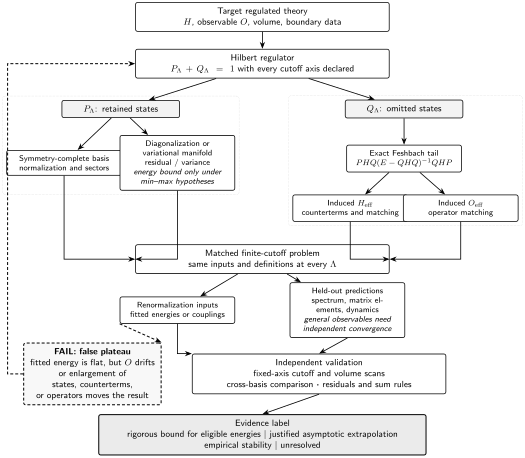
The symmetry-complete basis is one necessary branch of a controlled truncation. Exact block structure and matrix checks must join omitted-state corrections, effective observables, and cross-basis tests; monotone energy convergence alone does not certify a matrix element. The false-plateau branch is schematic and not to scale.
Reporting truncation errors and convergence
Section titled “Reporting truncation errors and convergence”| Field | Required declaration | Independent test | Failure signal |
|---|---|---|---|
| Target | Hamiltonian, prior regulator, volume, boundary data, observable | Units and free or exact limit | Changing target across cutoff points |
| Projectors | PΛ, QΛ, all cutoff axes, limit order | State counts and nestedness | Unidentified omitted states |
| Basis and sectors | Normalization, Gram matrix, null removal, exact charges | Hermiticity and selection rules | Duplicates or broken constraints |
| Induced Hamiltonian | Derived operator basis and approximation order | Omitted-state toy model or perturbative coefficient | Drift incompatible with the declared tail |
| Counterterms | Inputs, running coefficients, and no-double-counting rule | Refit protocol at every cutoff | A fitted datum presented as a prediction |
| Variational status | Manifold, optimizer, symmetry, bound hypotheses | Residual, variance, and ansatz enlargement | Energy plateau with a large residual |
| Effective observables | Projected and induced operator terms | Sum rule or matched matrix element | Spectrum stable while the observable drifts |
| Cutoff sequence | Independent basis, volume, counterterm, time, and state scans | Fixed-axis and cross-term fits | Only one diagonal sequence |
| Extrapolation | Asymptotic form, fit window, covariance, alternatives | Window and model stability | Exponent chosen from the desired answer |
| Held-out tests | Unused spectrum, matrix element, dynamics, and second basis | Blind comparison after choices freeze | All tests participated in tuning |
| Adversarial enlargement | Larger state and operator bases | Repeat the full match and prediction | Former plateau moves beyond its error |
| Claim | Bound, asymptotic evidence, empirical stability, or unresolved | Error and cost reproduced independently | Precision exceeds the weakest test |
Adversarial failure: Hermitian but duplicated
Section titled “Adversarial failure: Hermitian but duplicated”Suppose a two-boson zero-momentum generator stores both ordered lists and for as independent states, then fills matrix elements symmetrically. The resulting matrix is Hermitian and its eigensolver residuals can be tiny. Nevertheless, the Hilbert space contains two copies of one physical occupation state, producing spurious degeneracies and incorrect transition strengths.
An independent occupation-tuple count exposes the duplication. Alternatively, construct symmetric normalized states explicitly and compare the small-sector matrix entry by entry. Hermiticity is necessary but cannot establish basis uniqueness.
Observable-level validation checklist
Section titled “Observable-level validation checklist”- Compare basis dimensions in every exact sector against an independent enumerator at several small cutoffs.
- Verify that has the signature required by the declared theory after null removal—positive definite for a unitary Hilbert space. Test and for covariant matrix elements; for , test instead.
- Check exact charge and momentum commutators and every group-theoretically forbidden block.
- Reproduce the one-mode matrix, then test nonzero-momentum entries with repeated and distinct labels.
- Confirm the free spectrum and degeneracies before switching on interactions.
- Reserve at least one operator insertion that uses different selection rules from ; a Hamiltonian-only check cannot validate it.
- Repeat a final prediction in a second complete basis or truncation rule after matching the same physical inputs.
You should now be able to (1) enumerate a normalized symmetry-resolved scalar Fock basis without duplicates or null directions and (2) assemble and verify a sparse interaction or operator matrix using analytic selection rules and small matrices. Conformal and Hamiltonian Truncation applies these steps to UV operator states; Renormalizing a Truncated Hamiltonian supplies the induced matrix terms. Gauge-invariant bases return to Hamiltonian Lattice Field Theory.
Exercises
Section titled “Exercises”Enumerate a small scalar sector
Section titled “Enumerate a small scalar sector”Let , , and . List the zero-momentum even states made only from modes whose free energy does not exceed the cutoff. The vacuum energy is set to zero.
Solution
The mode energies are and . Even particle number and energy at most allow the vacuum and two zero-mode quanta: and . The pair has energy and is excluded. One-particle states are odd under , and mixed zero/nonzero states fail momentum or parity. Thus the sector dimension is exactly two.
Derive the off-diagonal one-mode entry
Section titled “Derive the off-diagonal one-mode entry”Show that .
Solution
Only the term lowers particle number by two. Acting on gives
All other normally ordered monomials change particle number by , or , so they do not contribute to this entry.
References
Section titled “References”- Hogervorst, Matthijs, Slava Rychkov, and Balt C. van Rees. “Truncated Conformal Space Approach in Dimensions: A Cheap Alternative to Lattice Field Theory?” Physical Review D 91, 025005 (2015). DOI.
- Rychkov, Slava, and Lorenzo G. Vitale. “Hamiltonian Truncation Study of the Theory in Two Dimensions.” Physical Review D 91, 085011 (2015). DOI.