

Matrix Product States, Finite Entanglement, and Continuum Limits
An MPS recovers one-dimensional QFT information by turning the many-body state into finite-dimensional transfer and tangent-space problems, then removing finite-entanglement, finite-volume, local-Hilbert, lattice-spacing, and optimization controls separately. The MPS correlation length is an infrared scale induced by finite bond dimension; it is not itself the continuum limit.
Required background. Entanglement structure and tensor-network ansätze supplies physical and virtual indices, Schmidt truncation, and tensor gauge. Variational principles and field-theory ansätze supplies energy stationarity and residual tests.
Helpful background. Lines of constant physics and continuum extrapolation supplies the tuning and spacing-limit contract.
MPS transfer channels and physical length scales
Section titled “MPS transfer channels and physical length scales”For a translation-invariant infinite MPS with tensor , define
Choose a canonical normalization so the spectral radius is and the corresponding left and right fixed points normalize expectation values. If the channel is injective, is nondegenerate and connected correlators have the spectral expansion
A negative or complex adds oscillation but does not change the decay length obtained from its modulus. A degenerate unit-modulus eigenvalue instead signals non-injectivity, symmetry breaking, or a cat-state structure; applying the injective formula without resolving sectors is a diagnostic failure. Transfer-channel methods and canonical gauges are developed in Schollwöck 2011, §§ 4–5, and the broader transfer-operator and injectivity structure is reviewed by Cirac et al. 2021.
Regulator and convention box. Record whether the MPS is open, periodic, or uniform; the unit cell; canonical gauge; bond dimension ; local dimension ; lattice spacing ; physical size ; symmetry sector; optimizer residual; and which transfer eigenvalue couples to each operator. Quote before scale setting. Do not combine a scan with changes in or bare couplings unless the joint path is explicitly modeled.
Exactly checkable transfer channel
Section titled “Exactly checkable transfer channel”Take a physical dimension four and bond dimension two with
Because , the channel is unital. Using gives
Thus the transfer spectrum is and
This fixture checks channel construction, normalization, degeneracy, and the absolute value in . It does not identify a Hamiltonian mass gap without showing that an operator couples to the mode and controlling the Euclidean-time or tangent-space relation.
Finite entanglement at a critical point
Section titled “Finite entanglement at a critical point”An exact critical ground state has divergent correlation length and logarithmic interval entropy. A finite- MPS instead produces a finite . In the asymptotic finite-entanglement regime,
and often . The exponent and correction terms require the critical universality class and an appropriate scaling window; a log–log straight line over three small bond dimensions is not sufficient. The original finite-entanglement analyses and the separation from finite-size scaling are given by Tagliacozzo et al. 2008, §§ II–IV, Pollmann et al. 2009, and Pirvu et al. 2012, §§ II–III.
For a finite ring, two infrared scales compete:
Finite-entanglement scaling requires large enough that the bond cutoff sets the infrared scale. Conventional finite-size scaling requires large enough that the MPS resolves the finite ring. Data straddling the crossover should be fit with a two-variable scaling form, not silently pooled.
The geometry map locates MPS on the Hamiltonian-state branch and shows why its transfer spectrum still precedes, rather than replaces, the physical regulator limits.
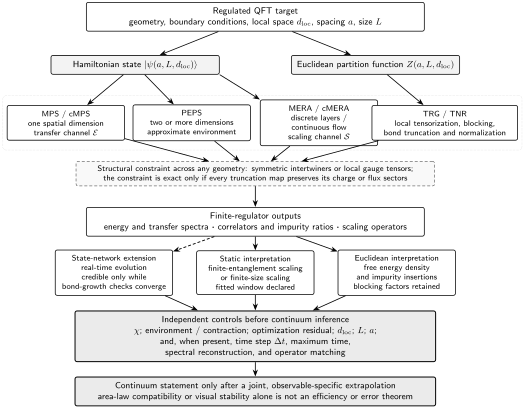
For MPS, controls the variational representation and is read from the transfer channel. The schematic map emphasizes that neither quantity removes , , , optimizer, operator-matching, or real-time controls.
Spectra and excitations
Section titled “Spectra and excitations”Ground-state transfer eigenvalues determine spatial decay scales. Energies require the Hamiltonian. A uniform-MPS tangent excitation with momentum has the form
After removing tangent gauge null directions, stationarity gives a generalized eigenproblem
The resulting is variational within the chosen tangent space, not an exact spectrum. Check momentum conventions, norm conditioning, multi-particle thresholds, and dependence. A relativistic continuum claim additionally tests
with the emergent velocity determined rather than assumed.
Joint continuum protocol
Section titled “Joint continuum protocol”The safe sequence is observable dependent, but a useful default is:
- At fixed bare lattice parameters, converge the optimizer and for several .
- Resolve finite- versus finite- scaling with both and checks where feasible.
- Tune a line of constant physics using dimensionless inputs that are not reused as held-out validation.
- Match or renormalize the operator at each .
- Extrapolate in with correlated uncertainties and at least one justified correction model.
- Repeat a selected point with an alternative unit cell, initialization, or algorithm.
The joint control structure is shown below. Inspect the dashed failure path: apparent convergence in is rejected when any environment, local-space, volume, spacing, or optimization scan moves the observable.
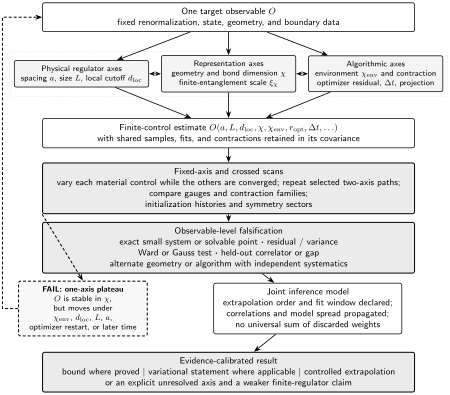
An MPS error statement is joint and observable specific. The schematic diagram does not prescribe additive errors: it requires fixed-axis and crossed scans, covariance-aware extrapolation, and an explicit weaker claim whenever one control remains open.
The declarations needed for this program are collected in the chapter’s tensor-network regulator and error record.
A reproducible critical-Ising MPS and Euclidean comparison must control size, bond dimension, contraction, and optimization jointly; its data do not substitute for the spacing extrapolation.
Adversarial failure: a false critical exponent
Section titled “Adversarial failure: a false critical exponent”Suppose grows smoothly for , and a power-law fit returns a stable . If is too small, the local cutoff can move the critical bare coupling while leaving each fixed- fit visually excellent. Retuning at may change both and the inferred central charge. The repair is a crossed scan and a held-out observable such as an excitation ratio or scaling dimension.
Observable-level validation checklist
Section titled “Observable-level validation checklist”- Confirm canonical normalization and left/right transfer fixed points.
- Identify the transfer eigenmode coupled to the stated operator.
- Test both finite-size and finite-entanglement regimes rather than mixing them.
- Report energy variance or projected residual and initialization dependence.
- Vary independently for bosonic or gauge-link local spaces.
- Check dispersion and at least one held-out ratio against exact diagonalization or another method.
- Renormalize the observable and state the order of , , , and limits.
What you should be able to do
Section titled “What you should be able to do”After this page, you should be able to:
- construct an MPS transfer channel, normalize it, and extract the operator-relevant correlation length or a tangent-space excitation scale; and
- design a continuum analysis that distinguishes finite entanglement from finite size, local Hilbert truncation, lattice spacing, and optimization error.
Exercises
Section titled “Exercises”1. Transfer correlation length. For the Pauli-channel fixture with , compute .
Solution
Here , so .
2. Scaling regime. Two calculations have and . Which is suited to finite-entanglement scaling and which to finite-size scaling?
Solution
The first has , so the bond-induced correlation length is the smaller infrared scale and finite-entanglement scaling is plausible. The second has , so the finite ring is the smaller infrared scale and finite-size scaling is plausible. Neither ratio alone proves asymptotia; nearby sizes and bond dimensions must confirm stability.
References
Section titled “References”- Cirac, J. Ignacio, David Pérez-García, Norbert Schuch, and Frank Verstraete. “Matrix Product States and Projected Entangled Pair States: Concepts, Symmetries, Theorems.” Reviews of Modern Physics 93 (2021): 045003. DOI.
- Pirvu, Bogdan, Guifré Vidal, Frank Verstraete, and Luca Tagliacozzo. “Matrix Product States for Critical Spin Chains: Finite-Size Scaling versus Finite-Entanglement Scaling.” Physical Review B 86 (2012): 075117. DOI.
- Pollmann, Frank, Subroto Mukerjee, Ari M. Turner, and Joel E. Moore. “Theory of Finite-Entanglement Scaling at One-Dimensional Quantum Critical Points.” Physical Review Letters 102 (2009): 255701. DOI.
- Schollwöck, Ulrich. “The Density-Matrix Renormalization Group in the Age of Matrix Product States.” Annals of Physics 326 (2011): 96–192. DOI.
- Tagliacozzo, Luca, Thiago R. de Oliveira, Salvatore Iblisdir, and José I. Latorre. “Scaling of Entanglement Support for Matrix Product States.” Physical Review B 78 (2008): 024410. DOI.