

Staggered Fermions and Taste
Staggered fermions spin-diagonalize the naive action and keep one Grassmann component per lattice site, but they do not produce one four-dimensional Dirac fermion: reconstruction on -site blocks yields continuum tastes in even dimension. A remnant axial symmetry is exact at zero mass. Gauge interactions break the larger taste symmetry at finite spacing, so taste splittings must vanish in a controlled continuum sequence. Taking a fractional determinant power is a separate sea-fermion operation whose validity requires locality and taste restoration in the continuum limit; it is not justified by the component reduction alone.
Required background. Naive Fermions and Species Doubling supplies the corner species that spin diagonalization reorganizes.
Helpful background. Representations, Intertwiners, Invariants, and Tensor Decomposition supplies the basis-change language used in spin–taste reconstruction. Lattice Perturbation Theory, Symanzik Analysis, and Improvement supplies the scaling logic for taste-breaking operators.
Spin diagonalization and the one-component action
Section titled “Spin diagonalization and the one-component action”Local regulator and convention card. Let on an even-dimensional Euclidean hypercubic lattice. Gamma matrices are Hermitian. We order and define and . Gauge links point from to . The free benchmark uses periodic even extents; the interacting discussion is four-dimensional unless stated otherwise. These are local additions to the global conventions.
Start from the naive field and make the site-dependent unitary change of basis used in the spin-diagonal construction Kawamoto and Smit 1981, pp. 100–124:
The identity
diagonalizes the explicit spin index. Each spin component obeys the same one-component action, so one may retain a single copy:
This reduction divides the naive multiplicity by the spinor dimension . The remaining continuum multiplicity is therefore
It gives two tastes in and four tastes in . Calling the one-component lattice variable “one flavor” would erase this reconstruction step.
Reconstructing spin and taste on blocked cells
Section titled “Reconstructing spin and taste on blocked cells”Write each site as , where the hypercube offset has . On the coarse lattice of spacing , define matrices
and reconstruct a spin–taste field schematically by
The index is continuum spin and is taste. In the free theory the blocked operator has the long-wavelength form
with taste-breaking terms that vanish as the cutoff is removed. Gauge-covariant reconstruction requires parallel transport within the hypercube; different path averages differ by finite-spacing operators, not by the continuum taste count.
Exact free benchmark
Section titled “Exact free benchmark”On a two-dimensional block, the four offsets provide four one-component variables. Reorganization into a two-component Dirac spinor leaves a two-dimensional taste index: exactly two tastes. For every periodic free lattice, the reconstructed squared eigenvalues are
with the two tastes exactly degenerate. This tests reconstruction and dispersion at fixed ; it says nothing about interacting taste breaking or determinant rooting.
Exact remnant symmetry and finite-spacing taste breaking
Section titled “Exact remnant symmetry and finite-spacing taste breaking”At , nearest neighbors have opposite , so the action is invariant under
This symmetry forbids an additive mass renormalization and protects one pseudoscalar channel. It is not the full continuum taste–chiral symmetry of four massless tastes.
Gauge interactions transfer momenta by amounts near and mix the corner sectors. In the Symanzik description, taste-breaking operators first contribute to pseudoscalar masses in the schematic form
where labels the taste matrix and for the Goldstone taste in the idealized symmetry classification. Improvement changes the coefficients and higher-order structure; it does not permit the splittings to be omitted. The directly discriminating observable is a set of matched splittings
measured at several spacings and extrapolated at fixed renormalized masses and volume.
Rooting is a separate continuum claim
Section titled “Rooting is a separate continuum claim”In four dimensions one unrooted staggered field describes four continuum tastes. Simulations targeting sea flavors often use
At nonzero with broken taste symmetry, this fractional power is not the determinant of an exactly local, taste-decoupled one-flavor Dirac operator. Renormalization-group arguments instead seek a blocked representation in which a local taste-singlet operator is approached and taste-violating terms vanish. Shamir’s analysis makes the conclusion conditional on testable scaling and locality assumptions Shamir 2007, §§2–4; the corresponding rooted effective theory likewise states its partially quenched and Symanzik assumptions explicitly Bernard, Golterman, and Shamir 2008, §§II–IV.
The correct scientific statement is therefore conditional: rooting can support a target continuum flavor count only if taste symmetry is restored, the blocked long-distance theory becomes local in the continuum limit, the mass and continuum limits are taken in a controlled order, and rooted observables agree with an independent formulation. Neither a good fit at one spacing nor the exact symmetry proves those conditions.
The shared formulation map shows why taste counting, remnant symmetry, and the rooted continuum claim must remain distinct. Inspect the staggered branch and then compare its tests with the locality, residual-mass, or measure tests on the neighboring branches.
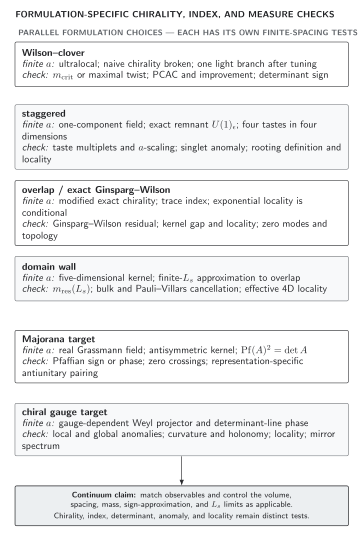
Lattice-fermion formulations trade different finite-regulator structures. Wilson methods require tuning and improvement; staggered methods require taste restoration and a separately qualified rooting step; exact Ginsparg–Wilson and overlap methods require locality and index checks; finite- domain-wall methods add a residual-mass test; Majorana and chiral-gauge targets add Pfaffian or Weyl-measure phases. The map is schematic, not to scale, and does not rank cost or accuracy.
Validation and stopping rules
Section titled “Validation and stopping rules”The staggered row of the fermion-formulation comparison table keeps remnant chiral symmetry, taste restoration, and the separate rooting claim attached to their respective checks.
A staggered calculation should expose these observable-level checks:
Observable-level validation checklist.
- reconstruct free tastes on blocked cells and reproduce their exact degeneracy and dispersion;
- verify the Ward identity at and identify which current and taste channel it constrains;
- measure a complete enough pseudoscalar taste multiplet to detect non-Goldstone splittings;
- vary at matched physical parameters and test the predicted disappearance of every reported ;
- if a fractional determinant power is used, state the exponent, sea-flavor target, mass range, locality assumption, and order of chiral and continuum limits;
- compare at least one renormalized observable with a formulation that does not use the same rooting assumption; and
- separate algorithmic cost from the physical tests.
Adversarial failure. Suppose the Goldstone-taste pion follows a smooth fit while a non-Goldstone taste was never measured. Exact can protect that one channel even when other tastes remain substantially split. The calculation cannot claim taste restoration until the multiplet, not only its protected member, shows the required convergence.
You should now be able to (1) derive the one-component action and reconstruct the taste multiplicity and (2) state a rooting claim with its finite-spacing nonlocality, taste-restoration, locality, limit-order, and cross-formulation tests explicit.
Exercises
Section titled “Exercises”Derive the staggered sign
Section titled “Derive the staggered sign”Using , show that .
Solution
Since differs from by one additional inserted in the ordered product, move that matrix past the factors with . Each anticommutation contributes . The remaining equal gamma matrices square to one, leaving exactly times the identity.
Test the remnant axial symmetry
Section titled “Test the remnant axial symmetry”Show that the massless hopping term is invariant under the transformation, but the mass term is not.
Solution
Nearest neighbors satisfy . The phase on is therefore , and similarly for the backward hop. The mass bilinear acquires , so a nonzero breaks the symmetry.
Precise continuations
Section titled “Precise continuations”Fermion Determinants, Pfaffians, and Measure Positivity separates fractional flavor powers from positivity. Anomalies, Ward Identities, and Chiral Diagnostics specifies the taste-resolved Ward and continuum tests. Wilson and Clover Fermions and Overlap and Domain-Wall Fermions provide independent discretizations for matched-observable comparisons. Mutable assessments of rooting evidence belong to the Lattice and Hamiltonian Field Theory Research guide.
References
Section titled “References”- Bernard, Claude, Maarten Golterman, and Yigal Shamir. “Effective Field Theories for QCD with Rooted Staggered Fermions.” Physical Review D 77 (2008): 074505. DOI. Open PDF.
- Kawamoto, Noboru, and Jan Smit. “Effective Lagrangian and Dynamical Symmetry Breaking in Strongly Coupled Lattice QCD.” Nuclear Physics B 192 (1981): 100–124. DOI.
- Shamir, Yigal. “Renormalization-Group Analysis of the Validity of Staggered-Fermion QCD with the Fourth-Root Recipe.” Physical Review D 75 (2007): 054503. DOI. Open PDF.