

Moving Frames, Cubic Irreducible Representations, and Partial-Wave Mixing
Finite volume preserves only the little group of the total lattice momentum, so a level carries a lattice irreducible representation rather than a unique continuum angular momentum. At rest, several continuum partial waves subduce into the same cubic irrep; in a moving frame the little group is smaller and opposite parities can mix when no additional symmetry forbids it. A valid quantization analysis therefore declares , the momentum star, irrep and row, spin or helicity basis, multiplicities, and partial-wave cutoff, then tests every allowed mixing rather than assigning one label to a level.
Required background. Elastic Two-Body Quantization Conditions supplies the determinant and its elastic hypotheses. Representations, Intertwiners, Invariants, and Tensor Decomposition supplies projection operators and subduction.
Helpful background. Lorentz Field Representations and Poincaré Particle Representations distinguishes continuum spin and helicity from lattice labels.
Momentum stars and little groups
Section titled “Momentum stars and little groups”Periodic boundaries quantize the total momentum as
The cubic rotation group maps through its star. At fixed , the little group contains the rotations that leave that momentum invariant, with the appropriate double cover for half-integer spin.
Moving-frame convention and truncation. Total momentum, momentum star, little-group irrep and row, spin basis, parity treatment, dispersion relation, and every retained partial wave are fixed before interpreting a level.
The detailed choices are:
| Field | Choice used on this page |
|---|---|
| Geometry | Periodic cubic spatial volume; momentum class is displayed in integer units |
| Frame | uses the continuum dispersion; a lattice dispersion alternative must be stated and tested |
| Symmetry label | denote a little-group irrep and row; an occurrence index distinguishes repeated subductions |
| Angular basis | Two-body states are labeled by channel, total spin , orbital momentum , total intrinsic spin , helicities when used, and multiplicity |
| Parity | At , parity labels irreps. At fixed nonzero , inversion maps and is not generally an internal symmetry of one momentum sector |
| Truncation | Every determinant lists included partial waves and repeats the fit after adding the lowest omitted wave allowed by |
For common momentum directions the single-cover little groups are
| Representative | Little group | Consequence |
|---|---|---|
| Parity is good; continuum splits among cubic irreps | ||
| Rotations about the momentum axis and reflections remain | ||
| Fewer rows distinguish angular structure; more waves may share an irrep | ||
| Threefold axial symmetry remains |
The labels depend on whether reflections, inversion, identical-particle exchange, and the momentum star are incorporated. Tables from another paper cannot be imported until these choices are translated.
Subduction is a projection, not a spin measurement
Section titled “Subduction is a projection, not a spin measurement”For a finite group and irrep , an operator can be projected by
with a fuller row–column projector used to build an orthonormal basis. Character orthogonality gives
which is an exact implementation check. At rest, the first few integer-spin subductions are
| Continuum orbital wave | content |
|---|---|
Thus an spectrum is not a pure S-wave spectrum: it contains . In a moving frame, a irrep such as can receive both S- and P-wave contributions for nonidentical particles because parity no longer separates them. Equal masses and exchange symmetry may remove some mixings, but that is an additional hypothesis, not a property of the irrep name alone. The systematic moving-frame construction originates with Rummukainen and Gottlieb 1995, §§ 2–3, pp. 401–421, and the little-group classification for arbitrary momentum is developed by Moore and Fleming 2006, §§ II–IV.
Quantization in an irrep block
Section titled “Quantization in an irrep block”For channel with masses , the center-of-momentum magnitude is
After subduction, the structural condition is
The geometry matrix is generally nondiagonal in partial waves and repeated occurrences that subduce into the same . The infinite-volume matrix is diagonal in and parity when the dynamics has those symmetries, but the finite-volume determinant couples its entries through . “The interaction is P-wave dominated” does not set every allowed S- or D-wave entry to zero; it proposes a truncation that must be challenged.
A practical operator basis follows the same symmetry reduction:
The coefficients must transform as the same irrep used in . Operator overlaps can then falsify a proposed assignment: a level that couples only to constructions absent from the purported irrep content signals a projection, tracking, or basis problem.
Noninteracting and truncation benchmarks
Section titled “Noninteracting and truncation benchmarks”Before fitting an interaction, reproduce the noninteracting spectrum
Project every momentum orbit into and verify its irrep multiplicity. This checks the momentum star, dispersion, projector, and free poles of independently of an amplitude fit.
Next perform nested partial-wave fits. If is the baseline, add the lowest allowed omitted wave with a bounded low-energy parametrization. The observable is stable only if the new coefficient is constrained by data or its allowed variation is included in the uncertainty. Setting it to zero and finding a good is not a truncation test.
Adversarial failure. A moving-frame level for two unequal scalars is fit with a pure P-wave resonance because its energy lies near a P-wave avoided crossing. But also admits an S wave, and a modest S-wave scattering length can move the same level. If operator overlaps or other irreps do not constrain that S wave, the resonance parameters are not identified. The fit must include it or report the degeneracy.
The spectrum-to-amplitude map below compresses the bookkeeping that the moving frame makes explicit. Before following the quantization branch, attach the total-momentum star, little-group irrep, subduced partial waves, channel normalization, and covariance to every level.
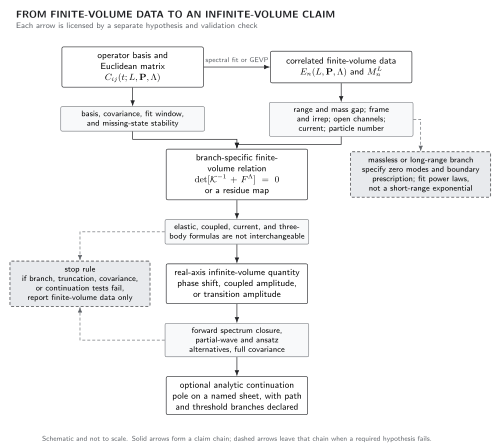
Finite-volume information reaches an infinite-volume claim only through a branch-specific map. Solid arrows show the controlled chain; dashed arrows show the long-range alternative and the stop rule. The image is schematic, not to scale, and the displayed determinant is structural: its channel, irrep, partial-wave, normalization, and sign conventions must be fixed locally.
Observable-level validation
Section titled “Observable-level validation”The moving-frame row of the finite-volume hypothesis and uncertainty table ties the little group, spin basis, multiplicities, and partial-wave cutoff to their spectrum and overlap checks.
Before accepting a moving-frame amplitude, verify that:
- the momentum class, star convention, little or double group, irrep row, and multiplicities are identical in operators and the geometry matrix;
- the chosen dispersion reproduces stable one-particle energies in every momentum used;
- free two-particle levels and their irrep multiplicities are reproduced;
- every partial wave allowed through the tested cutoff is listed, including opposite parity where the sector permits it;
- eigenvector overlaps and partner irreps support the level tracking; and
- adding the lowest omitted wave, removing ambiguous levels, and changing frames leaves the quoted amplitude within its uncertainty.
What you can now do
Section titled “What you can now do”You can now (1) project a continuum orbital or spin basis into a declared rest- or moving-frame lattice irrep and list every allowed mixing, and (2) test a level assignment by noninteracting multiplicities, operator overlaps, and a nested partial-wave truncation.
Scattering Amplitudes and Resonance Poles from Finite-Volume Spectra uses these blocks in correlated fits. Coupled-Channel Quantization and Inference adds channel indices. General representation theory remains with Mathematical Methods.
Exercises
Section titled “Exercises”1. Rest-frame contamination. Which is the lowest omitted orbital wave in an S-wave analysis at rest?
Solution
, because do not contain while does. Its threshold suppression may be strong, but symmetry does not set it to zero.
2. Projector check. Explain why on a momentum orbit gives the number of copies of times .
Solution
The orbit representation decomposes as . The projector is the identity on each of the copies of the -dimensional irrep and zero on all others, so its trace is . A noninteger result exposes a broken group action or numerical projector.
References
Section titled “References”- Moore, David C., and George T. Fleming. “Angular Momentum on the Lattice: The Case of Nonzero Linear Momentum.” Physical Review D 73 (2006): 014504; Erratum 74 (2006): 079905. DOI.
- Rummukainen, Kari, and Steven Gottlieb. “Resonance Scattering Phase Shifts on a Nonrest Frame Lattice.” Nuclear Physics B 450 (1995): 397–436. DOI.