

Local Hilbert-Space Regulators, Quantum Links, and Finite Gauge Groups
Continuous fields and compact Lie-group links usually have infinite-dimensional local Hilbert spaces. Finite calculations replace them by field-amplitude grids, occupation cutoffs, representation truncations, quantum-link algebras, or finite gauge groups. These choices are different regulators: some preserve gauge symmetry exactly while deforming the link algebra; others approximate the algebra and require symmetry-restoration tests. Agreement at one local dimension is never enough to identify the target QFT.
Required background. Regulated Hamiltonian field theory defines the role of the local representation.
Helpful background. Lattice gauge Hamiltonians supply the link algebra; representations and intertwiners organize gauge-invariant truncations; symmetry restoration supplies restoration tests.
Scalar local regulators
Section titled “Scalar local regulators”Local-Hilbert regulator card. The spatial lattice and continuous Hamiltonian time are held fixed while a field range, occupation cutoff, electric cutoff, quantum-link representation, or finite group is varied. The target algebra and gauge group are named separately from the finite approximation. Local dimension, basis scale, spacing, volume, and evolution errors are not removed along one untested diagonal sequence.
One may project a site oscillator onto the first states of a reference frequency . With ,
The commutator differs from through the upper boundary. Low-energy states have small defect only if their probability near is small. A state-sensitive diagnostic is
Vary both and the arbitrary basis frequency . Apparent stability in at a specially tuned can hide basis bias. Field-amplitude grids add range and spacing cutoffs whose wraparound or boundary behavior must be declared.
Electric-flux truncation
Section titled “Electric-flux truncation”For compact , retain with . The projected shift
satisfies but is not unitary:
Gauss’s law can remain exact because and allowed flux changes are represented consistently, while the group-element algebra is deformed at the cutoff boundary. Monitor boundary occupation and repeat all observables as grows.
A cyclic shift restores unitarity but changes the commutator at the wraparound. It defines a different finite regulator rather than a universally superior approximation.
Quantum links and finite groups
Section titled “Quantum links and finite groups”Quantum-link models replace classical group-valued matrix elements by operators in a finite representation, often built from rishons. Gauge generators and local commutation relations can close exactly at finite dimension, but link operators need not commute as ordinary coordinate functions on . Increasing the quantum-link representation is a regulator-removal path whose universality must be demonstrated.
The distinction between an exact finite gauge algebra and the coordinate-link algebra of the target theory is explicit in Chandrasekharan and Wiese 1997, pp. 455–471, building on the finite-matrix construction of Horn 1981, pp. 149–151.
Replacing a compact Lie group by a finite subgroup gives an exact finite gauge symmetry and unitary group elements. Yet is a different gauge group at finite cutoff. A sequence of subgroups supports the intended target only if low-energy spectra, symmetry-sensitive observables, and renormalized flows approach those of without an intervening phase obstruction.
The physical-sector map keeps these distinctions upstream of every observable.
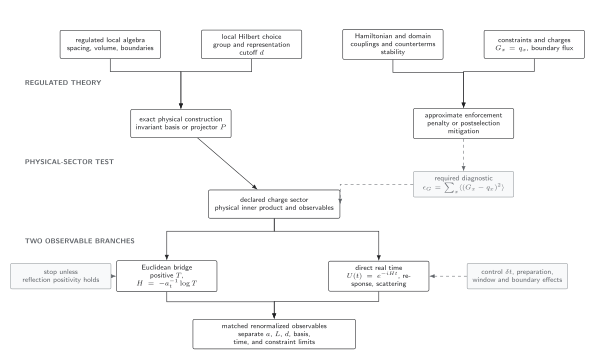
The local Hilbert choice determines which algebraic identities and constraints are exact before physical-sector construction. Convergence in or representation cutoff remains independent of spatial and time-evolution limits. The diagram is schematic.
A convergence design
Section titled “A convergence design”| Regulator | Exact at finite cutoff | Deformed relation | Essential diagnostic |
|---|---|---|---|
| Oscillator projection | finite Hermitian matrices | canonical commutator | boundary occupation, , and scans |
| Field grid | chosen discrete translations | continuum field range and momentum | range, grid-spacing, wraparound scans |
| Electric cutoff | flux basis and often Gauss law | link unitarity at boundary | maximal-flux weight and convergence |
| Quantum link | finite gauge algebra | coordinate-link algebra | representation-size and universality tests |
| Finite group | exact gauge symmetry | target Lie group and representation spectrum | subgroup sequence and phase continuity |
Use a partially crossed study in : at several fixed spatial lattices vary , extrapolate or bound the local-cutoff effect, and only then fit spatial cutoff and volume dependence. A single sequence can conceal compensation between errors.
Adversarial failure case
Section titled “Adversarial failure case”Tune the oscillator frequency at each dimension to minimize the vacuum energy, then quench into a state whose occupation reaches the retained basis edge. The optimized vacuum energy can be stationary over several values while the cutoff-edge probability, commutator defect, and late-time current change sharply. A vacuum-only study would falsely certify the regulator. Repeat at fixed , monitor the boundary weight during evolution, and test an excited-state matrix element that was not optimized.
Observable-level validation
Section titled “Observable-level validation”The equal-time regulator comparison table keeps local-field convergence distinct from spatial, gauge-sector, basis, and time-evolution controls.
- Measure cutoff-edge occupation and the state-resolved algebra defect on every prepared state and throughout the relevant evolution window.
- Vary field range and grid spacing, or electric cutoff and boundary rule, independently rather than reporting only the total local dimension.
- Reproduce a free oscillator or one-link spectrum and at least one matrix element before enabling interactions.
- Verify every exact finite-cutoff symmetry and quantify each deliberately deformed algebraic relation.
- Cross or representation size at enough points to predict a held-out spectrum, response, or Wilson-loop observable.
Common pitfalls
Section titled “Common pitfalls”Equating exact gauge symmetry with the correct gauge theory. Finite groups and quantum links can preserve a local symmetry exactly while targeting different short-distance algebras. Universality remains a physical question.
Monitoring only energies. A low spectrum can converge while matrix elements or real-time tails remain sensitive to cutoff-boundary occupation. Test the intended observables.
Freezing during . Ultraviolet fluctuations can demand increasing local dimension as spacing shrinks. Demonstrate uniform control rather than assuming it.
Learning outcomes
Section titled “Learning outcomes”- For a scalar, compact link, quantum-link, or finite-group regulator, state exactly which algebraic relations and symmetries survive at finite local dimension and compute a diagnostic for the first deformed relation.
- Design a crossed local-dimension, spacing, and volume study whose held-out observable distinguishes regulator restoration from basis tuning or accidental spectral agreement.
Exercises
Section titled “Exercises”- Compute for the open electric cutoff.
Solution
. Thus both ends of the retained flux interval create unitarity defects, on opposite products.
- Why is convergence in the ground-state energy insufficient for a scattering calculation?
Solution
Scattering depends on excited states, wave-packet propagation, currents, and long-time phases. Their support can reach the local cutoff even when the vacuum energy is stable.
References
Section titled “References”- Chandrasekharan, S., and Wiese, U.-J. (1997). Quantum link models: A discrete approach to gauge theories. Nuclear Physics B, 492, 455–471. DOI.
- Horn, D. (1981). Finite matrix models with continuous local gauge invariance. Physics Letters B, 100, 149–151. DOI.
Further reading
Section titled “Further reading”- Zohar, E., Cirac, J. I., and Reznik, B. (2016). Quantum simulations of lattice gauge theories using ultracold atoms in optical lattices. Reports on Progress in Physics, 79, 014401. DOI.