

Fermion Determinants, Pfaffians, and Measure Positivity
Integrating a complex lattice fermion produces a determinant; integrating a Majorana fermion produces a Pfaffian. Neither object is automatically a probability weight. Positivity follows only after the action, masses, flavor multiplicities, boundary conditions, chemical potentials, and spectral symmetries have been specified. The essential distinction is simple but consequential: a symmetry can make a determinant real without making it nonnegative.
Required background. Use naive lattice fermions and doubling for the finite-dimensional Dirac operator and momentum-space spectrum, and Grassmann Gaussian integration for the Berezin integral.
Helpful background. Wilson–clover fermions provide the main positivity example, while Ginsparg–Wilson symmetry supplies the exact-index and zero-mode refinements.
From the fermion action to the measure
Section titled “From the fermion action to the measure”Regulator and measure card. Work on a finite Euclidean lattice with fixed boundary conditions and a declared gauge background . Let be the complete fermion matrix, including spin, color, flavor, and lattice-site indices. The independent integration variables are and for a Dirac fermion. The bosonic gauge measure and gauge action are left implicit. All statements below concern the regulated, finite matrix; a continuum or infinite-volume limit is an additional claim.
For one complex fermion species,
The ordering convention for the Grassmann differentials fixes an overall sign once and for all. With degenerate species, the weight is . Noninteger flavor powers require a separately defined branch or positive operator; the notation alone does not define a local lattice theory.
For a real Grassmann vector with antisymmetric kernel ,
The last identity fixes the magnitude only up to a sign or, for a complex antisymmetric matrix, a phase. A simulation that replaces by has therefore made a substantive phase-quenching approximation unless the Pfaffian sign has been proved fixed; Montvay 2002, §§ 2.2 and 3.2 develops this issue for lattice Majorana fermions.
Reality is weaker than positivity
Section titled “Reality is weaker than positivity”At zero chemical potential, Wilson-type operators obey -Hermiticity, a finite-matrix relation that underlies the standard determinant-reality argument for Wilson fermions Wilson 1977, pp. 69–142:
Taking determinants gives
so the determinant is real. This proof does not establish its sign. For two exactly degenerate flavors one can instead combine the factors before assigning a sampling weight:
The final inequality holds because every eigenvalue of is nonnegative. It becomes strict only if has no zero mode. Thus a two-flavor Wilson determinant at real mass and zero chemical potential defines a nonnegative regulated weight, while one flavor can still change sign when a real eigenvalue crosses zero.
An exactly checkable pair of matrices isolates the logical gap. With ,
both satisfy , but
This is a useful unit test for any verbal positivity argument: if it would declare both determinants positive, it has silently used an extra hypothesis.
Antiunitary symmetries can produce stronger eigenvalue multiplets. If an antiunitary satisfies and , real eigenvalues occur with even degeneracy, giving a route to nonnegativity in some representations. The representation, discretization, mass, and boundary conditions must be checked explicitly; the existence of charge conjugation in the continuum is not by itself enough.
Zero modes, flavor powers, and phases
Section titled “Zero modes, flavor powers, and phases”Topology and mass determine how small eigenvalues enter the measure. For an exact chiral operator with the chapter convention , each zero mode contributes one factor of to . Schematically,
with the nonzero product paired according to the operator’s spectral symmetry. The determinant therefore suppresses gauge sectors with zero modes as , but the same zero modes can survive in correlation functions through inverse propagators. The index relation is reviewed on the Ginsparg–Wilson page; anomaly observables belong to the next page.
Three common changes invalidate the elementary two-flavor proof:
- Unequal or complex masses. The factors need not be conjugates, and a negative or complex determinant can remain.
- Real chemical potential. Typically , not ; hence and a fixed- determinant can be complex. Alford, Kapustin, and Wilczek 1999, §§ I–II contrast this case with imaginary chemical potential. This is the entry point to the finite-density sign problem, not its full analysis.
- Fractional powers or Pfaffians. Positivity of controls a magnitude, but locality, branch continuity, and any residual sign or phase remain separate obligations.
For determinant ratios, the same discipline applies. The identity
is algebraic; it does not guarantee that the ratio has a positive pseudofermion representation or that an iterative solver introduces negligible bias. Those numerical questions are treated with pseudofermions and determinant ratios.
The formulation map places the determinant or Pfaffian in its proper branch. Inspect the Majorana and chiral-gauge endpoints: a squared determinant does not fix a Pfaffian sign, and a local Weyl basis does not by itself define a globally integrable measure.
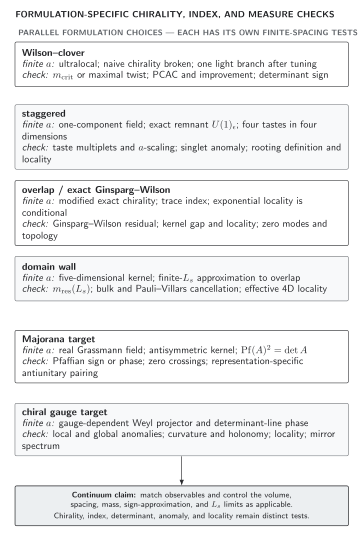
Lattice-fermion formulations trade different finite-regulator structures. Wilson methods require tuning and improvement; staggered methods require taste restoration and a separately qualified rooting step; exact Ginsparg–Wilson and overlap methods require locality and index checks; finite- domain-wall methods add a residual-mass test; Majorana and chiral-gauge targets add Pfaffian or Weyl-measure phases. The map is schematic, not to scale, and does not rank cost or accuracy.
A measure-consistency workflow
Section titled “A measure-consistency workflow”The determinant and Pfaffian column of the fermion-formulation comparison table separates reality, positivity, flavor powers, and phase obligations for the different regulated fermion measures.
For a proposed fermion weight, use the following order.
- Write the complete finite matrix and state its boundary conditions, masses, chemical potentials, representations, and flavor multiplicities.
- Prove each linear, Hermitian, or antiunitary relation at those parameters; do not import it from the massless continuum action.
- Infer only the spectral pairing that the relation actually implies, distinguishing reality from nonnegativity.
- Isolate zero modes and real-axis crossings, then determine their mass and topology dependence.
- For Pfaffians or fractional powers, define the sign or phase convention and test continuity along gauge-field paths.
- Compare the analytic prediction with a small exactly diagonalizable matrix before scaling to ensemble measurements.
Observable-level validation checklist. Report the smallest singular value of , the phase or Pfaffian sign when applicable, the fraction of configurations with a sign change, and the dependence on mass, volume, lattice spacing, and topological sector. For a claimed positive measure, verify against the product of squared singular values and repeat after varying boundary conditions. For reweighting, quote the average phase and its statistical precision rather than saying only that the sign problem is “mild.”
Adversarial failure case: the hidden square root
Section titled “Adversarial failure case: the hidden square root”Suppose a single-flavor calculation samples and calls it because is -Hermitian. The sampled object is , so every negative determinant has been assigned the wrong sign. The error can be invisible in perturbation theory around a region with fixed sign and appear only when an eigenvalue crosses zero. A correct analysis either proves such crossings absent, includes the sign by reweighting, or labels the calculation phase quenched.
What you should now be able to do
Section titled “What you should now be able to do”- Starting from a declared Dirac or Majorana lattice action, derive the determinant or Pfaffian and prove the exact reality, pairing, or positivity statement that applies.
- Given masses, flavors, boundary conditions, chemical potential, and topology, identify which change can introduce a zero, negative sign, complex phase, or ambiguous fractional power and name an observable that detects it.
Exercises
Section titled “Exercises”Two-flavor positivity
Section titled “Two-flavor positivity”Let be invertible and -Hermitian. Prove that two degenerate flavors have a strictly positive determinant, and state what changes when has a zero mode.
Solution
-Hermiticity implies . Therefore
If is invertible, every singular value is positive and . If has a zero mode, at least one and the two-flavor weight vanishes; it remains nonnegative but is not strictly positive.
A Pfaffian sign
Section titled “A Pfaffian sign”For
compute and . Why can not recover the continuous Pfaffian sign on both sides of ?
Solution
By definition , while . The principal square root gives and loses the sign change at the zero crossing. Recovering the Pfaffian requires an orientation or a continuous phase convention, together with explicit treatment of crossings through zero.
References
Section titled “References”- Alford, M. G., Kapustin, A., and Wilczek, F. (1999). “Imaginary chemical potential and finite fermion density on the lattice.” Physical Review D 59, 054502. doi:10.1103/PhysRevD.59.054502.
- Montvay, I. (2002). “Supersymmetric Yang–Mills theory on the lattice.” International Journal of Modern Physics A 17, 2377–2412. doi:10.1142/S0217751X0201090X; arXiv:hep-lat/0108011.
- Wilson, K. G. (1977). “Quarks and strings on a lattice.” In A. Zichichi (ed.), New Phenomena in Subnuclear Physics, Part A, pp. 69–142. Plenum Press. INSPIRE record.