

MERA, cMERA, and Renormalization Geometry
MERA encodes a discrete real-space scale transformation through unitary disentanglers and isometries, while cMERA defines a continuous variational flow from an infrared reference state to a UV-regulated field state. Their exact statements concern tensor identities, causal cones, and variational channels; continuum RG, conformal, or geometric interpretations require additional fixed-point, locality, and regulator tests.
Required background. Matrix product states, finite entanglement, and continuum limits supplies transfer channels and finite-entanglement reasoning. Wilsonian coarse graining and theory space supplies the continuum RG target.
Helpful background. Direct sums, tensor products, and index structure supplies tensor and isometry notation.
Discrete entanglement renormalization
Section titled “Discrete entanglement renormalization”In a binary one-dimensional MERA, a disentangler is unitary and an isometry obeys
Their orientation fixes whether embeds a coarse site into fine sites or coarse-grains. Unitarity cancels tensors outside the causal cone of a local operator, so its expectation value depends on only a bounded-width sequence of ascending or descending maps. This is an exact property of the network, not an assertion that the optimized tensors reproduce the target QFT. The disentangler–isometry construction and its causal coarse-graining logic were introduced by Vidal 2007.
At a scale-invariant fixed layer, the ascending channel acts on local operators. If
under a spatial rescaling by , the candidate scaling dimension is
Complex or negative eigenvalues may encode phases or lattice momentum, and degeneracies must be resolved with symmetry and operator mixing. The scale-invariant extraction of local observables and conformal data is developed by Pfeifer, Evenbly, and Vidal 2009, §§ II–IV.
Regulator and convention box. Record lattice, blocking factor , layer geometry, bond dimensions by layer, unitary/isometry orientation, transitional layers, scale-invariant layer, symmetry sectors, environment or contraction approximation, optimizer residual, , , and . For cMERA, also record the UV momentum cutoff, infrared reference, scale interval, ordering convention, entangler range, and generator basis. A scale direction is not a removed UV cutoff.
The geometry map distinguishes the discrete and continuous scale-organized ansätze from MPS transfer scaling and Euclidean tensor blocking.
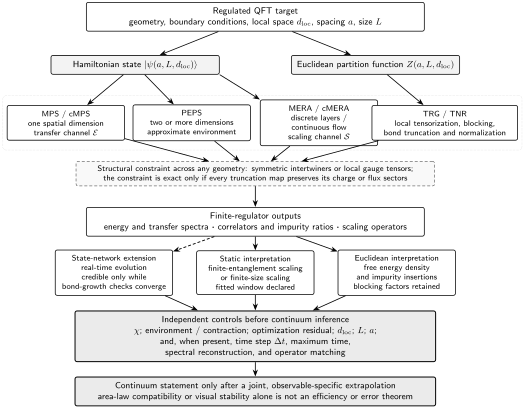
MERA supplies discrete causal layers and cMERA supplies a continuous variational scale flow. The map is schematic: neither construction by itself proves a Wilsonian continuum limit or an emergent spacetime geometry.
Exactly checkable scaling-channel benchmark
Section titled “Exactly checkable scaling-channel benchmark”For a binary scale transformation, suppose a normalized channel has eigenoperators
Then
The minus sign for adds a discrete phase but does not change the decay exponent. Iterating layers gives , while lengths grow by , so the coefficient falls as inverse length. This benchmark checks channel normalization, logarithm base, and the treatment of phases. A physical claim additionally compares the eigenoperators, degeneracies, and operator products with independently known continuum data.
Continuous MERA is a regulated variational flow
Section titled “Continuous MERA is a regulated variational flow”A standard cMERA state is written
where generates scale transformations, entangles modes near the active scale, and is a low-entanglement infrared reference. With self-adjoint generators the flow is unitary, so norm preservation is exact. The ansatz remains conditional on a UV cutoff, a restricted quasi-local generator family, and an optimized scale interval. The original field-theory construction and its free-model illustration are given by Haegeman et al. 2013.
cMERA should not be conflated with continuous MPS. cMPS is organized along physical space and is naturally suited to one-dimensional continuum fields; cMERA is organized along scale. Nor should the tensor network’s graph distance be called a bulk metric without a dictionary showing which correlations, entropies, or reconstruction properties it captures. Such geometric language is a bounded interpretation and its dated evidence belongs in the Research methods dossier.
Extraction and validation contract
Section titled “Extraction and validation contract”- Optimize finite transitional layers before fitting a scale-invariant channel.
- Check and constraints and remove channel null or gauge directions.
- Diagonalize in fixed symmetry and support sectors.
- Match lattice eigenoperators to continuum operators by quantum numbers and correlators, not eigenvalue alone.
- Vary bond dimension, layer pattern, contraction approximation, and number of transitional layers.
- Compare and selected OPE or correlator data with an independent finite-size, MPS, exact, or bootstrap result.
- For cMERA, vary UV cutoff and generator range before interpreting the flow as continuum.
The joint map shows why a stable scaling-channel eigenvalue can still fail when layer geometry, contraction, , , or optimizer initialization changes.
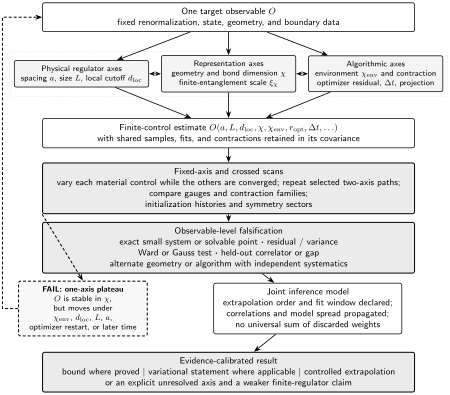
Scaling-channel convergence is not one dimensional. This schematic error map requires fixed-axis and crossed scans, continuum operator matching, and a held-out comparison before assigning a scaling dimension to the target QFT.
The common declarations are collected in the chapter’s tensor-network regulator and error record.
MERA or cMERA implementations require a current Research dossier before a dated capability comparison is treated as evidence.
Adversarial failure: plausible geometry, wrong operator spectrum
Section titled “Adversarial failure: plausible geometry, wrong operator spectrum”A MERA can display clean layers and narrow causal cones while its scaling channel has the wrong degeneracies or omits an allowed low-dimension operator. The graph still looks geometrically persuasive. The failure is found by symmetry-resolved channel diagonalization, correlator reconstruction, and comparison with independent continuum data; adding geometric interpretation cannot repair a deficient variational channel.
Observable-level validation checklist
Section titled “Observable-level validation checklist”- Verify every unitary and isometry constraint at the reported tolerance.
- Confirm identity-channel normalization and causal-cone cancellation.
- Resolve scaling eigenoperators by symmetry, support, phase, and degeneracy.
- Vary transitional layers, bond dimension, optimizer initialization, and contraction controls.
- Match at least one held-out correlator or operator product, not only eigenvalues used in tuning.
- For cMERA, vary UV cutoff, entangler range, and scale interval.
- Separate exact network statements, numerical evidence, continuum inference, and geometric interpretation.
What you should be able to do
Section titled “What you should be able to do”After this page, you should be able to:
- extract candidate scaling operators and dimensions from a normalized scale-invariant channel and compare them with independent continuum data; and
- state which MERA or cMERA conclusions follow from tensor identities and which require extra RG, locality, continuum, or geometric assumptions.
Exercises
Section titled “Exercises”1. Scaling eigenvalue. A ternary MERA has for an eigenoperator. Find its scaling dimension.
Solution
With , .
2. Norm flow. Show that the cMERA state preserves norm when is self-adjoint.
Solution
The path-ordered exponential generated by is unitary. Equivalently, differentiating gives for .
References
Section titled “References”- Haegeman, Jutho, Tobias J. Osborne, Henri Verschelde, and Frank Verstraete. “Entanglement Renormalization for Quantum Fields in Real Space.” Physical Review Letters 110 (2013): 100402. DOI.
- Pfeifer, Robert N. C., Glen Evenbly, and Guifré Vidal. “Entanglement Renormalization, Scale Invariance, and Quantum Criticality.” Physical Review A 79 (2009): 040301(R). DOI.
- Vidal, Guifré. “Entanglement Renormalization.” Physical Review Letters 99 (2007): 220405. DOI.