

Coupled-Channel Quantization and Inference
When two-body channels communicate, every finite-volume level constrains a matrix amplitude through one coupled determinant. Threshold openings change both the real-axis unitarity relation and the adjacent analytic sheet, while finite-volume irreps mix partial waves independently of channel mixing. A controlled inference must declare the channel basis and normalization, thresholds, sheet-sign vector, frame, irrep, partial-wave basis, and unitary parametrization, then show which amplitude combinations the available levels actually identify.
Required background. Moving Frames, Cubic Irreducible Representations, and Partial-Wave Mixing supplies the finite-volume basis. Scattering Amplitudes and Resonance Poles from Finite-Volume Spectra supplies correlated fitting and named-sheet continuation.
Helpful background. Partial-Wave Unitarity supplies the infinite-volume matrix relation.
Channels, thresholds, and normalization
Section titled “Channels, thresholds, and normalization”Let label two-particle channels with stable constituent masses . Their center-of-momentum momenta are
Use asymptotic channel states normalized by
with the required symmetrization factors included in the channel basis for identical particles.
Coupled-channel convention and regime. The channel basis, phase-space normalization, threshold branches, finite-volume irrep, and partial-wave truncation below are part of the determinant, not interchangeable notation.
The detailed choices are:
| Field | Choice used on this page |
|---|---|
| Channel basis | Stable two-particle species, ordering, identical-particle factors, and phase choices are fixed before fitting |
| Real-axis amplitude | , with for open channels and real symmetric under time reversal |
| Finite-volume condition | defines the sign of ; indices are channel, , and occurrence |
| Thresholds | A closed channel is analytically continued with and is not dropped discontinuously at threshold |
| Sheets | records the sign of every relative to the physical branch and the crossed-cut path is stated |
| Supported conclusion | The page gives a durable inference contract; comparative framework and application status is dated in Research |
On a real interval with open channels, unitarity is
Changing channel-state phases sends and for diagonal unitary ; the spectrum, eigenphases, and pole positions are invariant. Individual off-diagonal signs are not meaningful without this convention.
The coupled determinant
Section titled “The coupled determinant”In a declared finite-volume block,
contains infinite-volume channel dynamics; contains the box, boosts, irrep subduction, masses, and on-shell sum–integral differences. Both are matrices in the same ordered basis. Briceño derives the relativistic condition for arbitrary numbers of two-body channels, spins, total momenta, and masses, with corrections exponential in the interaction-range scale (Briceño 2014, §§ II–III). The theorem’s “below higher-particle thresholds” condition must be checked for the actual quantum numbers; it is not synonymous with “two channels were included.”
For two S-wave channels in one irrep, the visible core is
If , the determinant factorizes into two elastic conditions. This is an exact analytic benchmark: a coupled-channel implementation must recover two independent spectra without residual off-diagonal dependence. If channel 2 is moved far above the fitted region while its effects are analytic, integrating it out should shift smooth channel-1 parameters rather than create a spurious threshold cusp. The corresponding spinless multichannel construction and its two-channel reduction are given by He, Feng, and Liu 2005, §§ 2–3.
Near the second threshold, the closed-channel momentum approaches zero and its analytic contribution changes rapidly. Dropping channel 2 below threshold and activating it above threshold makes the amplitude nonanalytic by construction. Retain it on both sides with the correct branch.
Unitary parametrizations and identifiability
Section titled “Unitary parametrizations and identifiability”A real symmetric matrix can be parameterized as
This enforces real-axis two-body unitarity but does not prove that the chosen number of poles or polynomial order is sufficient. Alternatives can use an effective-range or conformal expansion, provided they preserve the same thresholds and normalization.
One energy level supplies one scalar condition—the vanishing of one determinant eigenvalue. A two-channel symmetric amplitude contains three real functions at each energy before additional structure is imposed. Therefore a sparse spectrum cannot determine all matrix elements pointwise. Identifiability comes from a bounded parametrization and levels across volumes, frames, irreps, and threshold regions that respond differently to its parameters.
Measure sensitivity with the Jacobian
Small singular values of identify parameter combinations that the levels do not constrain. Priors or smoothness assumptions may regularize those directions, but the resulting amplitude components must be labeled parametrization dominated.
Threshold sheets and pole continuation
Section titled “Threshold sheets and pole continuation”For two channels, label local sheets by relative to the physical branch. The physical sheet is ; crossing only channel 1 gives , and crossing both gives . Which sheet borders the physical axis depends on energy: between thresholds it is , while above both it is . Continue
along the declared cut-crossing path. Additional left-hand and multiparticle cuts can invalidate this local picture globally.
Pole positions are invariant under channel rephasing, while residues transform with the channel basis. Report the sheet vector, the threshold ordering, the continuation path, and the residue convention together. A pole that moves to a different sheet under an equally valid threshold or amplitude alternative is not summarized by one mass and width.
Adversarial failure. Synthetic levels all lie below the second threshold and are insensitive to , yet a two-pole ansatz returns a narrow channel-2 resonance with tiny bootstrap error. The error is conditional on a flat likelihood direction fixed by the ansatz. The sensitivity matrix, removal of the second pole, and held-out levels above threshold expose that the pole is not identified.
The branch-status map below shows why the coupled-channel result cannot inherit an elastic validation record. Follow its branch through threshold conventions, matrix identifiability, sheet choices, and an independent benchmark before assigning a pole interpretation.
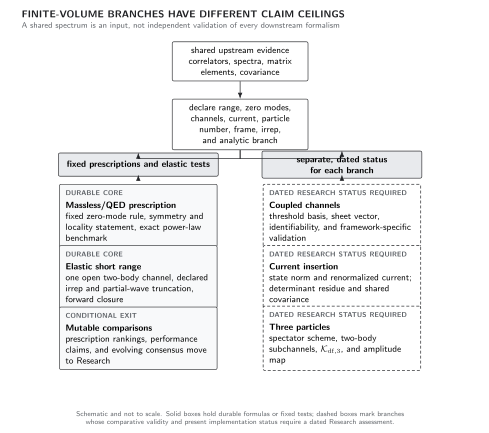
Finite-volume branches have different limits of interpretation. A fixed massless-field prescription and an exact power-law test are durable; mutable prescription comparisons may move to Research. Coupled-channel, current-insertion, and three-particle claims require separate dated status and validation. The map is schematic and not to scale.
Observable-level validation
Section titled “Observable-level validation”The coupled-channel row of the finite-volume hypothesis and uncertainty table keeps channel thresholds, normalization, sheet choices, and identifiability separate from the elastic limit used as a check.
Before accepting a coupled amplitude, verify that:
- all open and nearby two-body channels and the first omitted three-particle threshold are listed for every fitted energy;
- channel phases, identical-particle factors, state normalization, , and the basis order agree in , , operators, and residues;
- the determinant reproduces both the decoupled elastic limit and synthetic coupled spectra;
- levels from multiple volumes, frames, irreps, and both sides of important thresholds constrain the sensitivity directions quoted as results;
- at least two unitary parametrizations and a larger partial-wave basis are propagated; and
- every continued pole carries its sheet vector, path, cross-channel residue normalization, and parametrization uncertainty.
What you can now do
Section titled “What you can now do”You can now (1) write a coupled determinant with channel, irrep, partial-wave, threshold, and normalization indices explicit, and (2) use the spectrum sensitivity matrix to separate amplitude combinations constrained by levels from those fixed mainly by the parametrization.
Finite-Volume Matrix Elements and 1→2 Transitions uses the same determinant residue in current mappings. Three-Body Quantization and Decay Amplitudes is a distinct particle-number branch. General multichannel analyticity belongs to Scattering, and dated method status belongs to the Lattice and Hamiltonian Field Theory Research area.
Exercises
Section titled “Exercises”1. Decoupling. Set in the displayed determinant. Show that its roots are the union of two elastic spectra.
Solution
The determinant becomes . It vanishes when either factor vanishes, exactly the two independent elastic quantization conditions.
2. Channel rephasing. Let . What changes under ?
Solution
The off-diagonal entries change sign, while diagonal entries, determinant roots, eigenphases, and pole positions do not. Channel-2 pole couplings change sign in that basis, so a residue sign must never be quoted without the phase convention.
References
Section titled “References”- Briceño, Raúl A. “Two-Particle Multichannel Systems in a Finite Volume with Arbitrary Spin.” Physical Review D 89 (2014): 074507. DOI. Open PDF.
- He, Song, Xu Feng, and Chuan Liu. “Two Particle States in a Box and the -Matrix in Multi-Channel Scattering.” Journal of High Energy Physics 2005, no. 7 (2005): 011. DOI.