

Chiral Gauge Theories on the Lattice
A chiral gauge theory can be regulated on a lattice only when its local and global gauge anomalies cancel and the regulator supplies a gauge-covariant, local Weyl operator with a globally integrable fermion measure. Anomaly cancellation is necessary, not sufficient: one must still construct the measure phase over every included gauge-field sector, prove or test locality, recover the intended Weyl spectrum without light mirrors, and control finite-volume and continuum limits. General vectorlike overlap or domain-wall success does not by itself solve this chiral measure problem.
Required background. Use anomaly and Ward-identity diagnostics for regulated anomaly tests, overlap and domain-wall fermions for local sign-function realizations, and perturbative chiral gauge anomalies for representation-theoretic cancellation conditions.
Helpful background. Standard Model anomaly cancellation supplies a central representation test, while global and torsion anomalies explain why vanishing triangle coefficients need not exhaust the obstructions.
Weyl projection and the missing phase
Section titled “Weyl projection and the missing phase”Regulator and status card. Work at finite Euclidean lattice spacing and finite volume with a gauge-covariant Dirac operator satisfying gamma-five Hermiticity and . Gauge fields are restricted to a stated admissible or otherwise locality-controlled set. The discussion separates exact finite-lattice statements, all-orders perturbative results, and nonperturbative proposals. Research status below is checked through 9 August 2026; later claims belong in the dated lattice and Hamiltonian field-theory research guide.
Define
The Ginsparg–Wilson relation implies . A left-handed lattice field can therefore be constrained by
The asymmetry of the projectors is essential: depends on the gauge field. Choose orthonormal bases for its image and for the image of . Expanding and gives the Weyl determinant
Replacing by changes by . Thus the projector fixes the Weyl subspace but not the phase of its Grassmann measure. The phase is physical regulator data because its gauge variation must cancel the consistent anomaly.
For an infinitesimal gauge-field variation , the basis defines a measure connection
Its curvature is fixed by the projector,
A local current realizing this curvature must exist, its divergence must cancel the local gauge anomaly, and its holonomy around every closed loop in gauge-field space must agree with the determinant line bundle. This last integrability condition detects global obstructions that an infinitesimal triangle calculation can miss. Lüscher formulates the projector curvature and reconstruction problem explicitly Lüscher 1999, §§ 3–6.
An exact representation benchmark
Section titled “An exact representation benchmark”For four-dimensional left-handed Weyl fermions of integer charges , the perturbative cubic gauge anomaly is proportional to , and the mixed gauge–gravitational anomaly is proportional to . Consider
Then
and
The spectrum is genuinely chiral—no charge appears with its opposite—yet both polynomial tests vanish exactly. This makes it a useful input fixture for a measure-construction code. It is not a proof of the finished theory: one must still test the finite-lattice current, topology-sector dependence, global holonomies, locality, and continuum spectrum. For anomaly-free multiplets, Lüscher gives a nonperturbative finite-volume Ginsparg–Wilson construction including topological sectors under the construction’s stated gauge-field conditions Lüscher 1999, §§ 7–11.
For a non-Abelian representation , the local four-dimensional condition is
summed over all left-handed species. This does not test torsion or other global anomalies. Nor does it construct the current . Lüscher proved that anomaly-free chiral gauge theories for arbitrary compact groups admit a gauge-invariant lattice regularization to all orders in perturbation theory Lüscher 2000, §§ 4–6; that result should not be relabeled as a general nonperturbative construction.
Construction strategies and their obligations
Section titled “Construction strategies and their obligations”The useful classification is by what each strategy must demonstrate, not by a single quality score.
| Strategy | Mechanism | Decisive finite-lattice obligations |
|---|---|---|
| Ginsparg–Wilson Weyl measure | Gauge-dependent chiral projector and reconstructed local measure current | Local and global anomaly cancellation; curvature and holonomy integrability; locality in every included sector; smooth topology transitions or explicit sector prescription |
| Domain-wall or boundary inflow | Put target Weyl modes on a boundary and use a higher-dimensional bulk | Remove or gap the opposite boundary without breaking gauge symmetry; cancel bulk contributions; show locality of the boundary effective action; test unwanted conserved currents and remote zero modes |
| Mirror-fermion decoupling or symmetric mass generation | Add interactions intended to gap mirrors while preserving the gauge symmetry | Demonstrate a finite correlation length, no symmetry breaking or topological order that changes the target, no propagator-zero substitute for a missing pole, correct anomaly matching, and a clean target spectrum |
| Gauge-fixed construction | Break manifest gauge invariance at the cutoff and tune toward a gauge-invariant continuum theory | Identify the critical surface, control gauge-fixing and ghost sectors, tune all relevant counterterms, and recover unitary gauge-invariant observables |
Every row also inherits the determinant or Pfaffian phase tests from the measure-positivity page. A proposal that presents only a free dispersion relation has not yet tested the interacting Weyl measure.
Status-qualified evidence matrix
Section titled “Status-qualified evidence matrix”| Claim | Evidence class as of 9 August 2026 | Safe conclusion |
|---|---|---|
| Anomaly-free chiral multiplets with a Ginsparg–Wilson operator | Nonperturbative finite-volume reconstruction under stated admissibility and locality conditions | Established special construction; do not generalize it automatically to arbitrary non-Abelian theories |
| Anomaly-free compact-group theories near the trivial field | Recursive construction to all orders in lattice perturbation theory | Perturbative consistency is established; global nonperturbative completion remains an additional problem |
| Generic interacting non-Abelian chiral spectrum | Multiple Ginsparg–Wilson, gauge-fixed, mirror-decoupling, and higher-dimensional strategies | No formulation-independent general nonperturbative conclusion follows from the special cases alone |
| Symmetric mass generation of mirrors | Model results and active constraints on zeros, symmetry realization, and anomaly matching | Treat each claimed phase as model-specific until the full spectral and infrared tests pass |
| Recent finite-boundary or topological-phase constructions | Concrete Weyl boundary spectra and proposed locality mechanisms, with continuing scrutiny of currents and bulk modes | Promising research program, not a settled universal regulator |
Kaplan’s finite-boundary proposal states a locality mechanism conditional on anomaly cancellation and a large extra-dimensional volume Kaplan 2024, abstract and main construction. Subsequent analyses have identified concrete tests involving conserved currents, propagator zeros, and symmetric-mass-generation phases Golterman and Shamir 2024, Golterman and Shamir 2026. These papers sharpen the evaluation criteria; their coexistence is precisely why the broad status must remain dated and qualified.
The shared formulation map shows the extra endpoint conditions introduced by a chiral-gauge target. Inspect the final branch: exact chiral kinematics and a local anomaly test still have to be joined to global measure integrability, mirror decoupling, locality, and the intended continuum limit.
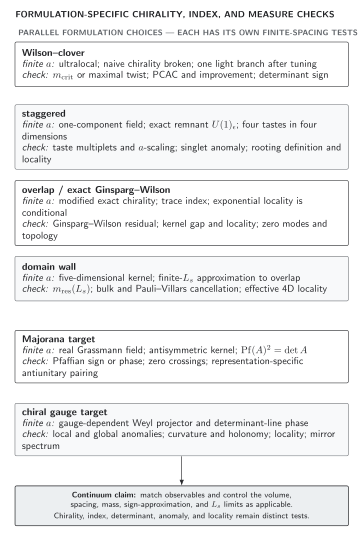
Lattice-fermion formulations trade different finite-regulator structures. Wilson methods require tuning and improvement; staggered methods require taste restoration and a separately qualified rooting step; exact Ginsparg–Wilson and overlap methods require locality and index checks; finite- domain-wall methods add a residual-mass test; Majorana and chiral-gauge targets add Pfaffian or Weyl-measure phases. The map is schematic, not to scale, and does not rank cost or accuracy.
A construction assessment
Section titled “A construction assessment”The chiral-gauge row of the fermion-formulation comparison table keeps operator locality, mirror content, anomaly cancellation, and the Weyl-measure phase as separate construction requirements.
Before accepting a proposed lattice chiral gauge theory, require all of the following.
- Target and anomaly statement: list every Weyl representation, chirality, global form of the gauge group, spin structure, and all local and global anomaly tests.
- Finite regulator: give the action or Hamiltonian, boundary conditions, admissible gauge-field set, projector, and exact finite-lattice gauge transformation.
- Measure: construct the phase connection, verify its curvature, and test holonomy on noncontractible loops in gauge-field space and between topology sectors.
- Locality: bound or measure kernels of the Dirac operator, measure current, and effective gauge action as functions of separation, volume, coupling, and extra-dimensional size.
- Spectrum: show the target Weyl poles and the absence or controlled gapping of mirrors; inspect propagator zeros as well as poles.
- Dynamics: test symmetry realization, mass gaps, induced interactions, and possible topological order rather than relying on free counting.
- Continuum evidence: match Ward identities and gauge-invariant correlators at several lattice spacings and volumes, with all tuning trajectories declared.
Observable-level validation checklist. Report the norm and range of the gauge variation of the effective action; the curvature residual of on elementary two-parameter loops; the phase holonomy on representative noncontractible loops; the chiral pole and zero content of the full propagator; mirror-sector correlation lengths and symmetry order parameters; locality envelopes for the Weyl operator and measure current; and scaling of gauge-invariant correlation functions with , volume, and any fifth-dimensional extent. State numerical tolerances and their stability under precision changes.
Adversarial failure case: mirrors vanish from poles, not from physics
Section titled “Adversarial failure case: mirrors vanish from poles, not from physics”Suppose an interacting mirror propagator loses its massless pole, while its inverse develops a zero at the same momentum. Declaring the mirror “gapped” from the absence of a pole alone can miss long-distance anomaly-carrying structure or a singular effective action. Measure position-space correlation lengths, inspect both the propagator and inverse propagator, test all preserved symmetries and anomaly matching, and verify that no additional topological sector remains. A successful free target spectrum is not a substitute for this interacting test.
What you should now be able to do
Section titled “What you should now be able to do”- Given a proposed chiral lattice action, check anomaly cancellation, gauge covariance, locality, Weyl spectrum, measure curvature and holonomy, mirror-sector dynamics, and continuum scaling with explicitly named observables.
- Classify each supporting result as an exact special construction, an all-orders perturbative result, a finite-volume numerical observation, or an unresolved general claim, and avoid promoting one class into another.
Exercises
Section titled “Exercises”An anomaly-free chiral charge set
Section titled “An anomaly-free chiral charge set”Verify the two anomaly sums for , and show that the set cannot be partitioned into vectorlike pairs .
Solution
The linear and cubic sums are
and
The opposite charges are all absent, so no member has a vectorlike partner. Polynomial anomaly cancellation therefore does not require a vectorlike spectrum.
Curvature is not global integrability
Section titled “Curvature is not global integrability”Assume the measure connection has the required local curvature everywhere on a gauge-field space containing a noncontractible loop . Explain what further datum must be checked and give its observable form.
Solution
Curvature controls infinitesimal contractible loops but does not fix the phase around a noncontractible loop. One must compare the connection holonomy
with the phase obtained by transporting the Weyl determinant basis around . A mismatch is a global obstruction even when the local anomaly polynomial and local curvature condition vanish.
Where the result stops
Section titled “Where the result stops”The perturbative and global anomaly classifications belong to the symmetry volume, and the Standard Model representation check belongs to Standard Model anomaly cancellation. Theorem-level construction and obstruction statements belong to chiral gauge theory and Standard Model construction. Current proposals, disputes, and evidence updates belong to the dated Research guide.
References
Section titled “References”- Golterman, M., and Shamir, Y. (2024). “Propagator zeros and lattice chiral gauge theories.” Physical Review Letters 132, 081903. doi:10.1103/PhysRevLett.132.081903.
- Golterman, M., and Shamir, Y. (2026). “Constraints on the symmetric mass generation paradigm for lattice chiral gauge theories.” Physical Review D 113, 014503. doi:10.1103/qd1t-wzy1.
- Kaplan, D. B. (2024). “Chiral gauge theory at the boundary between topological phases.” Physical Review Letters 132, 141603. doi:10.1103/PhysRevLett.132.141603.
- Lüscher, M. (1999). “Abelian chiral gauge theories on the lattice with exact gauge invariance.” Nuclear Physics B 549, 295–334. doi:10.1016/S0550-3213(99)00115-7; arXiv:hep-lat/9811032.
- Lüscher, M. (2000). “Lattice regularization of chiral gauge theories to all orders of perturbation theory.” Journal of High Energy Physics 2000(06), 028. doi:10.1088/1126-6708/2000/06/028; arXiv:hep-lat/0006014.
- Lüscher, M. (2000). “Weyl fermions on the lattice and the non-Abelian gauge anomaly.” Nuclear Physics B 568, 162–179. doi:10.1016/S0550-3213(99)00731-2; arXiv:hep-lat/9904009.