

Lattice Perturbation Theory, Symanzik Analysis, and Improvement
Lattice perturbation theory expands the declared finite-spacing action, measure, and operators themselves. Its propagators and vertices are periodic functions of momenta, and every loop integral runs over a compact Brillouin zone. Matching compares renormalized quantities in a named lattice and continuum scheme. The resulting coefficients enter the Symanzik effective action and operator expansion, where exact regulator symmetries determine the allowed cutoff terms. Improvement is successful only when the predicted leading power is absent from held-out observables across several spacings.
Required background. Lattice Momentum, Propagators, and Cutoff Dispersion supplies lattice kernels and Brillouin zones. Bare Parameters, Tuning Conditions, and Continuum Targets fixes the target trajectory. Relevant, Marginal, and Irrelevant Directions supplies the RG classification.
Helpful background. Momentum-Space Feynman Rules and Anatomy of a Loop Integral provide continuum diagrammatics. Representation and Spurion Constraints on Operator Bases and Symmetry-Protected Operators, Currents, and Improvement supply basis and current constraints.
In the chapter’s observable-chain table, this page supplies the regulated-action, lattice-matching, and improvement inputs required before a continuum fit.
Lattice Feynman rules come from the regulated action
Section titled “Lattice Feynman rules come from the regulated action”Use the two-dimensional Euclidean scalar fixture
Define dimensionless variables
In lattice units the free propagator and quartic vertex are
with momentum conservation modulo in each component. The vertex sign is the coefficient in the expansion of ; a different convention for amputated Euclidean vertices must be translated consistently.
Perturbative conventions. The page uses a Euclidean weight , incoming lattice momenta in , the site-wide conventions, and the dimensionless action above. The lattice action, field measure, gauge-fixing and ghost terms when present, operator basis, continuum target scheme, scale , and infrared regulator are local. Continuum must never replace inside a lattice loop.
At one loop, the tadpole self-energy has symmetry factor :
The domain, measure, propagator, vertex, and symmetry factor are inseparable parts of the rule. In gauge theory, expansion of link variables and the Haar measure adds vertices; gauge fixing and ghosts must be derived from the lattice formulation rather than copied from the continuum.
A bounded one-loop matching coefficient
Section titled “A bounded one-loop matching coefficient”To compare the ultraviolet finite parts rather than two different infrared problems, use the same positive mass in the lattice and continuum denominators at this order and define . It can be viewed as the common tree-level mass; it is removed only after the subtracted difference is formed. The normalized square-lattice Green function obeys Guttmann 2010, Eqs. (4) and (6). With , this gives
where the complete elliptic integral uses the modulus convention
The reduction is short enough to check. Write the denominator as
and use
to integrate . The remaining integral becomes
and the tangent half-angle substitution reduces it to the displayed complete elliptic integral. This derivation checks both the factor of two and whether a numerical library expects the modulus or parameter .
Libraries that accept the parameter require an explicit conversion. For ,
Using then yields
In two-dimensional at , the corresponding subtracted tadpole is
Therefore the finite lattice-to- coefficient is
With the self-energy convention above, the one-loop contribution to the mass matching is
The subscript prevents this equality from being mistaken for an all-orders relation. This is a complete one-loop matching benchmark because the common infrared prescription, lattice integral, continuum subtraction, scale, action, and symmetry factor are fixed. The coefficient is not universal: changing the lattice action or continuum scheme changes its finite part.
The choice makes this a compact matching benchmark, but it is a scale that moves as the regulator is removed. If the target observable is quoted at a fixed physical scale , the matched parameter or operator must be converted or RG evolved from to before results at different spacings are compared.
Numerical evaluation should compare four independent routes: periodic quadrature over the Brillouin zone, adaptive integration, the elliptic formula, and the small-mass extrapolation. Grid error, adaptive error, special-function convention, asymptotic-fit error, and floating-point error remain separate. Taking in either infrared-divergent integral before forming the difference is invalid.
The QFT.org 2026 Chapter 2 benchmark, validated snapshot evaluates the elliptic form with an arithmetic–geometric mean and agrees with a midpoint Brillouin-zone quadrature to relative error . Its small-mass finite part is , and it separately verifies the extra self-energy factor . Those are deterministic numerical cross-checks for this fixture, not evidence for unrelated lattice actions.
Symanzik action and operator expansions
Section titled “Symanzik action and operator expansions”For momenta and masses well below , a local lattice theory can be represented by a continuum effective action
and a lattice operator by
The bases contain every local operator allowed by the exact lattice symmetries, boundary conditions, and quantum numbers. Lower-dimensional mixings belong in the first matching problem, not in a positive-power cutoff expansion. Logarithms can multiply powers of through anomalous dimensions.
Terms proportional to the leading equations of motion can be removed by field redefinitions for on-shell observables under suitable boundary conditions. They may still matter for off-shell Green functions, contact terms, boundary observables, and a fixed operator definition. “Redundant” must therefore state the observable class.
For the standard free scalar, define the dimensionful lattice momentum symbol and hypercubic invariants by
so has the usual mass dimension two and every displayed correction has the same dimension. The leading bulk artifact is represented by a hypercubic dimension- operator. A five-point Laplacian can cancel its tree-level coefficient, but temporal next-nearest-neighbor terms require a separate reflection-positivity check. Boundary and anisotropic lattices admit additional localized or direction-dependent operators.
Symanzik’s construction and improvement conditions are developed in the original two-part analysis Symanzik 1983, Part I, pp. 187–204 and Symanzik 1983, Part II, pp. 205–227. Lattice power counting provides conditions under which continuum renormalization and lattice integrals have the expected asymptotic structure Reisz 1988.
Coefficient determination and improvement tests
Section titled “Coefficient determination and improvement tests”Improvement coefficients can be determined perturbatively, nonperturbatively from Ward identities or matching conditions, or by a hybrid method. The condition used to tune a coefficient is not an independent test. Reserve observables with different kinematics or operator content.
Suppose an unimproved dimensionless observable has
and the leading coefficient is canceled. The improved prediction is
only if no other action, operator, mass-dependent, boundary, or mistuning term survives. Testing requires multiple spacings spanning an asymptotic window, common physical volume and masses, and a comparison of versus residual models. A small coefficient over one interval is weaker than the predicted power law.
On-shell improvement of an action does not automatically improve a composite operator. The action changes energies and states; the operator expansion changes matrix elements. Both must be treated for a precision observable.
Adversarial failure cases
Section titled “Adversarial failure cases”Continuum propagator inside the Brillouin zone. Replacing by changes the regulator and the finite matching coefficient.
Tadpole factor lost. The is a graph symmetry factor. Numerical agreement after retuning another convention does not repair a missing factor.
Scale changed without RG conversion. The displayed comparison uses . Another changes the logarithm and must be evolved.
Power divergence invented in the two-dimensional fixture. The matched difference is logarithmic and finite. Dimensional analysis and the exact elliptic result rule out an uncanceled term here.
One improved observable. A coefficient tuned on one dispersion point can overfit it. Test other momenta, directions, and an operator matrix element.
Off-shell and on-shell improvement conflated. Equation-of-motion operators may drop from one class and remain in another.
The chain below distinguishes a matched improvement coefficient from the continuum claim it helps to control. Inspect how the action, operator basis, scheme, scale, and cutoff ansatz remain linked, and how an alternative action or held-out observable supplies an independent test.
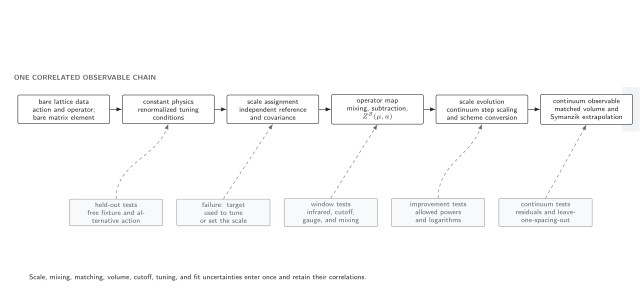
A continuum prediction requires a tuned bare trajectory, a regulator-consistent calculation, and a renormalized observable in a named scheme. When momentum-space lattice perturbation theory is used, its propagators, vertices, and Brillouin zone must be retained unless a controlled matching or subtraction justifies a continuum replacement. Step scaling or scheme conversion is optional when the matching scale is already suitable. The failure exits reject an untuned trajectory, an unjustified continuum propagator inside a lattice loop, a defining input counted as a prediction, and a one-spacing or unsupported extrapolation. Schematic, not to scale.
Observable-level validation checklist
Section titled “Observable-level validation checklist”Before claiming matching or improvement, require:
- propagators, vertices, measures, and conservation deltas derived from the exact lattice action;
- compact Brillouin-zone loop domains and lattice momentum symbols;
- all gauge-fixing, ghost, Haar-measure, and operator-insertion terms when applicable;
- a named continuum scheme, scale, infrared prescription, and basis translation;
- symmetry factors and dimensions checked independently;
- exact, quadrature, and asymptotic routes agreeing for a bounded fixture;
- a symmetry-complete Symanzik action and operator basis;
- tunable and equation-of-motion-redundant terms separated by observable class;
- multiple matched spacings and held-out observables showing the predicted residual power; and
- perturbative truncation, nonperturbative tuning, and continuum-fit uncertainties kept distinct.
Any implementation of the exact tadpole fixture must reproduce before making a broader matching claim.
Exercises
Section titled “Exercises”1. Tadpole symmetry factor. Expand to first order and contract two fields at the vertex with two external fields. Show that the self-energy coefficient is .
Solution
There are ways to attach the two labeled external fields, leaving the remaining two fields to contract with each other. Dividing by gives . The minus sign from the Euclidean interaction expansion is incorporated in the vertex convention; the mass correction has the displayed positive loop coefficient in the inverse propagator.
2. Directional improvement test. Along a sequence of square periodic lattices with fixed and , let and compare the allowed modes and ; take so both lie inside the first Brillouin zone. Show that they have equal but different , and find their leading difference in . Why is this pair useful when testing cancellation of the term?
Solution
Both modes have , while
Therefore
The continuum contribution is identical, so the directional difference isolates the hypercubic coefficient at leading order. An exactly diagonal mode cannot have the same nonzero norm as an on-axis mode on one square periodic box, because has no nonzero integer solution; the and pair avoids that impossible requirement.
What you can now do
Section titled “What you can now do”You should now be able to derive lattice Feynman rules, evaluate and independently check a compact-zone matching integral, construct the allowed Symanzik action and operator basis, and test improvement through residual scaling. Continue with Lines of Constant Physics and Continuum Extrapolation to combine tuning, scale, renormalization, volume, and these cutoff predictions in one correlated limit.
References
Section titled “References”- Guttmann, Anthony J. “Lattice Green Functions in All Dimensions.” Journal of Physics A: Mathematical and Theoretical 43, no. 30 (2010): 305205. doi:10.1088/1751-8113/43/30/305205.
- QFT.org. “Lattice Observables and Continuum Inference Benchmark.” JavaScript source, validated 25 August 2026. SHA-256
d76924d8c724cb7c9307fb38265336495fa3ff1a98103b3fa4fa734262647c2a. Reproducibility record. - Reisz, Thomas. “A Power Counting Theorem for Feynman Integrals on the Lattice.” Communications in Mathematical Physics 116, no. 1 (1988): 81–126. doi:10.1007/BF01239027.
- Symanzik, Kurt. “Continuum Limit and Improved Action in Lattice Theories. I. Principles and Theory.” Nuclear Physics B 226, no. 1 (1983): 187–204. doi:10.1016/0550-3213(83)90468-6.
- Symanzik, Kurt. “Continuum Limit and Improved Action in Lattice Theories. II. O() Nonlinear Sigma Model in Perturbation Theory.” Nuclear Physics B 226, no. 1 (1983): 205–227. doi:10.1016/0550-3213(83)90469-8.