

Symmetric and Gauge-Invariant Tensor Networks
Symmetric tensor networks impose a global charge or local Gauss constraint as an intertwining equation on every tensor. This can make symmetry leakage exactly zero within the represented sectors, but it does not remove the physical error caused by truncating the available charges, flux representations, local Hilbert space, bond degeneracies, volume, or lattice spacing.
Required background. Entanglement structure and tensor-network ansätze supplies virtual indices and tensor gauge. Lattice gauge Hamiltonians and Gauss’s law supplies the physical Hilbert space and local constraints.
Helpful background. Representations, intertwiners, invariants, and tensor decomposition supplies representation and fusion notation.
Global symmetry as an intertwiner
Section titled “Global symmetry as an intertwiner”For an MPS with an on-site representation , a symmetric tensor obeys
On an internal bond, the from one tensor cancels the from its neighbor. Only boundary representations remain, fixing the total charge sector. For a compact completely reducible group, each virtual space decomposes as
where carries an irrep and is its degeneracy space. Clebsch–Gordan or intertwiner tensors contain the group structure; variational freedom resides in the degeneracy tensors. This separation and its computational consequences are derived by Singh, Pfeifer, and Vidal 2010.
Regulator and convention box. State the symmetry group, irrep labels, incoming/outgoing dual conventions, fusion tree, boundary charge, represented sector set, degeneracy dimensions, physical local cutoff, bond dimensions by sector, and the rule used when truncating multiplets. For gauge networks, state the Gauss-generator sign and link orientation at every vertex. An exactly invariant tensor can still represent a physically inadequate flux cutoff.
Local gauge constraints and virtual flux
Section titled “Local gauge constraints and virtual flux”Let be a Gauss generator. A physical state satisfies
at every uncharged vertex, or equals the specified boundary/static charge when one is present. A gauge-invariant local tensor is an intertwiner from incoming link representations and matter to outgoing link representations. For an Abelian orientation convention, its nonzero blocks obey
This selection rule makes the local constraint exact algebraically. For non-Abelian groups, charges fuse through intermediate irreps and multiplicity labels; truncation must retain complete irrep multiplets and consistent fusion channels. Gauge-invariant tensor constructions and representation truncations are reviewed by Zohar and Burrello 2016, §§ 2–4. A continuous-group lattice-gauge construction that implements these representation and intertwiner data is given by Tagliacozzo, Celi, and Lewenstein 2014.
The geometry map shows symmetry as a structural layer across MPS, PEPS, MERA, and Euclidean tensor networks—not a separate continuum limit.
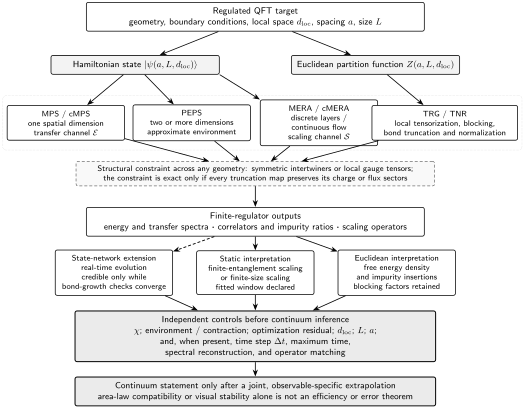
Symmetry or gauge invariance can be exact at each tensor even while the represented charge and flux content is truncated. The schematic map separates structural constraint preservation from physical and continuum completeness.
Exactly checkable Abelian link fixture
Section titled “Exactly checkable Abelian link fixture”Consider two matter sites joined by one oriented Abelian link, from site 1 to site 2. Define
The basis state
obeys exactly. A local tensor representation may be written with Kronecker constraints
Contracting enforces a neutral boundary state. Reversing the link orientation requires in both Gauss operators and tensors; changing only one produces an immediate nonzero residual. This fixture checks orientations, dual representations, boundary charge, and exact sector selection.
Now truncate . The Kronecker rules still enforce Gauss’s law exactly, but a link-raising operator cannot act faithfully at . Constraint preservation therefore does not certify the electric-field truncation. One must enlarge and test flux distributions and observables.
Constraint-preserving truncation
Section titled “Constraint-preserving truncation”For a symmetric Schmidt decomposition, reduced density matrices are block diagonal in charge. Retain complete multiplets, choosing degeneracy states within each irrep sector. Cutting through an irrep partway breaks symmetry even if its singular values are small. Conversely, retaining complete multiplets but omitting a relevant irrep preserves symmetry while introducing a physical ansatz error.
A penalty Hamiltonian
is different. At finite , it suppresses rather than removes gauge-violating states. A small expectation of the total penalty can hide localized leakage or cancellation in other diagnostics. Exact tensor constraints and energetic penalties must be labeled separately.
Use the common tensor-network regulator and error record to report sector content, truncation, constraint tests, and the continuum boundary.
Adversarial failure: exact Gauss law, wrong string tension
Section titled “Adversarial failure: exact Gauss law, wrong string tension”A U(1) network with can satisfy every local Gauss law to machine precision. At strong electric fluctuations, however, the flux distribution piles up at and the string tension drifts when is raised. The exact residual only tests the constraint subspace. The repair is a flux-cutoff scan, boundary-sector check, and held-out Wilson-string or energy-density observable.
Observable-level validation checklist
Section titled “Observable-level validation checklist”- Verify the local intertwiner equation on every tensor block.
- Check all Gauss residuals and the total boundary charge.
- Retain complete irreps and document degeneracy truncation within each sector.
- Reverse selected link orientations and confirm dual labels and signs transform consistently.
- Scan the represented charge or flux set independently of bond degeneracies.
- Compare a constrained exact-diagonalization fixture or analytically solvable link.
- Test a held-out flux distribution, string observable, or Ward identity.
- Separate exact structural preservation from local-space, volume, spacing, and operator-matching errors.
What you should be able to do
Section titled “What you should be able to do”After this page, you should be able to:
- construct and verify a symmetric or gauge-invariant local tensor from representation and boundary-charge data; and
- distinguish exact constraint preservation from finite representation, flux, degeneracy, penalty, and continuum errors.
Exercises
Section titled “Exercises”1. Boundary charge. With the same link orientation, take , , and . Compute and and interpret the result.
Solution
and . The state carries one unit of external charge at site 1; it is not in the uncharged physical sector unless was specified.
2. Multiplet truncation. Why does keeping two of the three magnetic components of a spin-1 irrep break SU(2), even if the omitted singular value is smallest?
Solution
SU(2) rotations mix all three magnetic components. A two-dimensional subset is not an invariant subspace of the spin-1 irrep, so the truncated tensor cannot satisfy the intertwiner equation. One may discard or retain the whole irrep, or truncate only its degeneracy space.
References
Section titled “References”- Singh, Sukhwinder, Robert N. C. Pfeifer, and Guifré Vidal. “Tensor Network Decompositions in the Presence of a Global Symmetry.” Physical Review A 82 (2010): 050301(R). DOI.
- Tagliacozzo, Luca, Alessio Celi, and Maciej Lewenstein. “Tensor Networks for Lattice Gauge Theories with Continuous Groups.” Physical Review X 4 (2014): 041024. DOI.
- Zohar, Erez, and Michele Burrello. “Building Projected Entangled Pair States with a Local Gauge Symmetry.” New Journal of Physics 18 (2016): 043008. DOI.