

Three-Body Quantization and Decay Amplitudes
Three-particle levels constrain a three-body amplitude only through a declared formalism that resolves a spectator, interacting two-body subchannels, symmetrization, and a genuine three-body kernel. In the relativistic field-theory construction used here, the finite-volume determinant contains the physical two-body matrix and a divergence-free three-body quantity ; the latter is regulator and scheme dependent and becomes a physical amplitude only after solving infinite-volume integral equations. A spectrum formula alone does not supply a decay-amplitude normalization.
Required background. Coupled-Channel Quantization and Inference supplies determinant, threshold, identifiability, and sheet discipline.
Helpful background. Three-Body Renormalization and Universality supplies infinite-volume three-body dynamics. Complete Lattice Error Budgets supplies the multistage uncertainty contract.
One explicit relativistic three-body branch
Section titled “One explicit relativistic three-body branch”To make every statement testable, adopt the baseline Hansen–Sharpe branch:
- three identical spin-zero particles of mass in a periodic cubic box;
- a symmetry separating odd- and even-particle sectors, so transitions are absent;
- total center-of-momentum energy in a stated interval below the first omitted higher-particle threshold;
- no two-body -matrix pole in the original baseline interval, with a smooth cutoff that restricts spectator kinematics; and
- all partial waves and spectator momenta retained up to declared cutoffs.
Later extensions relax several of these assumptions. They are not silently folded into this baseline; their present domains and equivalences belong to the Lattice and Hamiltonian Field Theory Research area. In particular, the coupled two- and three-particle spectrum relation is constructed in Briceño, Hansen, and Sharpe 2017, §§ II–V, but using that extension requires declaring its enlarged particle-number and two-body-pole hypotheses.
Three-body formalism boundary. The determinant below is the stated identical-scalar, particle-number-parity branch with a declared spectator regulator and truncation; its divergence-free kernel is scheme dependent until the associated infinite-volume integral equations are solved.
The detailed choices are:
| Field | Choice used on this page |
|---|---|
| Spectator | labels the on-shell spectator; the nonspectator pair is expanded in partial waves in its own center-of-momentum frame |
| Symmetry | Identical-boson symmetrization is included; the baseline has a particle-number parity and no mixing |
| Two-body input | The same physical and its subthreshold continuation are used in the pair subchannel and all validation limits |
| Three-body input | is divergence free only by a declared subtraction and cutoff scheme; it is not called the scattering amplitude |
| Quantization sign | defines the sign and normalization of on this page |
| Observable | A physical is obtained only after the matching integral equations; a decay bridge additionally requires a current-specific finite-volume residue relation |
With compound indices , the structural condition is
is not a purely geometric zeta function. It contains finite-volume sums, the two-body matrix for the nonspectator pair, exchange between spectator choices, cutoff functions, and symmetrization. The determinant therefore resums repeated two-body scattering as well as genuine three-body interactions. The relativistic condition and its original hypotheses are derived by Hansen and Sharpe 2014, §§ II–VI.
Why a divergence-free kernel appears
Section titled “Why a divergence-free kernel appears”A connected amplitude contains physical singularities from a particle spectating while the other two scatter, followed by a change of spectator. Schematically,
where is a known sequence of pairwise scatterings with on-shell exchange singularities. Subtracting defines a smoother divergence-free object, but the split depends on the cutoff and subtraction prescription. The formalism parameterizes that short-distance information by .
The physical amplitude is recovered from coupled integral equations of the form
where and attach the pairwise rescattering and solves an infinite-volume kernel equation. The symbols are structural because their measures and cutoff factors are formalism-specific. The essential check is exact: changing the allowed cutoff or subtraction shifts and the intermediate functions, but a consistently matched and predicted spectrum must remain invariant. Hansen and Sharpe give the amplitude relation and demonstrate this logical separation in Hansen and Sharpe 2015, §§ II–V.
Calling a fitted constant a “three-body force” can be useful within one isotropic truncation, but it is not a scheme-independent observable. Only its effect on the spectrum and the matched can be compared invariantly.
Free and weak-coupling benchmarks
Section titled “Free and weak-coupling benchmarks”For three noninteracting particles, the exact levels are
After symmetrizing momentum triples and projecting the little-group irrep, the quantization implementation must reproduce these energies and multiplicities as the interactions are removed. This checks spectator enumeration, double-counting factors, boosts into the pair frame, and permutation symmetry.
At weak coupling, first set while retaining a small two-body scattering length. The leading shift of the threshold level must agree with the independent large- expansion driven by pairwise interactions. Only then turn on a three-body kernel and verify the first order at which it can contribute. The original condition was checked against multiple nontrivial orders of the threshold expansion (Hansen and Sharpe 2014, § VII).
A three-body bound state supplies another branch. Its finite-volume shift is exponential in a binding or breakup momentum and has spectator-dependent image structure. It is not obtained by inserting the bound-state energy into an elastic two-body zeta function. A controlled check reproduces a known nonrelativistic or synthetic bound-state limit before interpreting an interacting QFT level.
From levels to a physical amplitude
Section titled “From levels to a physical amplitude”A reproducible inference has two nested inverse problems:
- fit to two-particle levels in the same masses, volumes, frames, and conventions;
- hold its covariance and parametrization alternatives while fitting to three-particle levels;
- vary spectator cutoffs, pair partial waves, and the three-body kernel basis;
- solve the infinite-volume integral equations for in every outer resample; and
- predict held-out three-particle levels and a free, threshold, bound-state, or synthetic amplitude benchmark.
The two-body input is not exact auxiliary data. Its uncertainty and analytic continuation into subthreshold pair energies can dominate the inferred three-body quantity. Shared two- and three-particle correlators also make their covariance nonzero.
For a decay or current-induced amplitude, the spectrum determinant is only the strong final-state input. One additionally needs a finite-volume matrix-element relation with the residue of the three-body quantization condition, a current-renormalization convention, and an infinite-volume transition-amplitude map. Applying the one-to-two Lellouch–Lüscher factor to a three-particle level is not a controlled approximation.
Adversarial failure. Two cutoff functions yield very different fitted constants but identical spectra. Reporting their spread as a physical systematic is wrong if the matching integral equations have not been solved. After consistent matching, should agree; failure of that cancellation diagnoses implementation or truncation error.
The branch-status map below makes the three-body limit on the conclusion explicit. Its scheme-dependent intermediate kernel, subchannel treatment, regulator, integral-equation map, and benchmarks must close on their own; two-body success supplies input, not certification.
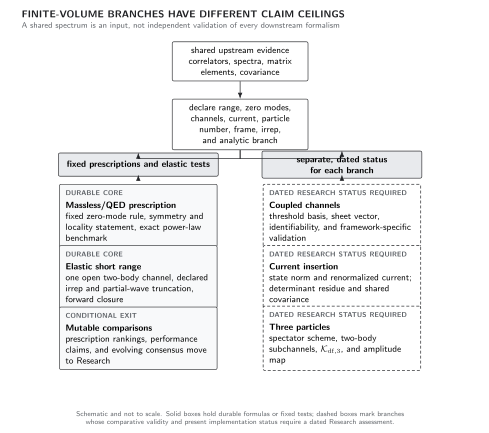
Finite-volume branches have different limits of interpretation. A fixed massless-field prescription and an exact power-law test are durable; mutable prescription comparisons may move to Research. Coupled-channel, current-insertion, and three-particle claims require separate dated status and validation. The map is schematic and not to scale.
Observable-level validation
Section titled “Observable-level validation”The three-particle row of the finite-volume hypothesis and uncertainty table distinguishes formalism-dependent kernels and regulators from the physical amplitude and its independent validation tests.
Before accepting a three-body quantity, verify that:
- the declared formalism’s particle content, rule, two-body pole treatment, energy domain, spectator cutoff, and partial-wave truncation all apply;
- free energies, symmetrized multiplicities, and irrep projections are exact;
- the same reproduces the two-body spectrum and is propagated with covariance into the three-body fit;
- a weak-coupling, threshold, bound-state, or synthetic benchmark is reproduced before physical inference;
- cutoff and subtraction changes move but cancel in held-out spectra and the matched ; and
- a decay claim includes a separate current residue, normalization, and renormalization check rather than borrowing the two-body factor.
What you can now do
Section titled “What you can now do”You can now (1) identify the spectator, pair subchannel, symmetrization, , , and every scheme-dependent object in one relativistic three-body condition, and (2) demand a free, weak-coupling, threshold, bound-state, or synthetic closure plus scheme cancellation before inferring a physical three-body amplitude.
General three-body dynamics and universality remain with Gauge Theories and the Standard Model, and infinite-volume amplitude analyticity remains with Scattering. Framework equivalence and current application status belong to the Lattice and Hamiltonian Field Theory Research area.
Exercises
Section titled “Exercises”1. Scheme dependence. Two schemes give . What equality should be tested?
Solution
After using each kernel with its own , cutoff, subtraction, and matching integral equations, the predicted finite-volume energies and physical must agree within truncation and numerical uncertainty. Equality of the intermediate kernels is neither required nor generally expected.
2. Count a free level. At , take the momentum triple with . What is its free energy?
Solution
. Permutations do not produce new states before symmetrization; the momentum orbit must then be decomposed into cubic irreps with the correct multiplicity.
References
Section titled “References”- Briceño, Raúl A., Maxwell T. Hansen, and Stephen R. Sharpe. “Relating the Finite-Volume Spectrum and the Two-and-Three-Particle Matrix for Relativistic Systems of Identical Scalar Particles.” Physical Review D 95 (2017): 074510. DOI. Open PDF.
- Hansen, Maxwell T., and Stephen R. Sharpe. “A Relativistic, Model-Independent, Three-Particle Quantization Condition.” Physical Review D 90 (2014): 116003. DOI. Open PDF.
- Hansen, Maxwell T., and Stephen R. Sharpe. “Expressing the Three-Particle Finite-Volume Spectrum in Terms of the Three-to-Three Scattering Amplitude.” Physical Review D 92 (2015): 114509. DOI. Open PDF.