

Wilson and Clover Fermions
Wilson fermions lift the naive doublers by adding a momentum-dependent scalar term that is negligible for the physical branch but of order at every other Brillouin-zone corner. The price is explicit chiral-symmetry breaking at nonzero lattice spacing, hence additive mass renormalization and a critical-mass tuning. Clover improvement cancels the leading on-shell linear artifacts only after its coefficient and the relevant operators are improved; twisted mass can protect a two-flavor determinant and gives automatic improvement for specified observables at correctly tuned maximal twist, while breaking flavor and parity at finite .
Required background. Naive Fermions and Species Doubling supplies the corner linearization that the Wilson term modifies.
Helpful background. The Nielsen–Ninomiya Obstruction identifies the chiral hypothesis being relaxed. Lattice Perturbation Theory, Symanzik Analysis, and Improvement supplies the effective-action logic behind improvement.
The Wilson term separates the corner masses
Section titled “The Wilson term separates the corner masses”Local regulator and convention card. We use a four-dimensional Euclidean hypercubic lattice with spacing , Hermitian , , Wilson parameter , and link variables in the fermion representation. The forward and backward covariant differences are and ; is the bare mass, and the subtracted mass is defined only after the critical point is found. The free benchmark takes , , and periodic boundaries. These choices extend the global conventions.
Define
The Wilson–Dirac operator Wilson 1977, pp. 69–142 is
Its free symbol is
Near the origin the last term is , an irrelevant correction. At a corner with components equal to , however, it is . The sixteen naive branches therefore have the exact free corner masses
| Number of components | Multiplicity | Effective mass |
|---|---|---|
| 0 | 1 | |
| 1 | 4 | |
| 2 | 6 | |
| 3 | 4 | |
| 4 | 1 |
For and fixed positive , only the origin remains light as . The binomial degeneracies and mass gaps are an exact benchmark for any free Wilson implementation.
The same scalar term is responsible for the cost. At ,
which is nonzero at finite . This is the declared change to the no-go assumptions. It permits all chirality-breaking operators allowed by the remaining symmetries, including an additive shift of the mass.
Critical mass and gamma-five Hermiticity
Section titled “Critical mass and gamma-five Hermiticity”In a gauge background at zero chemical potential,
Thus is Hermitian and is real. Reality alone is not positivity for one flavor; the determinant conditions are treated separately on Fermion Determinants, Pfaffians, and Measure Positivity.
Because chiral symmetry no longer pins zero bare mass, the renormalized light-fermion point lies at an interaction-dependent . A practical tuning condition uses the nonsinglet partially conserved axial current (PCAC) mass,
with the discretized current, source, time window, boundary conditions, and renormalization prescription declared. The critical mass is found by interpolating to zero at fixed gauge coupling and volume, then controlling the volume and spacing dependence. A vanishing bare is not the tuning condition.
Near criticality, isolated real modes of can produce very small eigenvalues and unstable propagators, historically called exceptional configurations. A solver that converges on typical configurations does not show that these spectral tails are controlled.
Clover improvement applies on shell
Section titled “Clover improvement applies on shell”The leading dimension-five fermion operator in the Symanzik description can be canceled on shell by the Sheikholeslami–Wohlert, or clover, term Sheikholeslami and Wohlert 1985, pp. 572–596:
Here is the Hermitian clover average defined with the page’s link orientation. A source that uses anti-Hermitian gauge fields moves the displayed factor of ; the invariant check is gamma-five Hermiticity and the resulting on-shell scaling, not the isolated sign in this convention.
Improvement requires more than adding this term:
- tune to the chosen critical-mass condition;
- determine in a stated scheme, perturbatively or nonperturbatively;
- improve and renormalize the composite current or operator, for example ;
- keep physical masses and volume matched while varying ; and
- show that a held-out on-shell observable loses its linear- term within uncertainty.
Off-shell Green functions, boundary counterterms, heavy-quark regimes with , and unimproved operators can retain effects. Clover improvement is therefore an observable-level statement with hypotheses, not a property conferred on all data by one action coefficient.
Twisted mass within the Wilson family
Section titled “Twisted mass within the Wilson family”For a mass-degenerate flavor doublet, the twisted-mass operator may be written
It obeys . At , the physical mass is set by the renormalized twisted mass and the theory is at maximal twist. For the degenerate pair,
when denotes the full two-flavor block; in particular, nonzero protects the two-flavor weight from a zero eigenvalue.
At correctly tuned maximal twist, parity-even on-shell physical observables are automatically free of linear- artifacts under the symmetry and mass-regime hypotheses of the improvement theorem Frezzotti and Rossi 2004, §§2–4. This does not mean the finite-spacing action has exact parity or full isospin: the twist singles out , so charged–neutral splittings and parity mixing are direct cutoff diagnostics. Automatic improvement can also fail when the critical mass is mistuned or the small-mass power counting leaves the theorem’s regime.
The formulation map below locates the Wilson family among alternatives without turning the comparison into a ranking. Follow its branch to the critical-mass, improvement, spectral, and Ward-identity tests; the other branches retain different finite-spacing obligations.
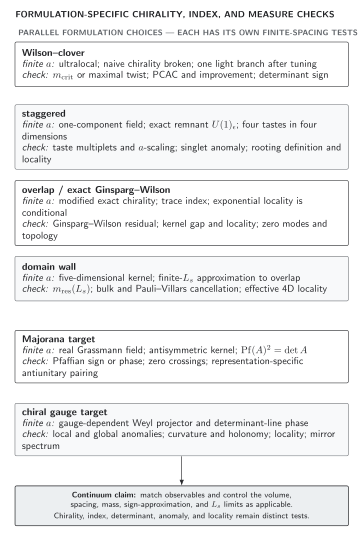
Lattice-fermion formulations trade different finite-regulator structures. Wilson methods require tuning and improvement; staggered methods require taste restoration and a separately qualified rooting step; exact Ginsparg–Wilson and overlap methods require locality and index checks; finite- domain-wall methods add a residual-mass test; Majorana and chiral-gauge targets add Pfaffian or Weyl-measure phases. The map is schematic, not to scale, and does not rank cost or accuracy.
Specifying a Wilson-fermion calculation
Section titled “Specifying a Wilson-fermion calculation”The Wilson and twisted-mass rows of the fermion-formulation comparison table collect the mass-tuning, improvement, determinant, and symmetry tests that qualify a finite-spacing result.
Before using a Wilson-family continuum result, require this sequence:
Observable-level validation checklist.
- Spectrum: reproduce the free corner masses and verify gamma-five Hermiticity to numerical tolerance.
- Tuning: report , the interpolation to , and the stability against fit window and volume.
- Improvement: state , every improved operator coefficient, and whether the claim is on shell; at maximal twist also report the twist-angle condition.
- Finite-spacing breaking: measure a chiral Ward residual and, for twisted mass, at least one parity- or flavor-breaking splitting.
- Observable scaling: extrapolate a dimensionless spectral quantity, such as , using enough spacings to distinguish from behavior.
- Independent comparison: match a chirally symmetric formulation or a second Ward identity at common renormalized parameters.
Adversarial failure. A clover calculation at one lattice spacing may show a small PCAC mass and a stable hadron plateau. It still cannot demonstrate improvement: the critical mass could be mistuned, the interpolating current could be unimproved, and no spacing dependence has been observed. The stop rule is simple—do not label the result improved until a matched continuum sequence tests the predicted leading power.
You should now be able to (1) derive the Wilson corner-mass pattern and identify the explicit finite-spacing chiral breaking of the physical branch and (2) specify the critical-mass or maximal-twist tuning, improvement coefficients, flavor/parity diagnostics, Ward checks, and continuum evidence required for a Wilson-family observable.
Exercises
Section titled “Exercises”Recover the corner spectrum
Section titled “Recover the corner spectrum”For and , show that the determinant of the free operator near a corner with edge components describes a Dirac mode of mass .
Solution
Write . The sine term becomes , while each edge component contributes and each origin component contributes . Hence , which has the stated relativistic mass.
Separate reality from positivity
Section titled “Separate reality from positivity”Use to show that is real. Why does this not prove that one Wilson flavor has a nonnegative determinant?
Solution
Taking determinants gives . A real number may still be negative. Unpaired real eigenvalues can change the sign when they cross zero; squaring the determinant for two exactly degenerate flavors removes that sign but changes the flavor content.
Precise continuations
Section titled “Precise continuations”Anomalies, Ward Identities, and Chiral Diagnostics develops the PCAC residual, improvement, and continuum triangulation. Fermion Determinants, Pfaffians, and Measure Positivity proves the flavor-dependent measure statements. Solver performance and pseudofermion implementation belong to Pseudofermions, Determinant Ratios, and Solver Bias.
References
Section titled “References”- Frezzotti, Roberto, and Giancarlo C. Rossi. “Chirally Improving Wilson Fermions. I. Improvement.” Journal of High Energy Physics 08 (2004): 007. DOI. Open PDF.
- Sheikholeslami, Bijan, and Rainer Wohlert. “Improved Continuum Limit Lattice Action for QCD with Wilson Fermions.” Nuclear Physics B 259 (1985): 572–596. DOI.
- Wilson, Kenneth G. “Quarks and Strings on a Lattice.” In New Phenomena in Subnuclear Physics, Part A, edited by Antonino Zichichi, 69–142. New York: Plenum Press, 1977. DOI.