

Ginsparg–Wilson Symmetry and the Lattice Index
The Ginsparg–Wilson relation replaces naive anticommutation with a finite-spacing contact term. That change permits an exact modified chiral transformation, a nontrivial Grassmann-measure Jacobian, and an integer index on a finite lattice without reintroducing naive doublers. These algebraic statements support the intended continuum anomaly only when the operator is also gauge covariant and exponentially local in the gauge backgrounds being used.
Required background. The Nielsen–Ninomiya Obstruction supplies the naive chiral hypothesis that the Ginsparg–Wilson relation changes.
Helpful background. Fredholm and Dirac Index Theorems and Zero-Mode Counting supplies the rigorous index setting. Regulated Jacobians and Measure Variation supplies the continuum measure argument to which the finite lattice Jacobian is compared.
A modified exact chiral relation
Section titled “A modified exact chiral relation”Local regulator and convention card. We use a finite four-dimensional Euclidean lattice and a gauge-covariant Dirac matrix satisfying . The positive length fixes the normalization of the Ginsparg–Wilson contact term; for the standard overlap operator below, . Traces denoted include sites, spin, color, and flavor when present, while is local. The index sign is for zero modes with . These choices extend the global conventions.
The defining relation is
It reduces to continuum anticommutation on fixed physical momenta as , but it is not the naive relation at finite spacing. Ginsparg and Wilson obtained this structure from a renormalization-group blocking condition Ginsparg and Wilson 1982, pp. 2649–2657.
For the massless action , consider Lüscher’s infinitesimal transformation Lüscher 1998, Eqs. (4)–(7):
Its variation is exactly
This is an exact finite-dimensional identity, not an asymptotic restoration claim. A symmetric transformation can be written by distributing the contact factor between and ; observables and the index are unchanged when the convention is translated consistently.
The Jacobian and finite-spacing index
Section titled “The Jacobian and finite-spacing index”Define
Gamma-five Hermiticity and the Ginsparg–Wilson relation imply
The finite Grassmann measure transforms inversely to the fermion basis. Since on the unprojected finite lattice,
where
The last equality follows by decomposing the spectrum. Zero modes are eigenstates of and contribute their chirality. Modes at contribute the compensating trace required by , while complex modes pair so that their net contribution vanishes. Hasenfratz, Laliena, and Niedermayer exhibited the corresponding finite-cutoff index relation for fixed-point operators Hasenfratz, Laliena, and Niedermayer 1998, pp. 125–131.
An exact two-state algebra fixture
Section titled “An exact two-state algebra fixture”Take
Both sides of the Ginsparg–Wilson relation equal , and
This fixture checks the algebra and normalization exactly. It is not a local lattice field theory: it has no position-space decay, gauge covariance, or continuum limit. Passing it cannot replace locality and physics tests.
The spectral circle and locality requirement
Section titled “The spectral circle and locality requirement”For a normal gamma-five-Hermitian solution, an eigenvalue obeys
so the spectrum lies on the circle
The real intersections are and . This circle is a sharp numerical diagnostic, but it is algebraic: a nonlocal matrix can lie on it. A physical construction must additionally show
with a localization length that remains controlled over the gauge ensemble and regulator sequence. Smoothness or admissibility conditions used in a proof must be stated, not inferred from a small Ginsparg–Wilson residual.
The corner-charge map shows what the modified chiral relation changes. Follow the Ginsparg–Wilson branch from the vanishing net charge of a smooth periodic naive symbol to the modified algebra, then keep the separate locality and measure conditions visible.
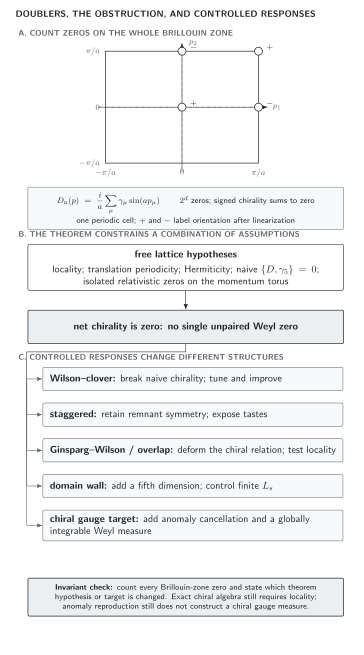
The two-dimensional free symbol has four zeros with charges , so the signed sum vanishes. Wilson, staggered, Ginsparg–Wilson, and domain-wall formulations alter different finite-regulator premises; a chiral-gauge target additionally requires anomaly cancellation and a globally integrable Weyl measure. The diagram is schematic and is not a cost or accuracy ranking.
Formulation, chirality, and index map
Section titled “Formulation, chirality, and index map”The figure shows how the principal formulation families connect finite-spacing chirality to the observable that must certify it. Follow each branch to its own failure test; no branch inherits the validation of another.
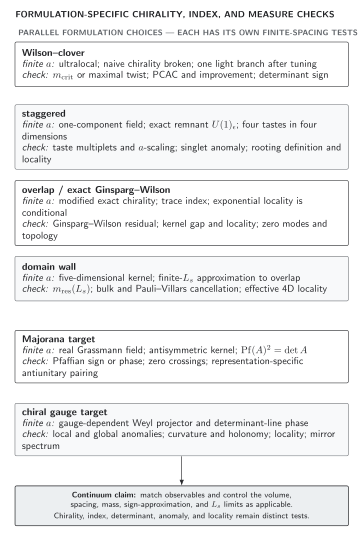
Lattice-fermion formulations trade different finite-regulator structures. Wilson methods require tuning and improvement; staggered methods require taste restoration and a separately qualified rooting step; exact Ginsparg–Wilson and overlap methods require locality and index checks; finite- domain-wall methods add a residual-mass test; Majorana and chiral-gauge targets add Pfaffian or Weyl-measure phases. The map is schematic, not to scale, and does not rank cost or accuracy.
The semantic table below is the structured equivalent of the map. “Not intrinsic” means that the listed issue is not created by that formulation; it does not mean that an interacting application can ignore it.
Table: finite-regulator tradeoffs and decisive tests.
| Formulation | Locality range | Finite- chirality and content | Residual mass, taste, and rooting | Index and anomaly diagnostic | Determinant or Pfaffian issue | Required control and evidence boundary |
|---|---|---|---|---|---|---|
| Naive | Nearest neighbor | ; sixteen species in four dimensions | No residual mass; species are not reconstructed tastes; no rooting | Corner charges cancel | Gamma-five Hermiticity makes the determinant real; positivity remains flavor dependent | Durable free benchmark; full-zone zero count must fail any one-species claim |
| Wilson–clover | Ultralocal stencil | Naive chirality broken; one light branch after mass tuning | No taste or rooting; residual breaking is monitored by Ward identities, not called | No exact Ginsparg–Wilson index; spectral flow and continuum topology need matching | One-flavor sign can occur; a degenerate pair is nonnegative | Durable method conditional on critical-mass tuning, operator improvement, and continuum scaling |
| Twisted-mass Wilson | Ultralocal stencil | Wilson breaking plus finite- parity and flavor breaking | No taste or rooting; tune maximal twist | Continuum index/anomaly tests plus twist Ward identities | Degenerate doublet has a protected nonnegative weight at nonzero twisted mass | Durable within stated automatic- hypotheses; measure flavor/parity splittings |
| Staggered | Nearest-neighbor one-component stencil | Exact ; four continuum tastes in four dimensions | Measure taste splittings; rooting uses power and is a conditional continuum operation | Taste-singlet anomaly must emerge while the protected nonsinglet channel stays distinct | At positive mass and zero chemical potential the unrooted determinant is nonnegative; a root fixes flavor power but adds locality questions | Durable formulation; rooting conclusions require taste restoration, locality, limit order, and cross-formulation agreement |
| Exact Ginsparg–Wilson class | Generally exponential, not ultralocal | Exact modified symmetry; no intrinsic taste multiplicity | No residual mass for an exact solution; no rooting intrinsic to the class | Exact trace index and measure Jacobian | Gamma-five Hermiticity gives a real vectorlike determinant; zero modes and flavor powers remain explicit | Durable algebra only after exponential locality, gauge covariance, normalization, and continuum checks |
| Overlap | Exponential under a controlled kernel gap or admissibility condition | Exact Ginsparg–Wilson symmetry for an exact sign function | No taste or rooting; sign approximation produces a measurable Ginsparg–Wilson residual | Exact index from kernel spectral flow | Vectorlike determinant properties depend on mass and flavor; topology crossings affect phase and algorithms | Durable vectorlike method with kernel-gap, locality-envelope, sign-tolerance, and topology tests |
| Domain wall at finite | Five-dimensional ultralocal kernel; effective four-dimensional range must be measured | Boundary modes approximate modified chirality | Report and dependence; no taste or rooting intrinsic | Approaches overlap index and anomaly as the sign approximation converges | Pauli–Villars cancellation and the target determinant phase must be checked | Durable vectorlike method when bulk cancellation, residual mass, locality, and behavior are controlled |
| Majorana | Inherits the chosen kernel’s range | Chiral properties depend on that kernel and representation | Taste, rooting, and residual mass are formulation dependent, not automatic | Index constraints depend on dimension and reality structure | The measure is ; its sign or phase is not fixed by | Durable algebra in declared representations; every sign claim needs eigenvalue or phase tracking |
| Chiral gauge | Target operator and measure must both be local | Weyl projectors can use ; mirror content must be absent or gapped | Residual mass, taste, or rooting are strategy specific and must be reported when present | Local and global anomaly cancellation plus measure curvature and holonomy | The Weyl-measure phase is physical data, not a nuisance to discard | Established special and perturbative constructions are bounded; general nonperturbative status is research-sensitive and belongs to the dated Research guide |
Validation and failure modes
Section titled “Validation and failure modes”For a claimed Ginsparg–Wilson realization, report:
Observable-level validation checklist.
- the exact normalization and the operator norm of ;
- gamma-five Hermiticity and the distance of every eigenvalue from the spectral circle;
- the trace index, the chiralities of exact zero modes, and their agreement with an independently defined smooth-background charge;
- a position-space locality envelope versus taxi-cab distance and its stability with volume and gauge roughness;
- the measure Jacobian in a controlled axial transformation or its Ward-identity consequence; and
- a matched continuum observable, since an exact regulator identity is not itself a continuum-QFT result.
Adversarial failure. Construct by diagonalizing the whole lattice and imposing the spectral circle eigenvalue by eigenvalue. The Ginsparg–Wilson residual and trace index can be exact while has order-one long-range matrix elements. The algebra passes and the locality contract fails; no local continuum claim follows.
You should now be able to (1) verify the modified chiral transformation and derive its finite Grassmann Jacobian and (2) connect the trace index to zero modes while stating the locality, gauge-background, normalization, and continuum assumptions that make it physically useful.
Exercises
Section titled “Exercises”Prove that the modified chirality operator squares to one
Section titled “Prove that the modified chirality operator squares to one”Starting from gamma-five Hermiticity and the Ginsparg–Wilson relation, show that .
Solution
Multiply the Ginsparg–Wilson relation on the left by to obtain . Then
Derive the spectral circle
Section titled “Derive the spectral circle”Let for a normalized eigenvector of a normal Ginsparg–Wilson operator. Derive the circle equation.
Solution
Take the expectation value of . Normality lets the same eigenvector diagonalize , giving . Completing the square yields .
Precise continuations
Section titled “Precise continuations”Overlap and Domain-Wall Fermions constructs concrete sign-function and fifth-dimensional realizations. Anomalies, Ward Identities, and Chiral Diagnostics turns the Jacobian and index into interacting tests. Chiral Gauge Theories on the Lattice adds the globally integrable Weyl measure. The theorem-level locality and construction boundary belongs to Chiral Gauge Theories and Standard Model Construction.
References
Section titled “References”- Ginsparg, Paul H., and Kenneth G. Wilson. “A Remnant of Chiral Symmetry on the Lattice.” Physical Review D 25 (1982): 2649–2657. DOI.
- Hasenfratz, Peter, Victor Laliena, and Ferenc Niedermayer. “The Index Theorem in QCD with a Finite Cut-Off.” Physics Letters B 427 (1998): 125–131. DOI. Open PDF.
- Lüscher, Martin. “Exact Chiral Symmetry on the Lattice and the Ginsparg–Wilson Relation.” Physics Letters B 428 (1998): 342–345. DOI. Open PDF.