

Enforcing Gauge Symmetry and Constraints
Gauge constraints are part of the regulated theory, not optional error indicators. A quantum simulation must either encode only physical states or impose and monitor the local Gauss operators throughout preparation, evolution, and measurement. Exact preservation, energetic suppression, projection, and postselection have different correctness statements; none may be inferred from a small final violation alone.
Required background. Encoding fields and truncating local Hilbert spaces supplies the finite gauge-link map. Lattice gauge Hamiltonians and Gauss’s law supplies oriented electric fields, charges, and the physical Hilbert space.
Helpful background. Physical gauge Hilbert spaces and constraint enforcement supplies reduced and redundant formulations of the same sector.
The physical sector
Section titled “The physical sector”Convention and regulator card. At fixed lattice, link truncation, boundary condition, and external-charge sector, let Hermitian generators define the physical subspace by . For nonzero prescribed boundary charge, replace zero by the declared eigenvalue. The leakage metric is evaluated before any postselection unless explicitly labeled conditional.
For commuting Abelian constraints, the projector is
For a compact non-Abelian group, the corresponding Haar average projects onto invariant states. An exact physical-space encoding builds a basis for and eliminates redundant states. A redundant encoding retains the full tensor product and requires the encoded Hamiltonian and gates to obey
on the represented algebra. The Hamiltonian lattice construction that motivates this condition is the Kogut–Susskind formulation Kogut and Susskind 1975.
A basis reduction can lower qubit count but may create nonlocal interactions or complicate boundaries. A redundant encoding can preserve geometric locality but spends resources on unphysical states. These are calculable tradeoffs, not a universal ranking.
Four enforcement mechanisms
Section titled “Four enforcement mechanisms”Invariant construction. Prepare and compile every primitive from gauge-invariant operators. If the algebra is represented exactly, physicality follows without a penalty scale. One must still test compilation error and the truncated link algebra.
Energy penalty. Use
For an error term , a gap of order can suppress transitions between sectors when is small and resonances are absent. This is perturbative protection, not exact restoration. Specialized single-body protection schemes can yield stronger bounds under explicit compliant-error hypotheses Halimeh et al. 2021.
Checks and correction. Ancillary tests oracles can flag constraint violations, permitting rejection or active correction. Stryker’s Gauss-law oracles make the logical predicate explicit for digital encodings Stryker 2019. Detection fidelity, correction action, and extra evolution must enter the error model.
Postselection or projection. Conditional estimates use
The estimator is meaningful for a gauge-invariant , but its variance grows as successful samples become rare. If noise within the physical sector is correlated with leakage, the conditional state need not equal the noiseless target. Therefore postselection removes detected unphysical support; it does not certify the remaining dynamics.
Constraint preservation in the full flow
Section titled “Constraint preservation in the full flow”The shared diagram places the constraint test before and after evolution. Inspect the dashed feedback: a small final Gauss residual must be paired with preparation, intermediate-time, and observable checks.
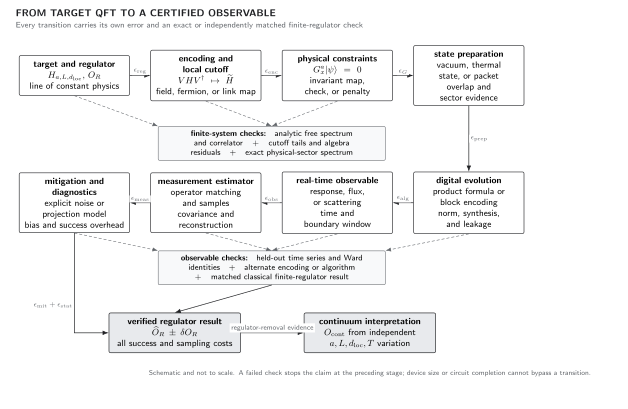
The physical-sector link in the simulation chain. Exact invariant encodings, symmetry-preserving gates, penalties, checks, and postselection provide different guarantees. The schematic map requires a leakage or projector diagnostic at the state and evolution stages and an independent exact-sector observable check.
The chapter-wide accuracy and resource comparison keeps the constraint method and its success overhead beside the claimed observable.
Analytic benchmark: one Abelian vertex
Section titled “Analytic benchmark: one Abelian vertex”Consider one oriented vertex with incoming electric flux , outgoing flux , and integer matter charge . With
the computational basis state is physical exactly when . For the equal superposition
one has and . This gives a calibration fixture for leakage measurement and postselection probability.
Now let commute with , start physical, and add . At short time,
so leakage probability begins as . A measured linear-in- leakage probability indicates preparation, measurement, or nonunitary effects not described by this coherent-error model.
Adversarial failures
Section titled “Adversarial failures”Large penalty, wrong low-energy theory. If the link truncation changes commutators or the penalty does not commute with desired boundary charges, increasing can freeze incorrect dynamics. Compare physical-sector spectra and matrix elements, not only .
Final-time cancellation. Coherent leakage can leave and re-enter the physical sector, giving a small final residual while corrupting phases. Measure several times or insert nondestructive checks where the protocol permits.
Postselection hides bias. Discarding violations changes the ensemble and can amplify rare, noise-correlated histories. Report acceptance, conditional variance, and a noise model; compare with an exactly invariant compilation.
Constraint without observable invariance. A measurement operator that fails to commute with the generators can create or probe unphysical components even when the state is physical. Test in the encoded algebra.
Observable-level validation checklist
Section titled “Observable-level validation checklist”- State every generator, orientation, boundary charge, representation cutoff, and physical-sector eigenvalue.
- Verify the encoded constraint algebra and or quantify its residual.
- Measure preparation leakage, intermediate-time leakage, final leakage, and postselection success separately.
- Reproduce an exact physical-sector spectrum and one gauge-invariant matrix element on a small lattice.
- Vary penalty strength, check frequency, link cutoff, and compilation precision independently.
- Report whether the observable is unconditional, projected, or postselected and include the resulting bias and sampling overhead.
Exercises
Section titled “Exercises”1. Projection of the vertex state
Section titled “1. Projection of the vertex state”For the benchmark state above, compute the normalized postselected state and the variance overhead for estimating a bounded observable from accepted samples.
Solution
, so the normalized conditional state is . Only a fraction of shots survives. For fixed accepted-sample precision, the raw shot count grows by , before any additional reweighting or noise correlation.
2. A symmetry-preserving product formula
Section titled “2. A symmetry-preserving product formula”If and , show that the first-order product formula preserves the physical sector exactly for any step size.
Solution
Each exponential commutes with , so commutes with . Its repeated product maps every eigenspace of to itself even though it has ordinary Trotter error relative to .
Learning outcomes
Section titled “Learning outcomes”After working this page, you should be able to:
- Construct either an exact physical-space encoding or a redundant constraint layer and state which algebraic relations, sectors, and boundaries it preserves.
- Given leakage and postselection data, distinguish symmetry preservation, energetic suppression, detected leakage removal, postselection bias, and correctness of the remaining physical dynamics.
Related topics
Section titled “Related topics”Digital Hamiltonian simulation and algorithmic error shows how to keep these commutators visible during compilation. Preparing interacting QFT states incorporates sector fidelity into state preparation.
References
Section titled “References”- Halimeh, Jad C., Haifeng Lang, Julius Mildenberger, Zhang Jiang, and Philipp Hauke. “Gauge-Symmetry Protection Using Single-Body Terms.” PRX Quantum 2 (2021): 040311. doi:10.1103/PRXQuantum.2.040311.
- Kogut, John, and Leonard Susskind. “Hamiltonian Formulation of Wilson’s Lattice Gauge Theories.” Physical Review D 11 (1975): 395–408. doi:10.1103/PhysRevD.11.395.
- Stryker, Jesse R. “Oracles for Gauss’s Law on Digital Quantum Computers.” Physical Review A 99 (2019): 042301. doi:10.1103/PhysRevA.99.042301.