

Statistics, Occupation Algebra, and Anyons
The field operators introduced so far were bosonic: their creation operators commute, so multiparticle wavefunctions are symmetric. That is not a small technical choice. The sign or phase acquired when identical particles are exchanged is part of the quantum definition of the particles.
For bosons, arbitrarily many quanta may occupy the same one-particle state. For fermions, the algebra itself enforces the Pauli exclusion principle: a single mode has only two states, empty and occupied. In the plane, particle worldlines can braid around each other, and an exchange may carry a phase that is neither nor . This is abelian anyon statistics.
The aim of this page is to connect exchange symmetry of wavefunctions, occupation algebra, and the topology of particle paths. The exchange argument fixes identical point particles in Euclidean , excludes collisions, and first considers scalar exchange sectors, in which each exchange acts by a phase. This nonrelativistic argument does not derive the relativistic spin–statistics theorem. Under its assumptions on local relativistic fields, that theorem connects integer spin to Bose statistics and half-integer spin to Fermi statistics; its treatment belongs to the later Dirac-field and Lorentz-group lessons. See Srednicki 2006, § 4, pp. 45–48 (author manuscript, PDF).
Exchange symmetry and operator algebra
Section titled “Exchange symmetry and operator algebra”For two identical particles, the labels and are bookkeeping devices, not physical labels. If a two-particle wavefunction is written as , then exchanging the arguments must give an equivalent state. In the scalar exchange sectors considered here, the two possibilities in three-dimensional Euclidean space are
for bosons and
for fermions. More generally, for identical particles, a permutation acts by
For bosons, . For fermions,
In the operator language, these two choices become two different algebras. A bosonic mode is created and destroyed by and with
A fermionic mode is created and destroyed by and with
Here
The commutator says that two bosonic creation operators may pass through each other without changing the state. The anticommutator says that two fermionic creation operators pick up a minus sign when interchanged:
This is why the algebra is more fundamental than the notation. Once the algebra is chosen, the symmetry or antisymmetry of all multiparticle states follows automatically.
Bosonic occupation numbers
Section titled “Bosonic occupation numbers”For one bosonic oscillator, the algebra is
Let be the normalized vacuum of this mode,
The normalized -particle state is
The ladder operators act as
The number operator
satisfies
The square roots are not arbitrary normalization decorations. They are forced by the commutation relation. For example,
Similarly,
so
Bosonic occupation is unbounded:
This unbounded ladder permits macroscopic occupation of a single mode. For , the adjacent ladder coefficients satisfy , but this does not by itself justify replacing the operators by a classical amplitude. In a number state, orthogonality gives , whereas ; no single complex amplitude reproduces both moments. A classical field approximation needs additional assumptions about the state and its fluctuations, as explained in the coherent and selected-phase descriptions of the preceding lesson.
The fermionic oscillator
Section titled “The fermionic oscillator”For one fermionic mode, the algebra is
The last two equations imply
With a normalized vacuum
there is only one nonzero excited state,
Trying to create a second particle in the same mode gives
This is the Pauli exclusion principle in its most economical form. It is not added after quantization; it is contained in the algebra.
The annihilation operator obeys
The number operator
has eigenvalues only and :
One also finds
Thus is a projection operator. A fermionic mode is either empty or occupied; there is no intermediate occupation number and no double occupation.
In the ordered basis , one convenient matrix representation is
These matrices obey and exactly.
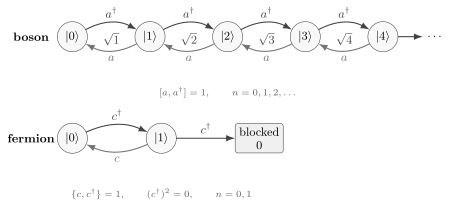
A bosonic mode has an infinite occupation-number ladder, with . A fermionic mode has only two states: and . The algebra blocks the next rung.
Many fermionic modes
Section titled “Many fermionic modes”For many fermionic modes, the anticommutation relations are
Here may be discrete labels, such as momenta in a finite box. An ordered -fermion state is
Interchanging two creation operators changes the sign:
If two labels coincide, the state vanishes. For example,
The annihilation operator removes a matching particle and produces a sign determined by how many fermionic operators it must pass. Acting on an ordered state,
The hat means that the entry is omitted. For instance,
This formula is the many-mode form of Pauli exclusion and antisymmetry. It is also the first place where fermionic signs become unavoidable in calculations. Later, the same bookkeeping will appear as the minus signs attached to fermion exchanges and closed fermion loops in Feynman diagrams.
The fermionic number operator for mode is
and the total number operator is
Each has eigenvalues and . The total particle number is still an integer, but it is now a sum of binary occupation numbers.
A q-oscillator toy model
Section titled “A q-oscillator toy model”A useful algebraic toy model interpolates between the bosonic and fermionic ladder formulas:
For the Hilbert-space derivation, first take to be real and let be the Hermitian adjoint of . Then squared ladder coefficients must be real and nonnegative. The complex root-of-unity continuation considered below is a formal algebraic observation, not a positive-norm Fock representation of this same -algebra.
Assume a vacuum
and define normalized states so that
Let
Then
where because . Acting with the deformed algebra on gives
Therefore
and in general
when . It is common to write this as a -number,
For real , all these coefficients are positive and the ladder is infinite. At the first attempted second-occupation coefficient vanishes. For , already , so the assumed positive-norm representation fails.
The two familiar cases are recovered immediately.
For ,
so
This is the ordinary bosonic oscillator.
For ,
Thus
The ladder truncates after one particle, as in the fermionic oscillator. This reproduces the occupation rule of a single fermionic mode; it does not by itself impose anticommutation relations between distinct modes.
A particularly suggestive choice is
For this is complex. Formally continuing the polynomial -number gives
At the level of the formal recurrence, this would terminate the ladder at and resembles a generalized exclusion rule. It cannot be read as while the earlier coefficients are complex: a squared norm cannot be complex.
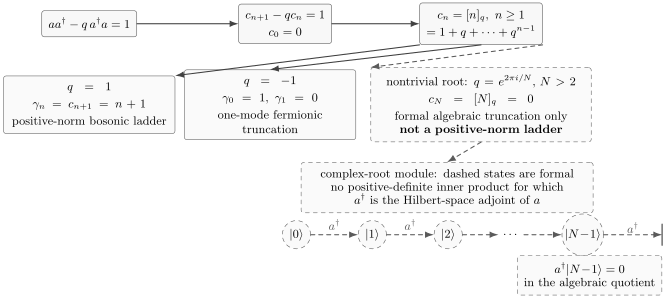
For real , the deformed algebra gives the recurrence , hence . The bosonic limit is . The one-mode fermionic occupation rule appears at . A nonreal root of unity gives only a formal truncated recurrence, not a realization of this relation with the creation symbol identified as the involutive adjoint.
This calculation is pedagogically useful, but it needs a warning. The algebra above is not, by itself, the full physical theory of anyons. Indeed, taking the adjoint of
replaces by . If both equations are to hold with the ordinary adjoint on a nontrivial positive Hilbert space, must be real. For nonreal , a construction must modify this relation or the identification of the creation symbol with the involutive adjoint; an indefinite inner product alone cannot make the stated algebra consistent. Indeed, subtracting the adjoint relation gives , hence ; associativity then gives , contradicting . This argument does not use positivity; for unbounded operators, assume a nonzero common invariant domain on which these products and relations hold. Even when a root of unity produces a formal exclusion rule, that rule is not the same thing as a braid-group exchange phase. Genuine anyonic statistics is best understood from the topology of particle exchange in two spatial dimensions, not merely from replacing a commutator by a -commutator.
Anyons and braid statistics
Section titled “Anyons and braid statistics”Fix identical point particles in Euclidean with distinct positions. The ordered configuration space is , where is the set on which at least two positions coincide. Identifying configurations related by a permutation gives the unordered space . An exchange history is a loop in this unordered space. Its class records which deformations into other exchange histories are possible without collisions. Loop classes compose to form the fundamental group; a scalar exchange sector assigns each class a phase through a one-dimensional unitary representation.
For , the ordered space is simply connected: every loop of labeled configurations can be contracted without collisions. The geometric reason is that a contraction sweeps a two-dimensional disk, whereas each coincidence condition imposes independent constraints; for the disk can be displaced to avoid all coincidence sets. Now lift an unordered exchange loop by following labels along the paths. Its final labels differ from the initial ones by a permutation. Every permutation can occur, and histories with the same final permutation differ by a contractible loop in the ordered space. Thus the unordered loop classes are exactly . This is the configuration-space argument of Laidlaw and DeWitt 1971, pp. 1377–1378 (PDF).
The elementary transposition , which swaps labels and , therefore obeys
A one-dimensional unitary representation therefore sends
so
All transpositions are conjugate in , so a scalar representation assigns them the same sign. The two choices give Bose and Fermi statistics. This conclusion concerns one-dimensional unitary representations; the permutation group also has higher-dimensional representations, which this calculation does not exclude.
In the plane, a pair of particles has a nonzero relative position in . A full winding of that relative position around the origin cannot contract without a collision. This already distinguishes a double exchange from doing nothing. With fixed particle number, the worldlines progress forward in time and form braids: their deformation classes give . The elementary braid and its inverse describe opposite orientations of exchange. Its generators obey
but there is no relation . These are the planar braid relations; see Nayak et al. 2008, § II.A.1, manuscript pp. 3–4, Eqs. (1)–(5) (PDF). Spaces with punctures or different global topology require their own configuration-space analysis.
For scalar phases, the first braid relation makes neighboring generators have the same phase, but puts no restriction on that common phase. A one-dimensional unitary representation may therefore assign
with arbitrary real modulo . For abelian anyons, the exchange rule for two identical particles is then
for one orientation of exchange, and
for the opposite orientation. The special cases are
All other values describe abelian anyons. These are statistical factors; ordinary dynamical and other path-dependent phases are separated from them. In a nonabelian exchange sector, braiding acts by unitary matrices on a degenerate state space, and some braid operations do not commute. Matrices alone are not sufficient: for example, the two-particle group has only one generator and all its operations commute. See Nayak et al. 2008, § II.A.1, manuscript pp. 3–4 (PDF). This lesson develops only the scalar exchange phases.
Follow the two paths in the schematic below upward in time. Both exchanges have the same handedness: the right-going strand passes in front at each crossing, so the particle in front changes after the first exchange. This convention defines the chosen . The endpoints return to their original positions, but the relative position has wound once.
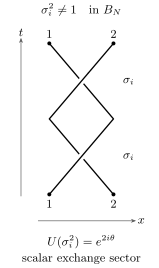
Two successive same-handed exchanges of adjacent particles in the Euclidean plane, with fixed , no collisions, and any other particles held away. Time increases upward; the gaps indicate separation in the omitted transverse spatial coordinate, not collisions. The endpoints return, but in . In a scalar sector, gives ; this factor can equal one, as for bosons and fermions, even though the braid remains nontrivial. For , the corresponding double exchange is the identity permutation. Schematic, not to scale.
There is also a field-theoretic realization of this idea. In dimensions, coupling particles to a Chern–Simons gauge field can attach flux to charge; the integrated gauge-field constraint relates the enclosed flux to the enclosed charge. See Zee 2010, 2nd ed., § VI.1, p. 317, Eqs. (1)–(3). A full winding of one charge around another then produces an Aharonov–Bohm monodromy. For identical abelian anyons, its statistical factor is the square of the elementary exchange phase: with the orientation convention above, a full winding gives and a single exchange gives . This exchange-versus-winding distinction is explained in Nayak et al. 2008, § II.A.1, manuscript p. 3 (PDF).
Relation to field operators
Section titled “Relation to field operators”For bosons and fermions, the field-operator version of the algebra is obtained by giving the mode label a continuous position or momentum value. At equal time,
for bosons, while
for fermions. The corresponding creation operators in momentum space obey
or
depending on the statistics.
The next step in the course is to diagonalize free nonrelativistic Hamiltonians in this language. For either bosons or fermions the free Hamiltonian takes the same formal shape,
but the meaning of the occupation number differs. For bosons,
while for fermions,
The same expression for therefore describes very different many-body physics. A Bose gas may form a condensate. A Fermi gas forms a filled Fermi sea. The distinction is not in the single-particle dispersion ; it is in the occupation algebra.
Summary
Section titled “Summary”The exchange statistics of identical particles is encoded algebraically by creation and annihilation operators. Bosonic operators commute, so the occupation ladder is infinite:
Fermionic operators anticommute, so a single mode has only two states:
For many fermionic modes, the sign in an annihilation formula counts how many occupied modes the annihilation operator passes through. This is the operator form of antisymmetric wavefunctions.
The deformed oscillator
leads to the recurrence
For real , it gives a compact algebraic bridge between bosonic and one-mode fermionic occupation ladders. A complex root of unity only suggests a formal generalized exclusion rule; it does not define positive norms through . The exchange argument is instead topological: for fixed identical point particles in Euclidean space with collisions excluded, the group is for and in the plane. In a scalar unitary sector, the former gives only Bose/Fermi signs, while the latter permits an arbitrary exchange phase . The q-oscillator is a useful calculation, not a substitute for braid statistics.
The key lesson is that the same free-particle energy spectrum can lead to radically different many-body physics depending on the algebra of the creation operators. Statistics is not decoration; it is part of the definition of the quantum field.
Common pitfalls
Section titled “Common pitfalls”-
Treating particle labels as physical distinctions. Artificial labels such as and can track paths in the ordered configuration space. They do not make identical particles distinct physical species or turn a label into an observable.
-
Deriving Pauli exclusion from repulsion. Pauli exclusion is not a short-range force. It follows from .
-
Forgetting fermionic signs or contact terms. Interchanging two creation operators, two annihilation operators, or an annihilator and a creator of distinct modes introduces a minus sign. Moving an annihilator past a creator also requires the contact term: .
-
Confusing the q-oscillator with physical anyons. The deformed oscillator is a useful algebraic model, but physical anyons arise from braid topology and are naturally realized in two spatial dimensions.
-
Extending the exchange argument beyond its assumptions. The planar braid group here assumes fixed particle number, Euclidean space, and no collisions. For , the two scalar unitary exchange sectors give Bose and Fermi statistics; topology alone has not excluded every higher-dimensional representation or proved the relativistic spin–statistics theorem.
The Library discussion of Anyons as Quasiparticles in Quantum Matter continues the exchange-versus-full-braid distinction into fractionalized quantum matter. The configuration-space argument and its dimensional assumptions remain those stated in this lesson.
Exercises
Section titled “Exercises”Exercise 1
Section titled “Exercise 1”Verify directly that the matrices
satisfy the one-mode fermion algebra. Compute and show that .
Solution
First,
and similarly
Next,
while
Therefore
The number operator is
Thus
So is a projection onto the occupied state.
Exercise 2
Section titled “Exercise 2”Let
Using the anticommutation relations, compute .
Solution
Start from
Use
First pass through :
Then pass through in the second term:
Finally,
Therefore
The alternating signs count how many creation operators passes before it annihilates the matching particle.
Exercise 3
Section titled “Exercise 3”For the deformed oscillator with real ,
derive
where and . Then evaluate the result for and .
Solution
Assume
The definitions give
Acting with on gives
Thus
and recursively
so
For ,
which gives the bosonic ladder coefficient .
For ,
Therefore , so the ladder truncates after the first occupied state, as for a fermionic mode.
Exercise 4
Section titled “Exercise 4”Fix identical point particles in Euclidean , exclude collisions, and work in a one-dimensional unitary exchange sector. For , an elementary exchange in the permutation group satisfies . Show that the only possible exchange phases are and . Then explain why the same argument fails for the braid group in the plane.
Solution
In a one-dimensional unitary representation, the exchange generator is represented by a phase:
If the group relation is
then the representation must obey
Therefore
These are Bose and Fermi statistics.
In two spatial dimensions, exchange is represented by a braid generator. The braid group does not impose . A double exchange is a nontrivial winding, not a path that can generally be deformed to doing nothing. Therefore a one-dimensional representation may assign
with arbitrary modulo . This gives abelian anyon statistics.
References
Section titled “References”- Laidlaw, Michael G. G., and Cécile Morette DeWitt. “Feynman Functional Integrals for Systems of Indistinguishable Particles.” Physical Review D 3 (1971), 1375–1378. DOI. Open PDF.
- Nayak, Chetan, Steven H. Simon, Ady Stern, Michael Freedman, and Sankar Das Sarma. “Non-Abelian Anyons and Topological Quantum Computation.” Reviews of Modern Physics 80 (2008), 1083–1159. DOI. Open PDF, accepted manuscript, arXiv:0707.1889v2. The page locators above refer to this manuscript.
- Srednicki, Mark. Quantum Field Theory. Prepublication author manuscript, 2006. Author’s draft and published-edition errata. Open PDF. The spin–statistics locator above uses this manuscript’s printed pagination.
- Zee, Anthony. Quantum Field Theory in a Nutshell. 2nd ed. Princeton University Press, 2010. Publisher.
Further reading
Section titled “Further reading”- Leinaas, J. M., and J. Myrheim. “On the Theory of Identical Particles.” Il Nuovo Cimento B 37 (1977), 1–23. DOI. An early configuration-space treatment.
- Weinberg, Steven. The Quantum Theory of Fields, Volume I: Foundations. Cambridge University Press, 1995. DOI. A broader treatment of multiparticle states and field operators.
- Wilczek, Frank. “Quantum Mechanics of Fractional-Spin Particles.” Physical Review Letters 49 (1982), 957–959. DOI. A classic planar charge–flux construction.