

Fermi-Surface Instabilities and One-Dimensional Fermions
The previous page built the field theory of a finite-density Fermi gas. The key lesson was geometric: low-energy modes do not sit near , but near the Fermi surface . In dimensions , the Fermi surface has many patches, and most small perturbations only connect a small part of the surface to another small part. In one spatial dimension the geometry collapses to two points,
That collapse makes the theory much more singular. A momentum transfer near maps one Fermi point to the other. A particle-hole pair can be made with arbitrarily small energy at a fixed nonzero momentum. This is the kinematic heart of the Peierls instability, charge-density-wave tendencies, spin-density-wave tendencies, and the broader statement that the naive Fermi-gas fixed point in one dimension is precarious.
The point of this page is not yet to solve one-dimensional fermions completely. That will eventually require bosonization and the special structure of two-dimensional field theory. Here we do something more basic and more diagnostic: we compute the free response functions and identify the logarithms that tell us which perturbations cannot be ignored.
Required background. Fermi surface and nonrelativistic many-body fields supplies the filled-sea propagator, the particle-hole bubble, and the response-sign convention used throughout this page. The one-dimensional singularity comes from perfect nesting, not merely from having fewer momentum states: the two Fermi points have opposite velocities, and a single transfer connects all low-energy right-left particle-hole pairs. That kinematic degeneracy converts a phase-space restriction into a logarithm.
Nested Fermi points
Section titled “Nested Fermi points”Linearized one-dimensional conventions. We work mostly with spinless fermions to keep factors transparent. A spin degeneracy multiplies free density response functions by , but spinful interactions have additional charge and spin channels.
The microscopic dispersion is
Near the two Fermi points,
with slowly varying right- and left-moving fields. The leading real-time action is
A potential energy couples as . With this sign convention, the static response of a free gas is negative: a positive potential energy lowers the density.
In one dimension the filled Fermi sea is the interval . Low-energy particles lie just outside the endpoints, while low-energy holes lie just inside them. There are two especially important ways to make soft particle-hole pairs.
First, a small momentum transfer moves a fermion within the same Fermi point. This is the smooth-density channel. Second, a momentum transfer
moves a fermion from the left Fermi point to the right Fermi point, or conversely from right to left for . This is the nested particle-hole channel.
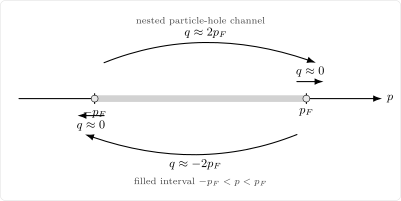
In one dimension the Fermi surface consists of two points. A small momentum transfer moves a state from just inside to just outside one endpoint; a transfer near does the same while mapping the left endpoint to the right one.
The word nesting means that a single momentum transfer maps an extended set of gapless states into another set of gapless states. In one dimension the “extended set” is just the two endpoints, but the nesting is perfect: the left endpoint and the right endpoint have opposite velocities and are separated by . This perfect kinematic match is what turns ordinary response into logarithmic response.
The density operator makes the same decomposition. Substitute
into . One obtains
where
Thus the density has a smooth part and an oscillatory part. The smooth part measures long-wavelength compression. The oscillatory part measures the tendency to form a charge modulation with wavelength
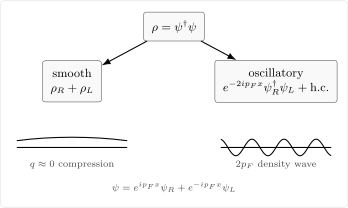
The one-dimensional density contains a smooth component and an oscillatory component. The latter is the field-theory avatar of a charge-density wave.
The same decomposition also explains why one-dimensional interactions are delicate. A short-range microscopic interaction contains Fourier components near and . The first gives forward scattering; the second gives backscattering between left and right movers. Both are marginal by power counting in the linearized theory.
The one-dimensional Lindhard function
Section titled “The one-dimensional Lindhard function”The free density response is still the particle-hole bubble from the previous page:
For the static response of the parabolic band, set . Since
a short calculation gives
The first check is the long-wavelength limit. Expanding the logarithm at gives
This is minus the one-dimensional density of states at the Fermi level. That sign agrees with the convention that is a potential energy.
The second check is the important one: near ,
The response diverges logarithmically. This is the Peierls singularity.
Here and below, denotes a momentum width around each Fermi point and
is the corresponding ultraviolet energy of the linearized theory. Keeping these two cutoffs distinct prevents dimensionally inconsistent logarithms.
The dynamic long-wavelength response is also useful. In the linearized theory, the right and left movers give
At and , this vanishes. A spatially uniform, time-dependent potential coupled to total particle number can be removed by a time-dependent phase rotation of ; it cannot create a density fluctuation. The static limit is different:
This is the same noncommutativity of limits that already appeared in the previous page, now in its sharp one-dimensional form.
The Peierls logarithm from chiral fields
Section titled “The Peierls logarithm from chiral fields”The logarithm at has a simple field-theory origin. The operator
annihilates a left mover and creates a right mover. Its susceptibility is a right-left bubble. In Euclidean frequency-momentum variables, its singular part has the form
where is the deviation from perfect nesting. The poles approach each other when both and are small. Equivalently, after the frequency integral the remaining momentum integral behaves as
Therefore
The product of propagators is negative at ,
so the response kernel has the same negative sign as the static Lindhard function. Its magnitude grows logarithmically as the energy and momentum deviation from nesting go to zero.
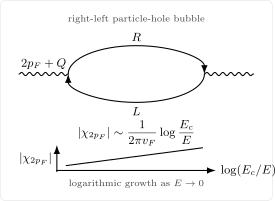
The density susceptibility is a right-left particle-hole bubble. Perfect nesting leaves an integral , producing the Peierls logarithm.
There is a complementary position-space way to see the same logarithm. For free chiral fermions in Euclidean spacetime,
Thus
Integrating this correlation function over two-dimensional Euclidean spacetime gives
So the Peierls logarithm is simply the logarithmic integral of an operator with dimension one in dimensions.
This position-space argument also explains why interactions change exponents in a Luttinger liquid. The free operator has dimension one, giving a logarithm when integrated over two Euclidean dimensions. Interactions can shift the scaling dimension, turning the logarithm into a power-law enhancement or suppression.
RPA criterion and soft modes
Section titled “RPA criterion and soft modes”A logarithm in the free susceptibility does not by itself prove that the ground state has ordered. It says that a weak perturbation in the corresponding channel is strongly amplified. A useful diagnostic is the random-phase denominator. For a density-density interaction with Fourier component ,
In the static channel,
If the effective interaction is attractive in this channel, , then the denominator can vanish:
For weak attraction this occurs at the exponentially small scale
This is the Peierls scale in its simplest mean-field form. In an electron-phonon system, the same logarithm softens the phonon at wavevector , making a lattice distortion energetically favorable. In a purely electronic model, the same singularity signals a strong charge-density-wave or spin-density-wave tendency, depending on the spin structure of the interaction.
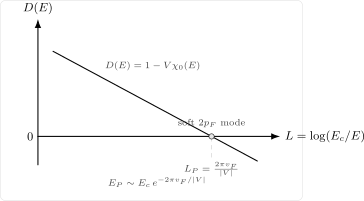
For an attractive nested-channel interaction, decreases linearly with . Its zero marks a soft mode, not merely a large perturbative correction.
This logic is the finite-density cousin of other instabilities. For electric Coulomb repulsion, screening makes long-wavelength potentials less singular. For an attractive long-range force, the sign of the response denominator is reversed and a homogeneous state can become unstable, the many-body analogue of the Jeans instability. The moral is the same: once a response denominator vanishes, the assumed background is no longer the correct saddle point.
RPA is only a channel diagnostic here. In one dimension, vertex corrections in the Peierls and Cooper channels can carry logarithms of the same order as the bubble chain. The controlled infrared description is an RG or bosonized theory; the RPA zero correctly identifies a dangerous channel but does not by itself determine the one-dimensional phase.
The competition between the particle-hole and Cooper logarithms, including their cancellation in the weakly interacting spinless model, is exhibited in Shankar 1994, § IV.E, preprint pp. 83–85, Eqs. (318)–(325) (PDF).
Cooper and Peierls channels
Section titled “Cooper and Peierls channels”The Peierls logarithm is not the only logarithm. The Cooper channel is also logarithmic. A right mover and a left mover with total momentum zero can repeatedly scatter into another pair with total momentum zero. The loop integral has the same radial structure:
In dimensions , the Cooper channel is still logarithmic because momenta and both lie on the Fermi surface. What is special in one dimension is that the particle-hole channel at is logarithmic too, and the same two Fermi points participate in both channels.
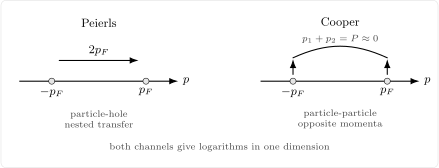
Two logarithmic channels compete in one dimension. The Peierls arrow denotes momentum transfer near ; the Cooper arc groups opposite momenta whose sum is near zero.
This competition is why one-dimensional fermions are not well described by a stable Landau Fermi liquid. In a Landau Fermi liquid, quasiparticles remain sharply defined and most interactions are perturbatively harmless at low energy. In one dimension, forward scattering is exactly marginal, while backscattering and pairing channels can produce logarithmic flow. Even when no conventional long-range order forms, the free-fermion exponents are generally replaced by interaction-dependent power laws. The resulting gapless phase is a Luttinger liquid.
A compact way to organize short-range interactions is the -ology notation. For spinless fermions one may write, schematically,
Here is same-branch forward scattering, is opposite-branch forward scattering, and is backscattering near . For spinful fermions, the charge and spin combinations of these couplings flow differently. On a lattice at commensurate filling, umklapp terms can also become important and open a Mott gap.
For a strictly local spinless interaction, Fermi antisymmetry relates some of these amplitudes and can make a nominal contact term vanish. The labels are independent most transparently for spinful fermions or finite-range interactions. The channel classification, rather than the number of independent bare constants, is what will survive into the RG analysis.
At this stage the important point is not the full -ology phase diagram, but the mechanism: logarithmic susceptibilities turn apparently marginal four-fermion interactions into running couplings. The later bosonization pages will replace these loop warnings by a more complete fixed-point description.
For this reason, the spinless formulas on this page should be treated as kinematic diagnostics, not as the full phase diagram. They identify the dangerous channels; the actual infrared fixed point depends on spin, symmetries, commensurability, and the signs of the marginal couplings.
The detailed solution belongs to later pages, but the warning belongs here: a logarithm is the perturbative announcement that the infrared theory has reorganized itself.
Example: opening a Peierls gap
Section titled “Example: opening a Peierls gap”Suppose an external or self-consistent distortion couples to the density operator. Write the mean-field Hamiltonian density as
In momentum space this is
The quasiparticle energies are
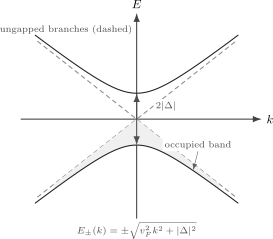
A distortion mixes right and left movers. The crossing of the two linear branches is avoided, and a gap opens at the Fermi energy.
The filled negative-energy band lowers the ground-state energy because the states near the crossing move downward. Subtracting the band energy, the singular part of the energy density behaves as
A lattice or order-parameter stiffness contributes a positive analytic term, for example . Because the fermionic term contains an extra logarithm, any weak attractive coupling can win at sufficiently low energy in the mean-field treatment. The result is a gap of the same exponential form as the instability scale.
This example is deliberately parallel to the BCS gap mechanism. The algebra differs by channel: BCS pairs particles with opposite momenta, while Peierls pairs a particle and a hole separated by . The shared feature is a logarithmic infrared enhancement.
This distinction matters experimentally and theoretically. A self-consistent Peierls gap breaks translation symmetry through a density modulation; an externally imposed distortion breaks translation explicitly. A BCS gap instead diagnoses pairing and, in a mean-field or higher-dimensional superconducting phase, broken particle-number symmetry. Similar exponentials do not imply identical order parameters.
Summary
Section titled “Summary”In one dimension the Fermi surface consists of two nested points. This makes the density response unusually singular. The exact static free response for a parabolic band is
so the response diverges logarithmically near . In the linearized theory, the same logarithm is the susceptibility of the operator
The density decomposes as
which identifies the oscillatory charge-density-wave channel. An attractive interaction in this channel can drive an RPA denominator to zero and open a Peierls gap. Meanwhile, the Cooper channel is logarithmic as well. The coexistence of these logarithmic channels is the perturbative reason one-dimensional fermions flow away from the naive free Fermi gas and toward Luttinger-liquid, density-wave, superconducting, or gapped behavior depending on symmetries and interactions.
Common pitfalls
Section titled “Common pitfalls”Calling the singularity ultraviolet. It is an infrared effect at a nonzero momentum set by the separation of the Fermi points.
Interchanging static and dynamic response. The functions and answer different questions. A uniform time-dependent scalar potential is a phase rotation; a static spatial modulation rearranges occupied states.
Equating a divergent bubble with proven long-range order. A logarithm in a susceptibility is a warning, not automatically a proof of order. In strictly one dimension, fluctuations are strong. Depending on the interaction and symmetries, the outcome may be a gap, a density wave, a spin gap, superconducting correlations, or a gapless Luttinger liquid with power-law order. Mean-field language identifies the dangerous channel; it does not replace the infrared solution.
Mixing the Peierls and Cooper channels. The former is particle-hole nesting at momentum transfer near ; the latter is particle-particle pairing at total momentum near zero.
Multiplying every spinless result by two. This is safe for free density response, but interactions split into charge and spin channels, and their RG flows are not obtained by a simple degeneracy factor.
Using one symbol for momentum and energy cutoffs. A patch width has units of momentum; the linearized energy cutoff is . The Peierls and Cooper logarithms must compare quantities with the same units.
The Library treatment of Polarization, the Lindhard Function, and Particle–Hole Continua supplies the broader response-function setting for this lesson’s one-dimensional nesting calculation. Keep the spinless species count and the stated static-limit prescription when comparing formulas.
Exercises
Section titled “Exercises”Exercise 1: Derive the one-dimensional static Lindhard function
Section titled “Exercise 1: Derive the one-dimensional static Lindhard function”Starting from
with , derive
Solution
Write
In the second integral set and then rename :
For the parabolic dispersion,
Therefore
The integral is elementary:
Evaluating the endpoints gives
Exercise 2: Separate smooth and oscillatory density components
Section titled “Exercise 2: Separate smooth and oscillatory density components”Show that the one-dimensional density operator decomposes as
Explain why the last two terms describe a density wave with wavevector .
Solution
Using
we get
The first two terms vary slowly if and are slowly varying. The cross terms carry phases , so their real part oscillates as . They therefore represent a density modulation with wavevector and wavelength .
Exercise 3: Recover the Peierls logarithm from scaling
Section titled “Exercise 3: Recover the Peierls logarithm from scaling”Use the scaling form
to show that the static susceptibility is logarithmically divergent.
Solution
The magnitude of the susceptibility is the spacetime integral of the correlation function. Up to normalization and the response-sign convention,
Set , so . In polar coordinates in the plane,
With a short-distance cutoff and long-distance cutoff ,
The precise prefactor depends on the normalization of the chiral propagators, but the logarithm is universal at the free fixed point.
Exercise 4: Find the RPA soft-mode scale
Section titled “Exercise 4: Find the RPA soft-mode scale”Assume the static susceptibility has singular part
and that an attractive interaction is treated in RPA:
Here is a momentum cutoff. Find the momentum scale at which the denominator vanishes and the corresponding energy .
Solution
The denominator is
The zero occurs when
Thus
Multiplying by gives the corresponding energy scale.
Exercise 5: Diagonalize the Peierls mean-field Hamiltonian
Section titled “Exercise 5: Diagonalize the Peierls mean-field Hamiltonian”Diagonalize the mean-field Hamiltonian matrix
and show that a gap opens at .
Solution
The eigenvalues solve
Therefore
This gives
so
At the two energies are , so the separation between the upper and lower bands is .
References
Section titled “References”- Shankar, R. “Renormalization-Group Approach to Interacting Fermions.” Reviews of Modern Physics 66, no. 1 (1994): 129–192. DOI. Open PDF: arXiv:cond-mat/9307009v2.
Further reading
Section titled “Further reading”- T. Giamarchi, Quantum Physics in One Dimension (Oxford University Press, 2004).
- A. O. Gogolin, A. A. Nersesyan, and A. M. Tsvelik, Bosonization and Strongly Correlated Systems (Cambridge University Press, 1998).
- G. Grüner, Density Waves in Solids (Addison–Wesley, 1994).
- F. D. M. Haldane, “Luttinger liquid theory of one-dimensional quantum fluids. I. Properties of the Luttinger model and their extension to the general 1D interacting spinless Fermi gas,” Journal of Physics C: Solid State Physics 14 (1981), 2585–2609.
- R. E. Peierls, Quantum Theory of Solids (Clarendon Press, 1955).
- J. Sólyom, “The Fermi gas model of one-dimensional conductors,” Advances in Physics 28 (1979), 201–303.
- A. Zee, Quantum Field Theory in a Nutshell, 2nd ed. (Princeton University Press, 2010).