

Compact Phases, Vortices, and Duality
A compact phase has locally smooth fluctuations and globally distinct winding sectors. In two dimensions, vortices have logarithmic interactions; their unbinding can destroy the long-distance stiffness that the Gaussian phase theory predicts. In three Euclidean dimensions, a dual gauge field reorganizes the same phase and vortex degrees of freedom. The distinction between a locally defined angle and its globally defined gradient is essential to both descriptions.
We develop this mechanism for a neutral, two-dimensional thermal phase model, then derive the local three-dimensional Euclidean duality. The latter also describes a suitable zero-offset quantum rotor model in dimensions. A generic finite-density quantum superfluid requires additional Berry-phase information.
Helpful background. Lesson 36 supplies the smooth-phase action, the sign of the induced current, and the distinction between a nonzero-momentum response and a fixed winding sector. Low-dimensional BKT physics connects the thermal result to Bose fluids.
Compactness and winding sectors
Section titled “Compactness and winding sectors”The field is circle-valued,
On a small patch choose a real lift and differentiate it. Lifts on overlapping patches differ by integer multiples of , so their derivatives agree. Denote this angular one-form by , with locally. A loop avoiding every core can nevertheless have
Thus can be closed away from cores without being the derivative of a globally single-valued real function. A branch cut in a chosen angle is a coordinate choice; the physical field need not jump there.
The unit-vortex example below compares a circle of radius outside a core of radius with the continuous angle lift along that same circuit. Follow the counterclockwise arrows from : the real lift increases even though the physical phase returns to its starting value.
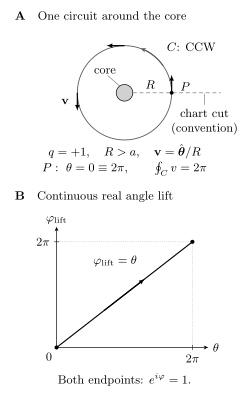
On , and . The counterclockwise circuit returns to with , while its continuous real lift gains . The dashed ray is an angle-chart convention; only the core is excluded. The angular one-form is closed outside the core but has circulation . Schematic geometry.
The local Euclidean action is
The source is a one-form with the phase charge absorbed into it. In the two-dimensional thermal model, is dimensionless. There the symbols , , and below denote costs divided by temperature; physical energy is . The cutoff is a lattice spacing or core radius. We orient the plane by and counterclockwise positive contours; in three Euclidean dimensions use .
The compact rotor
Section titled “The compact rotor”Let and let be a Euclidean duration, distinct from temperature . For
fixed angular endpoints lift to and on the covering line. The straight path in sector has action
With position states normalized to the periodic delta function for the measure , the free-particle fluctuation factor gives
Poisson resummation gives the same normalized kernel as
Winding of the coordinate and integer angular momentum are two descriptions of the same compact quantum mechanics.
Villain variables and lattice vorticity
Section titled “Villain variables and lattice vorticity”For angular site variables, a lattice model is
Its small-difference expansion is Gaussian. A different useful periodic weight is the Villain model,
Every link integer is summed. Keeping only the shortest lift is a minimizing approximation, not the definition of . The Villain weight approximates the XY weight in a suitable regime and supports the same BKT description; it is not the identical cosine model at the same numerical bare coupling. Exact transformations must specify which weight is being transformed. The periodic Gaussian and its vortex representation are developed in Polyakov 1987, §4.2, pp. 54–57, Eqs. (4.24)–(4.30).
On a square lattice set
The bare site differences telescope, but the integer branches need not:
Here is the oriented probe flux. This is the lattice realization of circulation of the angular one-form. Poisson transforming the link-integer sum gives a separate integer-current representation; integrating the site angles then enforces its lattice divergence constraint. Branch integers and conserved currents are distinct stages of that transformation.
Vortices in two dimensions
Section titled “Vortices in two dimensions”With , a vortex of integer charge has a local angle
Its cost outside the core is
For separated vortices use local lifts
Their angular one-form obeys the distributional identity
This is not a claim that ordinary distributional derivatives of one globally defined scalar fail to commute. Such derivatives do commute. The nonzero circulation belongs to the angular one-form, whose local angle lifts cannot be combined into a smooth single-valued real angle around a core.
For a neutral configuration, , the leading logarithmic interaction is
One way to obtain the coefficient is to write each unit-vortex field as . Green’s identity gives the cross integral ; combining self and cross terms cancels when the total charge is zero. Core energies are additional short-distance input; the displayed model for them is not universal. The charge factors in the pair interaction are essential. See Altland and Simons 2023, §6.5.3, p. 366; with our , a positive counterclockwise vortex is .
For a vortex–antivortex pair,
Increasing separation costs energy. With no imposed probe flux, a configuration of net charge has a leading cost . Boundary conditions permitting net winding allow such a configuration in a finite sample; they do not remove its divergence as . Neutrality removes this infrared term in the thermodynamic limit used below. Rotating states and imposed backgrounds require their own boundary and source conditions.
Keeping unit charges gives a regulated Coulomb gas:
The domain enforces a chosen core-separation cutoff, for example , in a finite box before the neutral thermodynamic limit. The fugacity is the dimensionless weight per unit vortex, including its core weight and the chosen short-distance measure. Writing absorbs that measure convention into . Without a core prescription the opposite-charge integral can diverge at zero separation; merely writing inside a logarithm does not regulate it. The pair counting and explicit lower cutoff are developed in Altland and Simons 2023, §6.5.3, pp. 367–368.
Vortex unbinding and long-distance stiffness
Section titled “Vortex unbinding and long-distance stiffness”A unit vortex in a large finite disk whose boundary conditions permit net winding has roughly possible positions. Its entropy and dimensionless free-energy estimate are
The estimate identifies the competition but uses the bare stiffness. On the infinite plane the allowed neutral process is pair unbinding. Small vortex dipoles also polarize the medium, so one must follow both the stiffness and fugacity under coarse graining. In the dilute unit-charge normalization above,
The first equation lowers the stiffness through dipole screening; the second gives the relevance of vortices. These are leading dilute-gas equations, with higher terms depending on the coupling convention. Their derivation and normalization are given in Altland and Simons 2023, §6.5.3, p. 369, Eqs. (6.50)–(6.51). Rescaling changes the coefficient of its squared term.
Below the transition the fugacity flows to zero and the stiffness approaches a finite . The critical limiting value gives the jump
Here is the long-distance phase stiffness, not the bare coefficient; see Altland and Simons 2023, §6.5.3, pp. 370–371.
For a Gaussian fixed-line theory, the phase variance and order-parameter correlator satisfy
The second line follows by taking the Gaussian expectation of the exponential. The transition has leading exponent , but marginal running can supply multiplicative logarithmic corrections. Away from a fixed line, scale-dependent enters an integral over logarithmic scale, not an exact power law obtained simply by substituting its value at the observation scale.
In the disordered phase, unbound vortices screen the logarithmic interaction and long-distance phase correlations decay exponentially. A Debye–Hückel approximation illustrates this with
whose two-dimensional position-space kernel is proportional to . This is a screened long-distance approximation, not an exact BKT critical propagator. The dilute flow ceases to be quantitatively controlled once the fugacity becomes large.
Transverse response of a superfluid
Section titled “Transverse response of a superfluid”First restrict to the smooth sector with fixed winding and suitable boundary conditions. For nonzero momentum,
where
For the forward spatial transform , derivatives become . Thus
The Gaussian saddle removes the longitudinal part. Up to a source-independent determinant,
Here in this Euclidean normalization, and is its positive Hessian. The induced source current is , with the sign used in Lesson 36. In a thermal problem multiply and this current by to obtain their physical normalization. Pure gradients are removed only if the corresponding phase change is allowed by the boundary and winding conditions. A constant holonomy on a ring or torus is not part of this argument.
For a static problem in three spatial dimensions define the probe curl . Then
The inverse Laplacian represents the nonzero limiting transverse stiffness. By comparison, a normal state with a finite analytic static susceptibility can have a leading local term , whose transverse kernel vanishes as . This is an example, not a claim that every gapless or critical normal state has local response. The probe free energy is also distinct from any separately added dynamical Maxwell action.
Vortex polarization changes the long-distance stiffness, and unbinding removes it in the two-dimensional disordered phase. A choice of branch cut alone has no such physical effect.
Dual gauge-field description
Section titled “Dual gauge-field description”Work in three Euclidean dimensions, either for a classical compact phase model or for a specified quantum rotor model with one coordinate interpreted as imaginary time. In the quantum case the vortex lines are worldlines. First take a topologically trivial domain with boundary terms absent; on nontrivial domains harmonic and flux sectors must be included separately.
The quantum-model boundary
Section titled “The quantum-model boundary”The quadratic, source-free density–phase action of Lesson 36 becomes
With , , its isotropic coefficient is . A Euclidean covector source rescales as . Unlike the two-dimensional thermal , this three-dimensional has units of inverse length.
A generic finite-density action also has an offset-density term : indeed . On regulated cells, its winding contribution is , where is the background number per cell and is the temporal winding. It is not generally removable. The model below assumes a zero offset, or an explicitly justified trivial winding phase; it does not make that assumption for a generic Bose fluid. The canonical term follows from Altland and Simons 2023, §5.2, p. 242, Eq. (5.7), and §5.2.4, pp. 254–255; the winding qualification follows by integrating it. The density–phase description explains the corresponding canonical pair.
The local Gaussian transformation
Section titled “The local Gaussian transformation”Write . A real auxiliary field gives the identity
The smooth part contributes
so its integral imposes . Locally solve this constraint by
The vortex current has unit flux through a transverse disk for a unit vortex. It is conserved in the interior when no vortex endpoint is inserted. Integration by parts fixes the coupling sign:
Consequently the weight is , with
The Maxwell coefficient follows from the contraction
The reverse scalar–Maxwell Gaussian transformation is given in Tong 2018, §8.1.1, pp. 390–391, Eqs. (8.7)–(8.9), PDF. His Maxwell coupling translates as . The source and vortex signs above follow from our explicit imaginary multiplier and orientation.
The real Euclidean auxiliary field is not the physical source current without a factor of . Completing its Gaussian gives, with ,
These relations fix the source dictionary along with both imaginary couplings. Rescaling or changing the sign of must change the flux and vortex-charge conventions together.
The local quadratic transformation does not specify all global gauge sectors or the vortex-core weights. Summing regulated vortex loops supplies that additional information. In the usual zero-offset rotor transition, uncondensed vortex matter accompanies the ordered phase, while vortex condensation gives a dual Higgs description of the phase with vanishing stiffness. This is the limited phase dictionary developed further in particle–vortex duality; it is not an assertion of identical microscopic actions at all scales.
Elasticity and dislocations
Section titled “Elasticity and dislocations”A related geometric construction applies to a two-dimensional crystal with a fixed reference orientation. Its local displacement is identified modulo Bravais lattice vectors. In linear isotropic elasticity,
with and for positive elastic energy. Local displacement lifts define a one-form whose Burgers circulation is
This parallels : the local derivative can be closed away from cores while having nonzero circulation around one. The analogy concerns this topological obstruction, not an identification of vector elastic interactions with the scalar vortex gas. Dislocation unbinding can destroy translational order; it does not by itself prove a direct continuous transition to an isotropic liquid. Orientational defects and possible intermediate phases are separate questions.
The compact gauge-theory bridge
Section titled “The compact gauge-theory bridge”In Lesson 38, the gauge connection itself is compact. A dimensionless link angle satisfies , with oriented plaquette curl
The unwrapped curl satisfies the lattice identity . Principal face representatives , however, can obey
The integer records the branch changes and defines a lattice monopole. In three Euclidean dimensions these are point events. When monopole events are allowed and their regulated dilute-gas description applies, the plasma supplies a confinement mechanism in pure compact gauge theory. Additional matter or topological terms can change that conclusion. The monopole-plasma treatment supplies those assumptions and the separate Wilson-loop calculation.
Exercises
Section titled “Exercises”Winding sectors of the compact rotor
Section titled “Winding sectors of the compact rotor”For , derive the winding-sector form of the compact rotor kernel by evaluating the classical action in each sector. The duration is , and the normalized common Gaussian prefactor is given above.
Solution
On the covering line, the path in sector satisfies
The classical path is
so
The action is
Summing the Gaussian contribution from all lifts gives
The fluctuation determinant is independent of , so it only multiplies the expression by an overall normalization.
Logarithmic energy of a vortex
Section titled “Logarithmic energy of a vortex”Compute the dimensionless thermal cost of a vortex in a disk of radius , with core cutoff , for
Solution
For ,
Therefore
Thus
The logarithmic divergence is the energetic reason isolated vortices are suppressed when the stiffness is large.
The transverse projector from phase integration
Section titled “The transverse projector from phase integration”Work at nonzero momentum in the smooth, fixed-winding sector, with boundary conditions permitting the longitudinal phase adjustment. Integrate out the phase for
Show that the source-dependent free energy depends only on the transverse part of .
Solution
The equation of motion for the Gaussian variable is
so
Substituting this saddle point, which is exact because the integral is Gaussian, removes the longitudinal part of . The result is
Thus
Topological invariance of the Burgers vector
Section titled “Topological invariance of the Burgers vector”In a two-dimensional crystal of fixed reference orientation, use smooth local displacement lifts modulo lattice vectors. Explain why
is invariant under smooth deformations of that do not cross a dislocation core.
Solution
The local lifts differ by constant lattice vectors, so defines a smooth closed one-form on the region swept out by the contour. It need not be globally exact there. For two contours and bounding that swept region with no singularity,
In components,
because ordinary derivatives commute on each smooth local lift. Nonzero circulation around a core is compatible with closure on the swept annulus. With the reference lattice fixed, the Burgers vector changes only when the contour crosses a singular core. This is the same local-versus-global distinction as vortex winding.
References
Section titled “References”- Alexander Altland and Ben Simons, Condensed Matter Field Theory, 3rd ed., Cambridge University Press (2023). doi:10.1017/9781108781244.
- Alexander M. Polyakov, Gauge Fields and Strings, Contemporary Concepts in Physics, vol. 3, Harwood Academic Publishers (1987). doi:10.1201/9780203755082.
- David Tong, Gauge Theory, lecture notes, University of Cambridge (2018), §8.1.1. Official notes. Open PDF: Chapter 8.