

Dirac Equation and Spinor Solutions
The previous page constructed the spinor representations of the Lorentz group and introduced gamma matrices as the algebraic bridge between vectors and spinors. We now turn that representation theory into dynamics. The result is the Dirac equation: a first-order relativistic equation whose solutions describe spin-one-half modes.
The main lesson is that the Dirac equation is not a replacement for the mass shell . It is a refined, spinorial way of imposing it. The Clifford algebra makes the operator a Lorentz-covariant square root of , while the spinor components encode the two spin states of a massive fermion and the two chiralities that become independent in the massless limit.
For calculations, the page has a simple payoff: learn to recognize which equations define the spinors, which equations define the spinors, and why the spin sums and are more useful than explicit spinor columns.
The square root of the Klein–Gordon operator
Section titled “The square root of the Klein–Gordon operator”A free scalar mode satisfies
In position space, with , this is the Klein–Gordon equation
For spinors, we can impose a stronger first-order equation. Define
Using the Clifford algebra,
because is symmetric and therefore kills the commutator part of . Hence
The free Dirac equation in momentum space is
In position space it is
Acting once more with gives
The overall minus sign is harmless because the expression is set to zero. The important content is that the Dirac equation implies the Klein–Gordon equation with the course-wide mostly-minus convention . Compare the same factorization in Schwartz 2014, § 10.3.1, p. 172, Eqs. (10.92)–(10.95).
Thus every component of a Dirac spinor obeys the Klein–Gordon equation. The converse is not true: a collection of four Klein–Gordon solutions is not automatically a Dirac spinor solution. The Dirac equation keeps only the spinor configurations whose components are related by the first-order constraint.
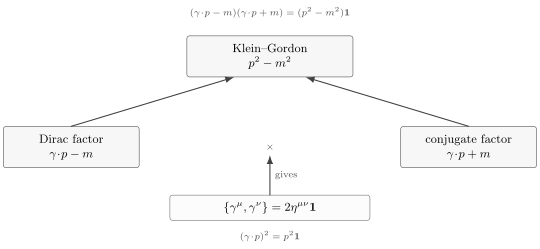
The Clifford algebra factorizes the relativistic mass-shell polynomial. The first-order equation implies the Klein–Gordon condition , while preserving spinor transformation properties.
The size of the spinor is fixed by the Clifford algebra. In spacetime dimensions, an irreducible complex spinor has dimension . In even dimension the complex Clifford algebra has one irreducible matrix representation up to equivalence; in odd dimension there are two choices distinguished by the sign of the highest-grade gamma product. In four dimensions this gives four complex components. On shell, the Dirac equation reduces the independent positive-energy solutions to two spin states, as required for a massive spin-one-half particle.
Lorentz covariance
Section titled “Lorentz covariance”The orbital Lorentz generators acting on functions of spacetime are
A spinor also needs intrinsic Lorentz generators acting on its components. In the site convention
while the actual generator matrix in the spinor representation is
From the Clifford algebra one obtains
This is the algebraic statement that the gamma matrices carry a Lorentz vector index while acting on spinor indices. For a finite Lorentz transformation,
and
If and the spinor transforms as
then
So solutions are carried into solutions. Lorentz covariance is not automatic merely because the wavefunction has four components; it follows from the compatibility between and the gamma matrices.
The full Lorentz generator acting on a spinor field is
The orbital part moves the argument of the field. The spin part rotates and boosts the spinor indices.
Weyl components and the mass term
Section titled “Weyl components and the mass term”Write a Dirac spinor in the chiral basis as
where and . On the previous page, was fixed by the Hermitian-vector map . With that choice, transforms with and with . The important invariant statement is that the mass term couples the two inequivalent Weyl representations. The momentum-space Dirac equation becomes
or
Equivalently,
The mass term couples the two chiralities. If , the equations decouple:
This is the Weyl limit. A massless left-handed spinor and a massless right-handed spinor are independent Lorentz-covariant fields; a massive Dirac fermion needs both.
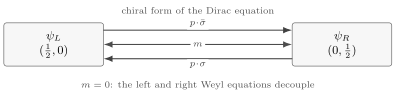
The momentum matrices and map between the two Weyl representations. The mass term identifies the two chiralities inside one massive Dirac spinor.
At rest, , the positive-frequency equation gives
Thus the rest-frame positive-frequency spinors may be written as
where are ordinary two-component Pauli spinors. The spin label is a rotation spin label, not a chirality label.
Plane-wave spinors
Section titled “Plane-wave spinors”For positive-frequency solutions, take
Then
For negative-frequency solutions, write
which gives
Here in the label of is still positive. The sign change comes from the phase: . This convention is what later lets the branch appear as antiparticle creation rather than as a negative-energy particle.
A compact chiral-basis solution uses the unique positive-semidefinite Hermitian square roots of and . They exist because, for on shell, the eigenvalues are :
and
Here and are orthonormal two-component spinor bases. On shell,
so
This verifies the two coupled Weyl equations directly. The matrix-square-root solutions are given in Schwartz 2014, § 11.2, p. 190, Eq. (11.25).
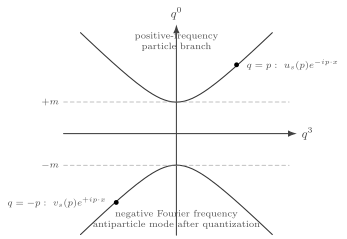
Writing a plane wave as , the mode has Fourier momentum while has . The label in both spinors nevertheless has ; after quantization the lower-frequency branch becomes the antiparticle creation term.
For explicit calculations it is often useful to choose Pauli helicity eigenspinors
The physical helicity carried by the two-component spinor is . With this notation,
The positive-frequency spinor becomes
The square roots are exactly what makes the two first-order equations true, because
Spin sums and projectors
Section titled “Spin sums and projectors”The standard spinor normalization used in the next page is
and
The first line is Lorentz invariant. The second line is the equal-time Hilbert-space normalization used in canonical quantization. For these normalizations and the following spin sums, see Schwartz 2014, § 11.2.1, p. 191, Eqs. (11.27)–(11.30).
The spin sums are
These identities are usually more important than the explicit spinors. They convert sums over external spin states into traces of gamma matrices, and they are independent of the particular spin basis used for the two states. In practice, one often chooses helicity spinors for external particles but immediately replaces spin sums by the covariant numerators above. Whenever a calculation seems to differ by a factor of or , check the spinor normalization before changing the physics.
For , the positive-frequency numerator defines a projector:
Indeed,
where was used. Since , this projector has rank two, matching the two spin states of a massive positive-energy fermion. The corresponding projector onto solutions of at the same positive-energy momentum label is
It obeys and . Because the covariant normalization of the spinors is negative,
Neither nor should be used at , where division by is singular; the chiral and helicity projectors are the appropriate massless objects.
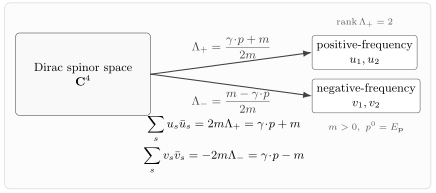
Spin sums turn basis-dependent spinor products into covariant matrices. With the stated normalization, while ; the minus sign in the latter is tied to .
The same numerator appears in the free Dirac propagator,
which will be derived after quantizing the Dirac field.
Chirality and helicity in the massless limit
Section titled “Chirality and helicity in the massless limit”When , the Dirac equation separates into two Weyl equations:
For a positive-energy mode with ,
Therefore
Since the spin operator is , a positive-energy left-handed Weyl mode has helicity , while a positive-energy right-handed Weyl mode has helicity .
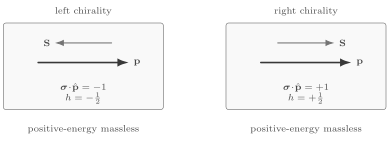
For , chirality and helicity lock together for positive-energy particle modes. Left-handed modes have spin antiparallel to momentum; right-handed modes have spin parallel to momentum.
For massive fermions the distinction matters. Chirality is a Lorentz-representation label, implemented by
Helicity is the projection of spin along momentum. A massive particle can be viewed from a frame that overtakes it and reverses its momentum, so helicity is not Lorentz invariant for massive particles. A massless particle cannot be overtaken, and helicity becomes invariant. This is why weak-interaction phrases such as “left-handed fermion” must be read carefully: for a massive fermion, a chirality projection and a helicity measurement are related but not identical.
Dirac adjoint, Lagrangian, and current
Section titled “Dirac adjoint, Lagrangian, and current”The ordinary Hermitian inner product is invariant under spatial rotations, but not under boosts, because finite-dimensional spinor boost matrices are not unitary. The gamma matrices instead obey
or, equivalently,
This identity implies
The invariant matrix is therefore , not the identity. This motivates the Lorentz-covariant adjoint
Indeed, if , then
It follows immediately that is a Lorentz scalar and is a Lorentz vector.
The free Dirac Lagrangian is
Varying gives the Dirac equation,
Varying and integrating by parts gives the adjoint equation
The Lagrangian is invariant under the global phase symmetry
The associated current is
Using the Dirac equation and its adjoint,
The time component is
As a classical wave equation this gives a positive density. In quantum field theory the deeper interpretation is that is a charge current, while the negative-frequency modes become antiparticle creation modes.
The same gamma algebra organizes all local Dirac bilinears. A basis for the complex matrices contains
independent elements:
| Gamma structure | Bilinear | Proper-Lorentz type |
|---|---|---|
| scalar | ||
| vector | ||
| antisymmetric tensor | ||
| axial vector | ||
| pseudoscalar |
The adjectives “axial” and “pseudo” distinguish behavior under parity; under the proper orthochronous Lorentz group they transform like a vector and scalar, respectively. This decomposition is also a useful completeness check for gamma-matrix manipulations.
Summary
Section titled “Summary”The Dirac equation
combines Lorentz covariance, the Clifford algebra, and spin-one-half representation theory. Squaring the operator gives the Klein–Gordon equation, so Dirac spinors live on the same mass shell as scalar particles, but with spinor polarizations attached to each momentum.
A massive Dirac spinor contains left- and right-handed Weyl components coupled by the mass. In the massless limit the components decouple, and chirality becomes tied to helicity for positive-energy particle modes.
The positive-frequency spinors obey , while the negative-frequency spinors obey . Their spin sums,
are the practical heart of spinor calculations and foreshadow the numerator of the fermion propagator. In both sums is the positive on-shell energy.
Common pitfalls
Section titled “Common pitfalls”Chirality and helicity differ at nonzero mass. They coincide for positive-energy massless particle modes, but a boost can reverse the momentum of a massive particle without changing its chirality.
Spinor boost matrices need not be unitary. The finite-dimensional matrix is not generally unitary for boosts. This does not contradict unitarity of the Lorentz transformation on the Hilbert space.
The spinors are not negative-probability states. Their label still has . The negative Fourier frequency is carried by , and after quantization this mode multiplies an antiparticle creation operator.
The momentum label in the spin sum has positive energy. In , do not silently replace by .
Spinor normalizations fix the completeness relations. The displayed spin sums assume and . Changing normalization changes the prefactors.
The Dirac adjoint is essential. The scalar and vector are Lorentz covariant; alone is neither a Lorentz scalar nor boost invariant.
Explicit columns are basis dependent. Spin sums and bilinears are usually safer covariant objects. Projectors divided by are only defined for .
The Library treatment of Plane Waves, Spin Sums, and Bilinears develops the normalization and completeness checks for these solutions. The next course lesson uses the same positive- and negative-frequency branches in the quantum field expansion.
Exercises
Section titled “Exercises”Exercise 1: squaring the Dirac equation
Section titled “Exercise 1: squaring the Dirac equation”Show directly that the Dirac equation implies the Klein–Gordon equation for each spinor component.
Solution
Start from
Act on the left with :
The cross terms cancel, leaving
Because is symmetric, the commutator part of drops out:
Therefore
Exercise 2: chiral equations imply the mass shell
Section titled “Exercise 2: chiral equations imply the mass shell”Using the chiral-basis equations
verify the helicity-basis spinor
Solution
Let
with
The first Weyl equation gives
Using ,
So the first equation holds. Similarly,
so the second equation also holds.
Exercise 3: the positive-energy spin-sum projector
Section titled “Exercise 3: the positive-energy spin-sum projector”Show that
is a projector on shell and acts as the identity on any .
Solution
Since ,
Thus
On shell, , so
Therefore
Exercise 4: chirality versus helicity at zero mass
Section titled “Exercise 4: chirality versus helicity at zero mass”For a massless positive-energy spinor, show that has helicity and has helicity .
Solution
For ,
With ,
Hence
The spin operator is , so the helicities are and .
Exercise 5: current conservation
Section titled “Exercise 5: current conservation”Use the Dirac equation and its adjoint to prove current conservation for .
Solution
The Dirac equation gives
The adjoint equation gives
Therefore
References
Section titled “References”- Schwartz, Matthew D. Quantum Field Theory and the Standard Model. Cambridge University Press, 2014, § 10.3.1, p. 172, and §§ 11.2–11.2.1, pp. 190–191. DOI.
Further reading
Section titled “Further reading”- Coleman, Sidney. Lectures of Sidney Coleman on Quantum Field Theory. Edited by Bryan Gin-ge Chen, David Derbes, David Griffiths, Brian Hill, Richard Sohn, and Yuan-Sen Ting. World Scientific, 2019. DOI.
- Srednicki, Mark. Quantum Field Theory. Cambridge University Press, 2007. DOI.
- Weinberg, Steven. The Quantum Theory of Fields. Volume I: Foundations. Cambridge University Press, 1995. DOI.
- Zee, A. Quantum Field Theory in a Nutshell. 2nd ed. Princeton University Press, 2010. Publisher.