

Superfluidity, Landau Criterion, and Accelerated Frames
A medium selects a rest frame, and a moving impurity can transfer energy and momentum to its excitations. The Landau criterion bounds when emission is energetically allowed; phase stiffness describes the fluid’s low-energy response. Rotating absorption and Rindler quantization provide two related applications of choosing a time-evolution generator, with different physical states and boundary conditions.
Our worked fluid is a uniform, weakly interacting neutral Bose gas in three spatial dimensions at zero temperature. We use one thermodynamic broken-symmetry representation. This choice is appropriate to that example; condensation and superfluid response are distinct diagnostics. The phase–density formulation supplies the canonical pair used below.
Energy in a moving frame
Section titled “Energy in a moving frame”For a Galilean system in a sector of fixed total mass , a passive change to a frame moving with velocity gives
The last term cancels between states in that sector. The generator relevant to excitation energies is therefore . A fluid-rest-frame excitation with energy has shifted energy
A negative value means that this excitation lowers the shifted generator. It does not mean that relabeling coordinates creates a physical instability. Dissipation requires a subsystem, such as an impurity or boundary, that can exchange momentum, together with an allowed coupling and the appropriate conservation laws.
An active boost is a different operation. For a microscopic boson of mass , giving a rest state velocity acts as
For a uniform rest condensate, the phase gradient becomes . The boosted state has laboratory momentum and energy . It is not another unconstrained laboratory ground state. Persistent flow is instead discussed at fixed momentum, imposed twist, or within a metastable winding sector.
The Landau threshold
Section titled “The Landau threshold”Take an impurity of finite mass , initially with momentum . If it emits one excitation of momentum , momentum and energy conservation require
For fixed direction , the corresponding energetic lower bound is
The recoil-free expression is the limit. The direction in its denominator matters for anisotropic dispersion, as explained in Yu 2017, first preprint page, Eqs. (1)–(3), PDF. The finite- numerator follows from the conservation law just derived.
For an isotropic branch , alignment with the motion minimizes the ratio at fixed . Thus
If several excitation branches can couple, the infimum includes them all. These are energetic bounds for the specified emission channels, not decay rates. They do not decide vortex nucleation, boundary barriers or heating. Equality at an infimum also requires care: the minimizing nonzero momentum may not exist.
Two isotropic examples make that distinction explicit:
The first is the Bogoliubov branch of the weak Bose model derived below; the second is an ideal noninteracting quadratic branch. Their ratios satisfy
As , the bounds are and zero respectively, with neither attained at positive momentum. In the exactly linear phonon idealization , by contrast, every positive momentum attains the recoil-free ratio . Finite recoil adds , making its threshold unattained as well. For that model the most favorable emission is collinear:
so any nonzero emitted momentum requires .
The figure separates the dispersion from its ratio to momentum. Both panels use ; the same positive is merely a comparison scale for the ideal branch.
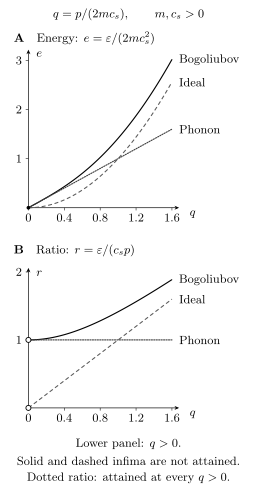
The Landau bound uses slopes from the origin, shown explicitly as below. The physical ratio has infimum for the Bogoliubov branch and zero for the ideal quadratic branch; neither is attained at nonzero momentum. The dotted linear phonon model has at every positive momentum, so its normalized ratio is 1. The same define the comparison units; the ideal branch is not assigned a sound speed. These exact isotropic branch plots omit impurity recoil and do not predict a decay rate or vortex threshold.
The moving-fluid convention in Altland and Simons 2023, §5.2.4, p. 257 shifts energies by . Relative to our impurity motion, , so the emission sign agrees.
Density and phase form one canonical pair
Section titled “Density and phase form one canonical pair”For the weak repulsive Bose model, write and . The static grand-potential functional is
Its uniform minimum has
This is a positive static radial curvature. To identify dynamical modes we must also retain the time derivative. Dropping a total derivative from the microscopic Bose action gives
The term makes density and phase conjugate variables. Expand ; the linear density term cancels because . Apart from the background phase derivative, the quadratic Lagrangian is
The conjugate-pair and long-wavelength derivation is developed in Altland and Simons 2023, §5.2.4, pp. 254–257, especially Eqs. (5.13)–(5.15). Their density variable is our , and the quadratic density cost here means after the chemical-potential tadpole is canceled. Their Euclidean Berry term continues to the real-time sign above.
At momenta small compared with the inverse healing scale, the last gradient term is subleading. Completing the square,
gives the phase action
Here denotes stiffness, not number density. The sound speed is
Retaining the density-gradient term gives two first-order equations,
Combining them yields
There is one positive-frequency Bogoliubov branch and its negative-frequency partner. Positive radial curvature did not supply a second, independently gapped amplitude mode. The full displayed dispersion belongs to the quadratic weak-Bose approximation; its high-momentum validity is limited by the microscopic interaction model.
The selected phase also needs its thermodynamic scope. At finite volume a number eigenstate has . A definite condensate phase is obtained by taking the thermodynamic limit before removing a symmetry-breaking source. Superfluid stiffness and condensation need not coincide in other dimensions or regimes; see Altland and Simons 2023, §5.2, p. 242, and §5.2.4, p. 254.
Source response and fixed winding
Section titled “Source response and fixed winding”Couple the conserved particle-number symmetry to a background one-form , with charge . Its transformation is
The spatial are covector components in this source convention. They are not silently identified with a raised Lorentzian electromagnetic vector. Cartesian spatial current labels below use ; they do not mean Lorentzian index lowering.
At long wavelengths, expand about the chosen rest density. The density–phase action contains
In particular, supplies the equilibrium density response. Eliminating gives
The background derivative does not alter local equations in a fixed smooth sector; global compact-phase sectors require separate treatment. It may be omitted in a fluctuation action only if the equilibrium current is stated separately. Functional differentiation gives
At zero source the phase equation has the sound pole
Varying the phase gives
For inverse Fourier phase , set . The retarded solution is
Substituting into gives the retarded spatial current response :
The first term is a source contact term and the second is phase exchange. Their combination, not the pole alone, gives the static limit.
To see that limit directly, minimize
Work at nonzero spatial momentum, with vanishing boundary terms and single-valued smooth phase variations in the zero-winding sector of the rest state. Decompose
For the exact longitudinal component removable within that sector, gives
Define the positive static Hessian , and the induced current about the zero-source rest state, by
Thus . The local contact and the phase-exchange term cancel the longitudinal response. The structure is nonanalytic at zero momentum, so the zero mode cannot be inferred by substituting .
A ring makes the global exception concrete. For circumference , uniform cross-sectional area , constant tangential source , and fixed winding ,
The candidate phase is not generally single-valued modulo around the ring. A nontrivial holonomy therefore cannot be discarded as an ordinary longitudinal fluctuation. Changing involves physics outside this smooth-sector minimization.
The background-source calculation describes a neutral fluid’s sound and stiffness. With an appropriately normalized dynamical Maxwell field, the charged phase instead participates in the Anderson–Higgs mechanism and transverse stiffness contributes to Meissner screening. This requires the electromagnetic dynamics; a nondynamical probe alone does not remove the neutral phonon.
Rotating absorption
Section titled “Rotating absorption”A rotating system uses the generator . Write for the angular-momentum quantum number, so it is not confused with the particle mass. A bosonic mode with laboratory frequency has corotating frequency
Consider an axisymmetric body at constant angular velocity, internally equilibrated, with a dissipative channel coupled to this mode. Absorbed energy and angular momentum are in the ratio . Positivity of dissipation in the rotating frame constrains the signed absorption fraction :
When and the channel has nonzero dissipative coupling, : outgoing power exceeds incident power by extracting rotational energy. A decoupled channel with is not amplified. This is the rotating-body argument in Bekenstein and Schiffer 1998, §IV, preprint pp. 10–12, Eqs. (21)–(26), PDF, using for their .
The shifted energy resembles , but the absorption and boundary conditions carry the physical content. The sign by itself is not a theorem of fermionic amplification or a substitute for the flux analysis of a particular horizon problem.
Accelerated coordinates and the vacuum state
Section titled “Accelerated coordinates and the vacuum state”In the right wedge of -dimensional Minkowski space, introduce
Differentiating and canceling the cross terms gives
At fixed the worldline satisfies , with proper time and proper acceleration
Rindler time is dimensionless boost time. A factor therefore has dimensionless boost frequency , while the observer measures proper frequency .
With , the Euclidean metric is
Regularity at the origin of the Euclidean plane requires . For the analytic Minkowski vacuum, this angular continuation yields the wedge KMS period in boost time. The observer at fixed has
The state assumption is essential. An arbitrary state in the wedge, including the Rindler vacuum, does not become thermal merely through a coordinate change. The analytic, Poincaré-vacuum/Wightman setting and Euclidean argument are discussed in Crispino, Higuchi and Matsas 2007, §II.I, preprint pp. 16–18, PDF. This statement concerns wedge correlation functions and boost evolution; it does not require a literal trace-class density matrix for an unregulated continuum wedge.
Massive Rindler modes
Section titled “Massive Rindler modes”For a real scalar of mass , the action and equation of motion are
Introduce a reference length and . Then
The conjugate momentum is , so the boost Hamiltonian is
For real positive boost frequency, set with . The mode equation becomes
The mass produces an exponential wall. Choosing a radial mode real and decaying as gives
Near the horizon the wall vanishes. The small-argument Bessel expansion explicitly gives
The coefficients are complex conjugates for the stated real parameters. The overall Klein–Gordon normalization is not fixed by choosing this radial profile. For there is no exponential wall, and this decaying massive boundary condition must be replaced.
These modes are the zero-transverse-momentum specialization of Crispino, Higuchi and Matsas 2007, §§II.D–E, preprint pp. 10–11, Eqs. (2.84)–(2.106), PDF. If their acceleration scale and coordinates are , the translation is , , and . Their four-dimensional transverse normalization is not being reused here.
Positive boost frequency and positive Minkowski frequency specify different mode decompositions. The Minkowski vacuum requires an analytic combination across the wedges. In a canonically normalized Rindler basis, its occupation factor is ; the Rindler vacuum uses zero-temperature boost occupations. Changing the time generator is therefore only part of the question: the state and its analyticity determine the occupation and KMS properties.
Common pitfalls
Section titled “Common pitfalls”An energetic bound is not a rate. The Landau and rotating-frame inequalities need a physical exchange or dissipative channel. A passive coordinate change supplies neither.
Static curvature does not count dynamical modes. In the weak nonrelativistic Bose fluid, density and phase are a conjugate pair and generate the Bogoliubov branch.
A transverse response requires its contact term and global scope. The Hessian is positive, while the induced static current is its negative action on the source. A fixed-winding holonomy is not removed by an arbitrary phase gradient.
Unruh thermality is a state statement. The temperature above applies to the Minkowski vacuum and proper-time normalization, not to every accelerated state.
The remaining limitation of the smooth fluid description is topological. The phase obeys ; winding changes and vortices require more than small real-valued phase fluctuations. The next lesson starts from this compactness. Its Euclidean probe absorbs the charge into the source, whereas the single-boson normalization here keeps explicit.
Exercises
Section titled “Exercises”A dispersion whose bound is not attained
Section titled “A dispersion whose bound is not attained”In an isotropic continuum model with no recoil or momentum cutoff, let a quasiparticle have dispersion
Assume and . Compute the Landau critical velocity
Interpret the result.
Solution
We have
For , this decreases monotonically as increases and approaches from above:
Thus the infimum is
This result should be interpreted with care. The relativistic-looking dispersion has no finite-momentum minimum of ; only its infimum is approached asymptotically. In a real condensed-matter system the high-momentum dispersion will eventually deviate from this form, and the actual minimum may occur elsewhere. The exercise shows both why the full dispersion matters and why the criterion is best written with an infimum.
Finite recoil in phonon emission
Section titled “Finite recoil in phonon emission”A body of finite mass moves with velocity through an unbounded homogeneous fluid. Assume an isotropic excitation branch and continuously variable momentum, with no infrared cutoff. Keeping the recoil term, show that emission of a quasiparticle with momentum requires
For the ideal phonon branch , with , find the infimum of speeds that permit emission at finite , and state whether it is attained at nonzero .
Solution
Energy conservation gives
Expanding the square,
Therefore
or
Since ,
For phonons,
The most favorable angle is , so
For any finite this is larger than , but by taking one approaches
Thus recoil does not change the infimum of the threshold in the ideal phonon theory, although no finite- emission occurs exactly at and recoil changes the kinematics at every fixed nonzero .
Euclidean regularity of Rindler space
Section titled “Euclidean regularity of Rindler space”In the right Minkowski wedge with , derive the Rindler metric from
Then analytically continue and require a smooth Euclidean plane including . Show that regularity requires to have period .
Solution
Differentiate:
Then
while the cross terms cancel. Since
we get
Set . The Euclidean metric is
This is the flat plane in polar coordinates. At , the coordinate is an angle. The plane is smooth only if
A different period would produce a conical singularity.
Rindler mode equation
Section titled “Rindler mode equation”Starting from the massive Klein–Gordon equation in Rindler coordinates,
take , and real boost frequency , and set and . Show that
Solution
Since ,
Therefore
and
Substituting into the wave equation gives
Multiplying by ,
With ,
Multiplying by gives
Static transverse response
Section titled “Static transverse response”Use the background spatial one-form components of the main text. Work in the smooth zero-winding sector, with boundary conditions making the integrations by parts below valid. Assume the longitudinal source is globally exact, , with an allowed single-valued phase variation. Consider the phase-only free energy
Decompose with . Minimize over and show that only the transverse field costs energy.
Solution
Substitute the decomposition:
The transverse field is orthogonal to gradients under integration by parts:
assuming boundary terms vanish. Therefore
The minimum over is obtained by choosing
so
Thus the phase screens the longitudinal part of , while the transverse part measures the stiffness. This is the static origin of the superfluid or superconducting current response.
References
Section titled “References”- Altland, A., and Simons, B. Condensed Matter Field Theory. 3rd ed. Cambridge University Press, 2023. DOI.
- Bekenstein, J. D., and Schiffer, M. “The Many Faces of Superradiance.” Physical Review D 58 (1998): 064014. DOI. Open PDF: preprint v1.
- Crispino, L. C. B., Higuchi, A., and Matsas, G. E. A. “The Unruh Effect and Its Applications.” Reviews of Modern Physics 80 (2008): 787–838. arXiv record. Open PDF: preprint v1, 2007.
- Yu, Z.-Q. “Landau Criterion for an Anisotropic Bose–Einstein Condensate.” Physical Review A 95 (2017): 033618. DOI. Open PDF: preprint v1.