

Schwarzian Derivative and the Virasoro Algebra
The central pole in the stress-tensor OPE has a finite geometric consequence. On the Euclidean plane, the holomorphic stress tensor transforms with an additive Schwarzian derivative proportional to its central charge . At nonzero it is therefore not a primary field under arbitrary local conformal maps. We derive the coordinate-change law on invertible patches, then use it to relate the plane identity vacuum to cylinder energy and radial adjoints.
This is one of the most compact places where the whole structure of two-dimensional conformal field theory shows itself. The same coefficient appears in three equivalent ways:
and
The first is local short-distance data, the second is the finite coordinate-transformation law, and the third is the operator algebra of infinitesimal conformal transformations. Their common normalization relates short-distance products, coordinate changes, and radial quantization.
Required background. Lesson 23 supplies the OPE, the mode convention, and the central extension used below.
The stress tensor is almost primary
Section titled “The stress tensor is almost primary”We work in one holomorphic sector; the barred sector has the corresponding formulas. The mode convention is
Contours are counterclockwise, and products are radially ordered. A contour deformation is made within a region where the stress tensor and its chosen weight are single-valued and no other singularity is crossed. The positive active Ward operation is
For a primary of weight this gives . The contour around is a local operation; it is not automatically the origin-centered mode acting on a field. Lesson 22’s mode contours distinguish these operations. We keep this positive sign throughout and explicitly invert the finite coordinate formula below.
A primary field of holomorphic weight has OPE
Multiplying by and taking the residue at gives
If the stress tensor were an ordinary primary of weight , we would have only
But the stress tensor has the OPE with itself
The fourth-order pole is a c-number singularity proportional to the identity, rather than to or one of its descendants. It is the local shadow of the central extension. Applying the contour prescription gives
The weight- terms are immediate. For the central term, use
Therefore
The stress tensor is therefore not a Virasoro primary when . It is quasi-primary under the global Möbius subgroup, for which the inhomogeneous term vanishes, but a general local conformal transformation acts on it as a weight- field plus the third-derivative term.
A useful immediate check is the global conformal subgroup. On the Riemann sphere, the globally defined holomorphic vector fields are
For these transformations,
Thus translations, dilatations/rotations, and special conformal transformations do not see the central term. The anomaly appears only for genuinely local conformal transformations.
The Schwarzian derivative and finite coordinate changes
Section titled “The Schwarzian derivative and finite coordinate changes”Let be a holomorphic coordinate change with on the patch in use. Where we use , restrict to a one-to-one coordinate patch. The formulas are local: maps with critical points, singularities, or multiple sheets require separate charts or additional data.
Define
The stress tensors in the two coordinates satisfy
The first term pulls back a quadratic differential; the second is inhomogeneous. When , the rescaled quantity has the standard projective-connection transformation law. When , transforms as a quadratic differential.
To keep the direction explicit, define the affine pullback of a fixed reference field by
The passive relation is . Solving for the other coordinate gives
Equivalently, . These are inverse descriptions of the same coordinate relation. In the active pullback , the reference field is held fixed; its inverse operation is . One must specify that direction before comparing infinitesimal signs.
For a controlled expansion, fix a holomorphic profile and let . On a compact subpatch with bounded derivatives, take small enough that and use an invertible restriction. In matrix elements away from other insertions,
This is precisely the positive contour variation derived above. Since , its active pullback has the negative variation. Di Francesco, Mathieu, and Sénéchal use that negative infinitesimal convention; solving their finite equation for the original tensor gives our positive pullback. See Di Francesco, Mathieu, and Sénéchal 1997, §5.4.1, pp.136–138, Eqs.(5.123)–(5.136).
Why successive maps agree
Section titled “Why successive maps agree”The Schwarzian vanishes for a Möbius map with , on a chart where its denominator is nonzero. Its derivatives cancel explicitly, as in Exercise 2. Such maps therefore act on without the inhomogeneous term.
The composition law can be derived without guessing:
On differentiating and subtracting half the square, the cross term cancels because . Thus
Consequently : pullbacks compose in the reverse operator order to coordinate maps. Setting gives the inverse identity used above. These formulas agree with Di Francesco, Mathieu, and Sénéchal 1997, §5.4.1, p.137, Eqs.(5.129)–(5.132).
This also explains how the infinitesimal law integrates locally. Let be a smooth path of invertible holomorphic maps with , remaining on suitable patches. Define the right-composition velocity . Then
Writing and using the composition law gives
The finite pullback therefore solves the Ward transport with its specified initial field. Locally this first-order linear transport fixes the solution along characteristics, as long as the maps and matrix elements remain regular. This is a coordinate-patch statement; it does not establish a global unitary representation of every conformal transformation.
Which cocycle appears here?
Section titled “Which cocycle appears here?”The Schwarzian composition law is a cocycle with values in weight-two fields: the old inhomogeneous term acquires the Jacobian squared when transported, and the next map contributes its own term. It makes the affine action on consistent.
A projective action on states instead has a two-argument phase, for example . Its phase cocycle is not literally the one-argument Schwarzian. The infinitesimal central extension is represented here by the TT OPE and the Virasoro commutator; the finite affine law does not by itself prove that a state-space action has been globally integrated. The same coefficient fixes both the infinitesimal anomaly and the Schwarzian term.
Virasoro algebra from the TT OPE
Section titled “Virasoro algebra from the TT OPE”The following calculation also checks the normalization used in Lesson 23. The difference of radial orderings produces a local contour about the second stress insertion, followed by an origin contour. This construction is explained in Di Francesco, Mathieu, and Sénéchal 1997, §6.1.2, pp.154–155, Eqs.(6.13)–(6.18), and §6.2.1, pp.155–157, Eqs.(6.21)–(6.25). Define
The commutator is computed by radial ordering: one contour surrounds the other, and the difference is the contour that picks up the singularity of at .
Using only the singular part of the OPE,
The double-pole term gives
The simple-pole term gives
After multiplying by and integrating, the derivative term is integrated by parts:
Together these two operator terms give
The central pole gives
Multiplying by and taking the residue yields
Therefore
This is the Virasoro algebra. If , it reduces to the Witt algebra of holomorphic vector fields
In this quantum stress-tensor realization, the fourth-order OPE pole fixes the central extension of the Witt algebra. The algebraic derivation does not require reflection positivity.
Global conformal transformations and the missing central term
Section titled “Global conformal transformations and the missing central term”The modes
generate the globally defined holomorphic transformations on the sphere:
The central term is proportional to
so it vanishes for . Hence
This is the Lie algebra of the global conformal group. The infinitesimal inhomogeneous term is proportional to the third derivative of the vector field. It vanishes for the three global polynomial generators. A particular mode commutator also needs opposite mode indices for a nonzero central term; being outside the global subalgebra is not sufficient for every bracket to have one.
This distinction is conceptually important. Global conformal invariance fixes two- and three-point functions and constrains four-point functions. Local conformal invariance, through the full Virasoro algebra, organizes an infinite tower of descendants and gives much stronger constraints. Minimal models owe their solvability to this enhancement.
A useful consistency check is the action of the global generators on the first descendant of a primary state. If is primary, then
The same result follows directly from the OPE. Differentiate
with respect to and set :
The coefficient of is . In the local descendant notation of Lesson 22 it is ; under the state–operator map it corresponds to . This is the level-one version of the contour derivation.
Plane-to-cylinder map and Casimir energy
Section titled “Plane-to-cylinder map and Casimir energy”Use the cylinder coordinate , with , and the map
Its image is the punctured plane; a logarithmic inverse requires a branch on a coordinate patch. The plane–cylinder geometry in Lesson 22 shows radial time and the angular identification. Here the new ingredient is the Schwarzian:
Therefore
In the state obtained by transporting the normalized plane identity vacuum, , so . This is a statement about that state. It does not identify the lowest energy in every possible boundary-condition or operator sector. The coordinate transformation and plane-vacuum expectation follow Di Francesco, Mathieu, and Sénéchal 1997, §5.4.2, pp.138–139, Eqs.(5.137)–(5.139).
For a nonchiral theory with , velocity one, and circumference , the energy and momentum operators are
An eigenstate of weights thus has
Descendants are included by using their shifted eigenvalues. If the chosen sector has an attained lowest state of weights , then
When the lowest total weight satisfies , this reduces to . The same central charge that appears in the local fourth-order pole supplies the universal energy offset; the spectrum of allowed states determines the rest.
Reflection positivity and adjoints
Section titled “Reflection positivity and adjoints”For the positivity argument, assume vacuum Euclidean correlators with an antilinear reflection/adjunction operation satisfying
for admissible smeared bosonic products supported on one side of the reflection surface. This is a condition on the correlation functions, not a claim that every functional-integral representation has a positive measure. For a scalar insertion, reflection reverses Euclidean time and takes the field adjoint; only for a Hermitian scalar does this reduce to the same field at the reflected point. The operation also conjugates coefficients and reverses operator order.
In radial quantization, . Reflection about is
Inspect the unchanged angle and reciprocal radii in the figure. The insertion points lie on opposite sides of the unit quantization circle, and their logarithmic times have opposite signs.
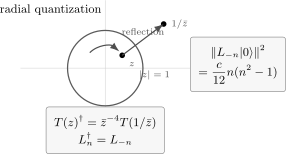
The exact example uses and and . Reflection in the unit quantization circle sends to and to . This geometry identifies reflected insertions; reflection positivity is a separate hypothesis on their correlation functions.
The holomorphic inversion has zero Schwarzian, so the stress tensor’s radial adjoint has the weight-two factor even though is not primary under a general local map:
Using the Laurent expansion on both sides gives
hence . The radial adjunction and mode convention are developed in Di Francesco, Mathieu, and Sénéchal 1997, §6.1.1, pp.151–153, Eqs.(6.1), (6.4), (6.7)–(6.10).
Take the identity vacuum with and regular at the origin. The absence of negative powers in its Laurent expansion gives
This full condition follows from regularity; global invariance alone only tests the three global generators. For ,
Reflection positivity therefore requires . This is a necessary condition, not a classification of unitary representations. The algebra itself may be studied without these positivity assumptions. The regular-vacuum condition and descendant norm agree with Di Francesco, Mathieu, and Sénéchal 1997, §6.2.2, p.157, Eqs.(6.26)–(6.27), and §7.2.1, p.205, Eq.(7.19).
Summary
Section titled “Summary”The central charge can be read in several mutually reinforcing ways.
The local OPE statement is
The infinitesimal transformation statement is
The finite geometric statement is
The mode-algebra statement is
The physical finite-size statement is that the Schwarzian shifts the cylinder Hamiltonian. Identifying its ground-state energy additionally requires the lowest weights in the chosen sector. The TT pole, affine coordinate transformation, and mode central term share one normalization.
Common pitfalls
Section titled “Common pitfalls”At nonzero central charge, the stress tensor is not a primary field under arbitrary local conformal maps. It is primary-like under the global Möbius group because the Schwarzian vanishes there, but under general holomorphic maps it has an additive term.
The affine pullback gives the positive contour variation while gives its negative near the identity. Solving a passive coordinate relation for the other tensor reverses the Jacobian and the inhomogeneous term together. Keep the held-fixed reference field explicit.
The central term in the Virasoro algebra is not optional once the OPE has a fourth-order pole. Removing it would destroy the Ward identities and the plane–cylinder Casimir shift.
The global conformal algebra is not the whole story in two dimensions. The modes form an subalgebra, but the local stress-tensor algebra contains all and is much more restrictive.
The Library treatment of The Virasoro Algebra and the Stress Tensor unifies the stress-tensor self-OPE, Laurent modes and finite conformal transformation. It provides the canonical continuation of the Schwarzian calculation performed here.
Exercises
Section titled “Exercises”Exercise 1: Infinitesimal stress-tensor anomaly
Section titled “Exercise 1: Infinitesimal stress-tensor anomaly”Use a counterclockwise local contour on a patch where the test function is holomorphic and no other insertion is enclosed. Use the OPE
to derive
Solution
By the Ward-identity contour prescription,
Only singular terms contribute. The simple pole gives
The double pole gives
The fourth-order pole gives
Adding the three pieces gives the result.
Exercise 2: Möbius maps have vanishing Schwarzian
Section titled “Exercise 2: Möbius maps have vanishing Schwarzian”Work on a coordinate patch with . In this exercise, in the matrix entries is unrelated to the central charge. Show that the Schwarzian derivative vanishes for
Solution
Let . Then
Hence
Therefore
This is why the stress tensor transforms as an ordinary weight- field under global conformal transformations.
Exercise 3: Central term from the fourth-order pole
Section titled “Exercise 3: Central term from the fourth-order pole”Starting from the OPE and the mode definition
derive the central term in . Use counterclockwise contours: after taking the difference of radial orderings, first take the local residue about with weight , then the origin-centered contour. No other singularity is crossed in the deformation.
Solution
The central term comes only from
In the contour computation,
The residue is
Thus
Exercise 4: Plane-to-cylinder Casimir shift
Section titled “Exercise 4: Plane-to-cylinder Casimir shift”Compute the Schwarzian derivative of on the cylinder of circumference . In the state transported from the normalized plane identity vacuum, assume and find the holomorphic cylinder stress expectation. No claim about a different sector’s lowest state is intended.
Solution
For ,
Therefore
The finite transformation law gives
Taking the plane vacuum expectation value gives
The antiholomorphic sector gives the analogous shift .
Exercise 5: Positivity of the stress-tensor state
Section titled “Exercise 5: Positivity of the stress-tensor state”Use the Virasoro algebra to compute . Assume the identity vacuum has unit norm, regular at the origin, and . Thus for . Compute the norm of .
Solution
The Virasoro algebra gives
The norm is
because and by conjugation. Since ,
In a unitary theory this norm is nonnegative, so this calculation gives the simple necessary condition .
References
Section titled “References”- Di Francesco, Philippe, Pierre Mathieu, and David Sénéchal. Conformal Field Theory. Graduate Texts in Contemporary Physics. New York: Springer, 1997. DOI.
Further reading
Section titled “Further reading”- A. A. Belavin, A. M. Polyakov, and A. B. Zamolodchikov, “Infinite conformal symmetry in two-dimensional quantum field theory,” Nuclear Physics B 241 (1984) 333–380.
- P. Ginsparg, “Applied Conformal Field Theory,” in Fields, Strings and Critical Phenomena, Les Houches Session XLIX, edited by E. Brézin and J. Zinn-Justin (Elsevier, 1989), pp. 1–168.
- J. Polchinski, String Theory, Volume 1 (Cambridge University Press, 1998), Sections 2.4–2.6, for the plane–cylinder map, stress-tensor anomaly, and Virasoro generators in worldsheet CFT.