

φ⁴ Theory and First Diagrams
The previous pages built the machinery: time ordering, Wick contractions, Gaussian generating functionals, functional derivatives, and Schwinger–Dyson identities. We now put those tools to work in the first genuinely interacting example: a real scalar field with a quartic self-interaction.
The interaction is simple enough to draw, but rich enough to teach nearly every organizational idea of perturbative QFT. A single vertex has four identical scalar legs. That one fact produces the first nontrivial combinatorics: vacuum bubbles, tadpoles, connected four-point functions, and symmetry factors. These diagrams are not decorative. They are a compact notation for terms in the Dyson expansion after Wick’s theorem has been applied.
The page keeps the external fields off shell and computes Green functions, not scattering amplitudes. This distinction matters: propagator corrections and connected four-point functions are the raw correlation functions from which physical amplitudes will later be extracted by amputation and on-shell limits.
The normalized interacting correlator
Section titled “The normalized interacting correlator”Let be the free vacuum and the interaction-picture field. Under the vacuum-preparation assumptions stated below, the normalized interacting correlator is represented by
This ratio uses the vacuum-preparation assumptions of the source-functional expansion: numerator and denominator share the switching, regulator and boundary prescription, and a literal ratio requires a nonzero denominator and a controlled interacting-vacuum switching limit. This is distinct from damping a fixed Hamiltonian. For a fixed self-adjoint Hamiltonian bounded below, shift the ground energy to zero and require nonzero projection of the boundary state onto a normalizable ground eigenspace; take long time at fixed damping before removing damping, specifying the selected ground-state components when that eigenspace is degenerate. The diagrams below are a formal expansion at a common regulator. Vacuum-bubble cancellation does not establish the switching limit or justify removal of the ultraviolet regulator.
The denominator is not a cosmetic normalization. It removes pieces in which part of the diagram is a vacuum bubble disconnected from the operator insertions. Without this division, an -point function would contain extra factors describing vacuum fluctuations that occur independently of the fields being measured.
Expanding to first order gives
where , , and means a free-vacuum expectation value. The subtraction term is exactly the first-order effect of dividing by the denominator.
This formula is the first place where it becomes unavoidable to distinguish several ideas that are often compressed into the phrase “draw the diagram.” Wick’s theorem generates contractions. The Dyson expansion supplies powers of and integrals over vertex positions. The normalization by cancels vacuum bubbles. What remains is organized by connectedness and by symmetry factors.
The φ⁴ vertex
Section titled “The φ⁴ vertex”The factor in the interaction is chosen so that a vertex with four distinguishable external attachments carries the simple factor . In coordinate space the vertex position is integrated over; in momentum space the same integration will later become momentum conservation at the vertex.
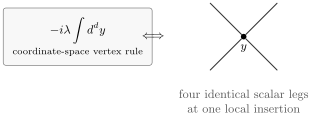
A insertion supplies four identical scalar fields at the same point . The possible attachments of four labeled external fields cancel the in , leaving the coordinate-space vertex factor .
More explicitly, for four external fields there are contractions connecting the four fields at to . Therefore
This is the simplest connected interaction diagram in scalar field theory. It is also the cleanest example of why is the natural normalization: the vertex factor is simple because the factorial has already paid for the permutations of identical fields at the vertex.
Vacuum bubbles and why they cancel
Section titled “Vacuum bubbles and why they cancel”At first order, even the vacuum functional contains a nonzero term:
Hence
Graphically this is a one-vertex vacuum bubble: the four fields at the vertex are paired into two loops. It is real QFT data about the vacuum energy, but it is irrelevant for normalized correlation functions of local operators. The division by removes all vacuum bubbles disconnected from the external insertions. This is why vacuum bubbles should not simply be erased from the theory; they are canceled in normalized correlators, while in contexts such as the cosmological constant or finite-temperature free energy they can become physically relevant.
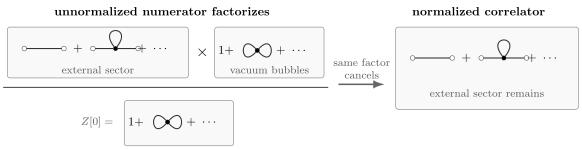
A vacuum bubble disconnected from the measured fields appears in the numerator, but the same factor appears in the denominator. Normalized Green functions keep diagrams connected to the operator insertions and discard purely vacuum factors.
The all-orders version is one of the most important bookkeeping facts in perturbation theory: disconnected vacuum bubbles exponentiate. Schematically,
and the normalized functional cancels the vacuum-bubble exponential.
Two-point function: the tadpole
Section titled “Two-point function: the tadpole”The first correction to the two-point function comes from
Wick’s theorem gives two relevant classes of terms:
The first term is a free propagator times a vacuum bubble. It is canceled by the denominator. The second term is connected to the external fields. Its factor has a simple origin: choose one of the four fields at to contract with , one of the remaining three to contract with , and then contract the last two with each other.
Thus the first interacting correction is
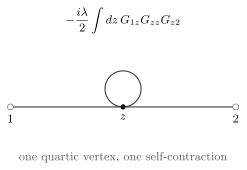
The tadpole correction to attaches two legs of the vertex to the external points and contracts the remaining two legs with each other. Its coefficient is .
The factor is the propagator evaluated at coincident points. In continuum field theory it is typically ultraviolet divergent. This is the first warning that interacting fields need renormalization. At this stage, however, the important lesson is more elementary: interactions correct propagation because a field quantum can interact with vacuum fluctuations and then continue on its way.
In momentum space, the same diagram is independent of the external momentum at this order. It behaves like a correction to the mass term. Later, this contribution will be organized as part of the self-energy.
Four-point function: the first connected vertex
Section titled “Four-point function: the first connected vertex”For a free Gaussian field, the four-point function is only a sum of pairings:
The free connected four-point function is zero. This is precisely what it means for the free theory to be Gaussian: every higher correlation function is built from two-point functions.
The first connected four-point contribution appears at order :
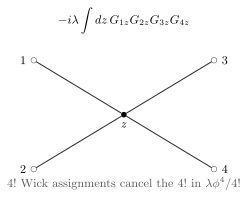
The first connected four-point function in theory has one integrated vertex. The contractions of the four identical fields at the vertex cancel the in the interaction.
The full normalized four-point function at order also contains disconnected terms: a tadpole-corrected two-point function multiplied by a free two-point function. The connected part isolates the genuinely four-field correlation. Amputating the four tree-level external propagators leaves the vertex factor . When isolated stable one-particle poles with nonzero field overlap and the required asymptotic states exist, LSZ reduction supplies the on-shell scattering interpretation with the appropriate external-state normalization. In the convention , this tree contribution is , so the invariant amplitude is ; see the scalar contact normalization check. Before reduction, the displayed expression remains an unamputated Green-function contribution.
Symmetry factors
Section titled “Symmetry factors”The preceding examples suggest a compact rule. For a coordinate-space diagram in theory,
where is the number of quartic vertices and is the symmetry factor of the diagram. Roughly speaking, counts permutations of identical internal lines and vertices that leave the diagram unchanged while the external labels are held fixed.
The examples above are:
At second order in , the two-point function contains the first “sunset” topology:
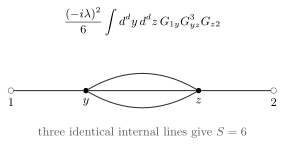
The sunset diagram has two quartic vertices and three identical internal propagators joining them. The final coefficient for the labeled two-point function is .
A quick way to see the factor is to count Wick contractions. Count labeled Wick contractions first; draw the unlabeled diagram only afterward. The Dyson expansion supplies for the two vertices and from the two interaction terms. The contractions give : either external point may attach to the first vertex, then one chooses a leg at each vertex for the two external fields, and then pairs the remaining three legs between the vertices. Therefore
Symmetry factors are not mysterious constants attached to pictures by decree. They are the residue of Wick’s theorem after the obvious factorials in the exponential and in the interaction have canceled most, but not all, of the identical contractions. Coleman 2019, § 8.4, pp. 164–165 develops this combinatorial cancellation.
Source-functional viewpoint
Section titled “Source-functional viewpoint”The same expansion can be generated without writing all Wick contractions by hand. Define the free source functional operationally by
so that field insertions are produced by . The interacting functional is
Normalized Green functions are obtained from
This formula is the algebraic engine behind the diagrams. Each functional derivative in the interaction vertex must land on a source from the Gaussian . Lines are the free two-point functions produced by the Gaussian. Vertices are the interaction derivatives. Vacuum bubbles cancel because we use , not . If a diagrammatic rule cannot be recovered from this labeled-source procedure, the rule has been remembered too vaguely.
Summary
Section titled “Summary”The quartic scalar interaction is the first place where perturbation theory becomes visibly diagrammatic. The normalized interacting correlator is the Dyson expansion of the interaction-picture theory divided by the vacuum functional. Wick’s theorem turns each term into products of free propagators.
At first order, theory produces three basic lessons. A one-vertex vacuum bubble contributes to but cancels from normalized Green functions. A tadpole corrects the two-point function and already displays the ultraviolet sensitivity of coincident propagators. A one-vertex connected four-point function gives the first genuine interaction among four scalar insertions and becomes the tree-level vertex after amputation.
The symmetry factor of a diagram is the leftover combinatorics after accounting for the factorials in the exponential and the interaction. Learning to compute these factors from Wick contractions is worth the effort: it prevents diagrams from becoming a mnemonic black box.
Common pitfalls
Section titled “Common pitfalls”- The denominator in the normalized correlator is not optional. It cancels diagrams disconnected from the external insertions.
- A free four-point function is not connected. It is a sum of products of two-point functions.
- The in does not make the vertex small by a factor of in the four-point tree diagram; it cancels the ways to attach the four legs.
- Tadpoles depend on whether the interaction is normal ordered. In perturbation theory, contractions among fields at the same vertex are removed.
- is not an innocent finite number in continuum QFT. It is a regulated quantity whose divergence will later be absorbed into renormalized parameters.
- Symmetry factors depend on what is labeled. External points in a Green function are labeled; internal vertices are integrated and may be permuted.
Exercises
Section titled “Exercises”Exercise 1
Section titled “Exercise 1”Derive the first-order tadpole correction to the normalized two-point function in theory and show that its coefficient is .
Solution
Start from
By Wick’s theorem,
Also,
The first term cancels against the denominator subtraction. Therefore
Since ,
Exercise 2
Section titled “Exercise 2”Show that the connected part of the first-order four-point function is
Solution
The relevant first-order term is
The connected contribution is the class of contractions in which each external field is contracted with one field at the vertex . There are such contractions. Each produces
Thus
Other first-order terms either cancel as vacuum bubbles or factor into lower-point functions, so they do not contribute to the connected four-point function.
Exercise 3
Section titled “Exercise 3”Derive the symmetry factor of the sunset contribution to the labeled two-point function.
Solution
At order the Dyson expansion gives
For the sunset topology, the two external fields attach to different vertices and the remaining three legs at are paired with the remaining three legs at .
There are two choices for which external field attaches to . Then there are choices for the leg at and choices for the leg at . The remaining three legs can be paired in ways. Hence the number of contractions is
Multiplying by the expansion factors gives
Therefore
Exercise 4
Section titled “Exercise 4”Suppose the interaction Hamiltonian density is instead of . Which of the first-order diagrams on this page survive?
Solution
Normal ordering removes contractions among fields inside the same interaction vertex. Therefore contractions of two fields at the same point inside are not allowed.
The one-vertex vacuum bubble requires pairing the four fields at among themselves, so it vanishes. The tadpole correction to the two-point function requires contracting two fields at with each other, so it also vanishes.
The connected four-point diagram survives. In that diagram, each of the four fields at contracts with one external field; there is no internal contraction within the same normal-ordered vertex. Thus
is unchanged.
References
Section titled “References”- Coleman, Sidney. Lectures of Sidney Coleman on Quantum Field Theory. Edited by Bryan Gin-ge Chen, David Derbes, David Griffiths, Brian Hill, Richard Sohn, and Yuan-Sen Ting. World Scientific, 2019. DOI: 10.1142/9371. § 8.4, pp. 164–165, derives the symmetry-number factor by counting equivalent Wick diagrams.
Further reading
Section titled “Further reading”- Peskin, Michael E., and Daniel V. Schroeder. An Introduction to Quantum Field Theory. Addison-Wesley, 1995. Publisher. §§ 4.1–4.2 discuss perturbative Green functions and symmetry factors in theory.
- Srednicki, Mark. Quantum Field Theory. Cambridge University Press, 2007. DOI: 10.1017/CBO9780511813917. §§ 8–10 develop path-integral generating functionals and Feynman rules in interacting scalar field theory.
- Zee, A. Quantum Field Theory in a Nutshell. 2nd ed. Princeton University Press, 2010. Publisher. Chapter I.7 introduces Feynman diagrams from source functionals.