

Operator Product Expansion in Perturbation Theory
The previous pages treated renormalization through vertices and masses. A hard loop was local when viewed from far away, so its effect could be absorbed into the coefficients of local operators. The operator product expansion is the local version of the same idea. Instead of asking how a loop corrects a vertex, we ask what happens when two local operators are brought close together.
The answer is not usually a single operator. It is an expansion:
The coefficients are singular functions fixed by short-distance physics. The operators carry the long-distance information. In a perturbative theory, Wick contractions let us calculate the coefficients explicitly. Once interactions are turned on, the same short-distance coefficients tell us which composite operators renormalize, which operators mix, and which logarithms appear in correlation functions.
This page develops the OPE in the simplest laboratory: the massless Euclidean scalar field in four dimensions, perturbed by . The goal is not merely to write formal expansions. The point is to see how the OPE reproduces two facts already encountered diagrammatically:
where is an infrared coarse-graining time, . Equivalently, with a renormalization scale increasing toward the ultraviolet,
What the OPE means inside correlation functions
Section titled “What the OPE means inside correlation functions”OPE normalization. The short-distance calculations below are Euclidean. We use the massless free propagator in four dimensions,
where . Composite operators are normal ordered with respect to this free propagator unless stated otherwise.
The two most important normalized operators on this page are
The interaction is
The factors and are not cosmetic. They fix the numerical OPE coefficients that lead to the standard one-loop coefficient for the beta function.
The operator product expansion is an asymptotic statement inside correlation functions. Let
be a collection of operators whose positions are far from the origin compared with :
Then the OPE means
The short-distance singularity in is universal for this local collision. The distant spectator operators only ask which local operator is produced at the origin.
At a scale-invariant fixed point, choose scalar scaling operators with dimensions . Dimensional analysis then fixes the leading scalar coefficient to have the form
up to tensor structures, descendant terms, and contact distributions. The constants depend on operator normalization. Away from a fixed point the Wilson coefficients also depend on running couplings and can contain logarithms of the separation.
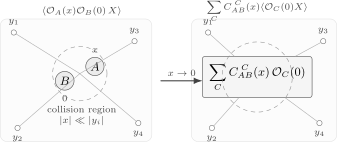
When two insertions are much closer to each other than to all other probes, their product can be replaced by a sum of local operators. The Wilson coefficients contain the short-distance singularity; the matrix elements of contain the long-distance physics.
There are four important qualifications.
First, means an expansion as , not an ordinary Taylor series. In the generic perturbative setting used here it is interpreted asymptotically. In a Euclidean conformal field theory, radial quantization instead gives genuine OPE convergence whenever a sphere can separate the fused insertions from all spectator insertions.
Second, the OPE is local. It is not a statement about long-distance factorization. It is precisely the tool used when short distances become dangerous.
Third, the choice of operator basis matters. Multiplying an operator by a constant, adding total derivatives, or changing the subtraction scheme changes the numerical Wilson coefficients. Physical predictions are invariant only after coefficients and operator normalizations are used consistently.
Fourth, the OPE is a statement about distributions. Contact terms supported at coincident points can be invisible in separated-point correlators but essential in Ward identities, operator mixing, and renormalization of integrated insertions. When an operator is integrated over spacetime, these local contact terms cannot be omitted.
The free scalar OPE from Wick contractions
Section titled “The free scalar OPE from Wick contractions”The simplest example is the free massless scalar field. Wick’s theorem gives
The second term is nonsingular as , so we expand the remaining field around the origin:
Thus
The identity operator is the most singular term. The next term is the local composite , and then come derivative descendants and higher-dimension operators.
For normal-ordered monomials, the Wick combinatorics is especially transparent. At leading order in , before writing derivative corrections,
The integer counts the number of contractions connecting the two operators. Each cross-contraction contributes one factor of . Fields left uncontracted at are Taylor expanded to the origin.
A useful example is , where . Wick contractions give
Substituting ,
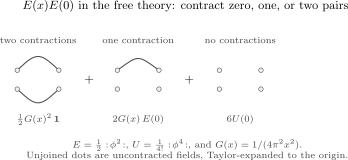
The free OPE of is just Wick’s theorem organized by how many cross-contractions connect the two composite operators. Two contractions produce the identity coefficient, one contraction produces , and zero contractions produce the local quartic operator .
This calculation already shows the general logic. The most singular term is not always the term that matters for a given physical question. In the centered free vacuum, , and the identity channel gives
This contribution is connected with respect to the two composite insertions: both cross-contractions join their vertices. Connectedness is defined by this cumulant subtraction, not by the local operator appearing in the OPE. The coefficient of controls how an insertion behaves under nearby fields. The coefficient of tells us that two thermal operators can produce the interaction operator.
The contraction rule and vanishing vacuum mean of a nonconstant normal product follow from Schwartz 2014, § 7.A, pp. 101–103. Here their Euclidean version uses in each contraction. The connected-correlator construction explains the cumulant subtraction; for the explicit two-point identity see Schwartz 2014, § 34.1.2, p. 738. The Lorentzian source-derivative factors of in that construction are absent from the Euclidean moment subtraction above.
For later comparison, here is the small amount of free-field algebra we will actually use:
| Collision | Coefficient kept | Meaning |
|---|---|---|
| identity singularity in the two-point function | ||
| thermal operator produced by a nearby thermal insertion | ||
| two thermal insertions can make the quartic interaction | ||
| one-loop renormalization of the thermal operator | ||
| one-loop renormalization of the quartic coupling |
The table is not a new principle; it is Wick’s theorem with the normalizations of and kept visible.
Composite operators and normal products
Section titled “Composite operators and normal products”Products such as and are not automatically well-defined local quantum operators. Even in the free theory,
is ultraviolet divergent. Normal ordering removes self-contractions at the same point:
and similarly for higher powers. This is enough for free-field OPE calculations. It makes each operator finite before we collide it with another operator.
In an interacting theory, normal ordering is not the whole story. Interactions introduce new short-distance divergences when a composite insertion approaches an interaction vertex or another composite insertion. Those divergences are local, so they are removed by redefining composite operators as linear combinations of local operators with the same quantum numbers. Schematically,
This is operator renormalization. The OPE is the natural language for it because it tells us exactly which local operators can appear when short-distance points collapse.
For example, in the -invariant scalar theory, even operators mix only with even operators. The operator can mix with the identity through additive vacuum terms and with total derivatives or equation-of-motion operators depending on the chosen basis. With a hard cutoff, can have power-sensitive mixing into lower-dimensional even operators such as and the identity. In a mass-independent scheme, logarithmic mixing is normally organized among operators of the same canonical dimension, together with total-derivative and equation-of-motion operators. Higher-dimensional operators are generated in the Wilsonian effective action, but that is distinct from logarithmic renormalization of a single insertion.
Endpoint logarithms in a composite two-point function
Section titled “Endpoint logarithms in a composite two-point function”Consider the two-point function of the thermal operator at separation in the massless theory perturbed by
The free answer is
At first order in ,
where the vacuum normalization gives no extra term because is normal ordered in the free theory.
The logarithmic divergence comes from two endpoint regions: close to and close to . When is close to , the relevant OPE is
Using the Wick formula with and , the term that leaves an behind is obtained by contracting the two fields in with two of the four fields in . There are
such contractions. Including the normalization factors gives
Therefore
To keep the endpoint regions disjoint, choose a fixed . Integrating near the origin over , where is a short-distance cutoff, gives
The finite term is proportional to and does not affect the universal logarithmic coefficient.
The endpoint near gives the same contribution. Hence the logarithmic part of the first-order correction is
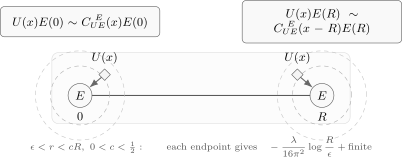
The first-order correction to has logarithmic endpoint regions. Near each endpoint, the OPE turns the integration over the interaction vertex into a multiplicative renormalization of the local operator .
This is exactly the OPE interpretation of the logarithmic factor used in the critical free-energy discussion. In the convention used here, define the multiplicative short-distance factor for each insertion by
so two insertions produce twice the logarithm. If we write , the infinitesimal form is
Once the coupling itself runs, this differential equation is integrated with , producing the logarithmic powers discussed earlier.
Interaction fusion and the one-loop beta function
Section titled “Interaction fusion and the one-loop beta function”The same logic gives the one-loop beta function for the quartic interaction. We need the OPE of two interaction operators:
From Wick contractions,
The coefficient of is the one that renormalizes the quartic coupling. Since
it is precisely logarithmic in four dimensions after integration over relative separation.
Now expand the interaction part of the Euclidean weight:
In the second-order term, focus on pairs with small separation
and center coordinate
Using the OPE,
contains
The shell integral is
Including the factor from the expansion gives
This term appears with a plus sign in the expansion of . To rewrite the result as an effective action, compare
Therefore the infrared Wilsonian flow is
Equivalently, for a renormalized coupling defined at momentum scale ,
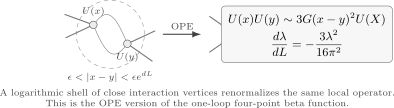
Two nearby interaction vertices fuse into a local interaction vertex. The coefficient of in the OPE is logarithmic in four dimensions, and its shell integral gives the one-loop coefficient of the beta function.
This derivation is the same physics as the one-loop bubble calculation, reorganized locally. The bubble diagram says that hard internal momenta correct the local four-point vertex. The OPE says that two nearby interaction insertions produce the same local operator already present in the action. Same coefficient, different language.
Why logarithms are selected
Section titled “Why logarithms are selected”The OPE makes the origin of logarithms almost too visible. In Euclidean dimensions, suppose
Then integrating the relative separation over a short-distance shell gives
up to the angular volume of . A coefficient with power is exactly marginal under the shell integration: it produces a logarithm.
More generally, if
then the shell integral behaves as
It is power divergent for , logarithmic for , and power suppressed for as the shell shrinks. In the language of the RG, these are the local signals of relevant, marginal, and irrelevant short-distance fusion.
For in , the coefficient has precisely the form . This is why the quartic coupling is marginal at tree level and runs logarithmically at one loop.
Summary
Section titled “Summary”The operator product expansion is the statement that short-distance operator collisions can be replaced by a sum of local operators:
In perturbation theory, the coefficients are computed by Wick contractions plus Taylor expansion. In the free scalar theory,
The coefficients of logarithmically singular terms are the local data that drive renormalization. For
we found
which gives
and
which gives
Thus the OPE is not a separate topic from renormalization. It is the operator-level expression of locality in the ultraviolet.
Common pitfalls
Section titled “Common pitfalls”Confusing normal ordering with the OPE. Normal ordering subtracts self-contractions inside one composite operator. The OPE studies singularities between two distinct insertions as their separation goes to zero.
Identifying the identity channel with disconnected terms. The free two-point function above is connected and comes entirely from the identity channel. When integrated interaction vertices produce an identity term in an effective action, it instead changes vacuum normalization or vacuum energy. These are different questions. Coupling renormalization is controlled by the coefficient of the operator already present in the action.
Treating OPE coefficients as convention-free numbers. Rescaling or changes the coefficients. The physical statement is invariant only after the operator normalization and coupling normalization are fixed.
Reading the OPE as a large-distance expansion. It is a short-distance expansion used inside correlators whose other insertions remain far away.
Exercises
Section titled “Exercises”Exercise 1 — Wick-contraction combinatorics
Section titled “Exercise 1 — Wick-contraction combinatorics”Derive the free-theory Wick formula
Explain the combinatorial factor.
Solution
Because both monomials are normal ordered, contractions are only allowed between a field at and a field at . Choose fields out of the fields in the first monomial and fields out of the fields in the second monomial. This gives
choices. Once the selected fields are chosen, pair them. There are pairings. Each pairing contributes one free propagator , so pairings contribute .
After these contractions, there are uncontracted fields at and uncontracted fields at . Taylor expanding the uncontracted fields at to the origin gives, at leading derivative order,
Summing over gives the stated formula. The omitted terms are derivative descendants and less singular terms obtained from the Taylor expansion.
Exercise 2 — The free OPE of E with E
Section titled “Exercise 2 — The free OPE of E with E”Using
show that
Solution
Start with
The Wick formula has three terms.
For , the coefficient is
so the contribution is .
For , the coefficient is
so the contribution is
For , the leading local term is
Now multiply by the normalization factor from each , giving an overall factor :
Using and , this becomes
Exercise 3 — Endpoint logarithms and thermal-operator renormalization
Section titled “Exercise 3 — Endpoint logarithms and thermal-operator renormalization”Compute the coefficient of in the OPE and use it to find the logarithmic endpoint correction to at first order in .
Solution
The term proportional to comes from contracting both fields in with two of the four fields in . The number of contractions is
Thus
Including the normalizations and , we get
Therefore
The first-order correction is
Take disjoint endpoint balls of radius , with and . The leading OPE term integrated near gives
The endpoint near gives the same logarithm. Since , the arbitrary partition contributes only a finite at fixed . The omitted region and nonleading OPE terms are needed for the full finite answer. The leading ultraviolet logarithm is independent of this partition:
Exercise 4 — Quartic fusion and the beta function
Section titled “Exercise 4 — Quartic fusion and the beta function”Show that the coefficient of in is . Then derive
for .
Solution
The term proportional to in
comes from two cross-contractions. The number of such contractions is
Therefore
Including on both sides,
Since
we have
The second-order term in the expansion of the Euclidean weight is
Using the OPE in a shell gives a contribution
The angular volume of is , so the shell integral is
Thus the second-order term contributes
to the expansion of . Re-exponentiating,
so
Exercise 5 — The dimensional criterion for a logarithm
Section titled “Exercise 5 — The dimensional criterion for a logarithm”In Euclidean dimensions, suppose an OPE contains
Classify the short-distance shell integral as power divergent, logarithmic, or power suppressed as the shell radius shrinks.
Solution
The shell integral over the relative coordinate has radial measure
so the relevant radial behavior is
If , then the exponent , and the integral is power divergent as the lower cutoff goes to zero.
If , then
is logarithmic.
If , then the integral is finite as the lower cutoff goes to zero and the contribution from a shrinking shell is power suppressed.
Thus logarithms arise precisely when the OPE coefficient scales as .
References
Section titled “References”- Schwartz, Matthew D. Quantum Field Theory and the Standard Model. Cambridge University Press, 2014. DOI.
Further reading
Section titled “Further reading”- Polyakov, Alexander M. Gauge Fields and Strings. Chur: Harwood Academic Publishers, 1987.
- Srednicki, Mark. Quantum Field Theory. Cambridge: Cambridge University Press, 2007, Sections 26–29.
- Weinberg, Steven. The Quantum Theory of Fields. Volume II: Modern Applications. Cambridge: Cambridge University Press, 1996, Sections 18.1 and 18.8.
- Wilson, Kenneth G. “Non-Lagrangian Models of Current Algebra.” Physical Review 179, no. 5 (1969): 1499–1512.
- Wilson, Kenneth G., and John Kogut. “The Renormalization Group and the Expansion.” Physics Reports 12, no. 2 (1974): 75–199.
- Zimmermann, Wolfhart. “Normal Products and the Short Distance Expansion in the Perturbation Theory of Renormalizable Interactions.” Annals of Physics 77, no. 1–2 (1973): 570–601.
- Zinn-Justin, Jean. Quantum Field Theory and Critical Phenomena. 4th ed. Oxford: Clarendon Press, 2002, Chapters 8–13.