

Noncommuting Charges and Generalized Gibbs States
Specified expectation values of noncommuting conserved charges still license a maximum-entropy state of exponential form, but not simultaneous sharp charge assignments. The multipliers combine into one modular generator, select a direction in charge space, and preserve only its centralizer. The inferred state can depend on the representation, reference frame, preparation constraints, and thermodynamic limit; it must not be conflated with an integrable GGE built from a complete commuting charge family.
A maximum-entropy and resource-theoretic derivation for noncommuting conserved quantities is given by Yunger Halpern et al. 2016, §§ Results–Discussion.
Required background. Conserved Charges and Grand-Canonical States gives compatible chemical potentials. Helpful background. Generalized Gibbs Ensembles for Integrable Charges supplies the distinct commuting integrable construction.
Maximum entropy does not require mutual commutation
Section titled “Maximum entropy does not require mutual commutation”Let Hermitian charges be exactly conserved,
but satisfy a Lie algebra
Maximizing
subject to and gives
No step in the variational derivation requires . What fails is the classical interpretation of one joint probability distribution over simultaneous eigenvalues.
The response of constraints to multipliers is not generally the equal-time covariance. Duhamel differentiation gives the Kubo–Mori matrix
This positive semidefinite information matrix controls local identifiability of modulo redundant directions. Replacing it by silently assumes commutation.
Residual symmetry and a spin example
Section titled “Residual symmetry and a spin example”For charges ,
A global rotation sends and together. Once a direction is fixed by a reference frame or preparation, the state commutes only with rotations about that axis. The residual algebra is the centralizer of .
For one spin ,
The state has a definite mean spin vector but no simultaneous sharp values of . Rotating the external reference frame rotates the multiplier; it does not produce three independent commuting chemical potentials.
Preparation and thermodynamic qualifications
Section titled “Preparation and thermodynamic qualifications”Expectation constraints may arise from a maximum-entropy inference, weak coupling to non-Abelian reservoirs, or a particular preparation protocol. These routes need not be equivalent. A resource-theoretic equilibrium construction can require a reference frame or a work-storage system carrying noncommuting charges; a finite isolated system may not operationally conserve each reservoir charge in the same way.
In the thermodynamic limit, symmetry breaking can make the map between and nonunique or discontinuous. Boundary conditions and order of limits then select phases. Maximum entropy supplies the least-biased state relative to the declared constraints; it does not prove equilibration, uniqueness across representations, or completeness of the constraint set.
Contrast with an integrable GGE
Section titled “Contrast with an integrable GGE”| Feature | Commuting integrable GGE | Noncommuting constrained state |
|---|---|---|
| Charge algebra | mutually commuting local/quasilocal family | genuinely non-Abelian or noncommuting |
| Primary issue | completeness for a thermodynamic macrostate | joint incompatibility and reference-frame dependence |
| Response matrix | ordinary covariance in common eigenbasis | Kubo–Mori/Duhamel covariance |
| Sharp values | simultaneous in principle | generally impossible |
| Typical application | post-quench integrable stationary data | non-Abelian charge constraints or reservoirs |
Both are exponential maximum-entropy states, but that shared syntax does not erase their different hypotheses.
The schematic below organizes the relationships used on this page. Inspect it with this question in mind: Which charge structures license chemical potentials or generalized equilibrium states?
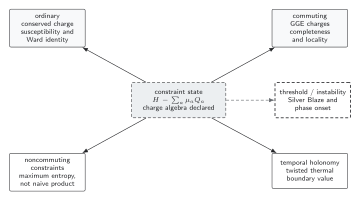
A grand-canonical state requires conserved charges and a declared algebra; commuting integrable charges, noncommuting constraints, temporal holonomies, and density thresholds demand distinct constructions and checks. Connections classify the charge structure and required construction; their direction is organizational, not a causal-time ordering. Dashed marks show qualifications and failure boundaries. The diagram is schematic and not to scale.
The surrounding discussion supplies the relevant equations and checks in text form; the figure is a navigational summary.
Exercise
Section titled “Exercise”For , show that constraining as well requires rotating the single multiplier vector rather than multiplying by an independent commuting factor .
Solution
Because , depends on ordering and is not the maximum-entropy exponential of the two constraints. The variational solution is , equal to an exponential along one resultant spin direction. Its mean aligns oppositely with that vector.
References
Section titled “References”- Jaynes, E. T. “Information Theory and Statistical Mechanics.” Physical Review 106, no. 4 (1957): 620–630. doi:10.1103/PhysRev.106.620.
- Yunger Halpern, Nicole, Philippe Faist, Jonathan Oppenheim, and Andreas Winter. “Microcanonical and Resource-Theoretic Derivations of the Thermal State of a Quantum System with Noncommuting Charges.” Nature Communications 7 (2016): 12051. doi:10.1038/ncomms12051; Open PDF.