

Thermodynamics and the QCD Equation of State
The QCD equation of state (EOS) is a set of mutually constrained thermodynamic functions, not an isolated pressure curve. At zero baryon chemical potential, continuum-extrapolated lattice QCD establishes a smooth crossover from hadronic to partonic thermodynamics and supplies the pressure, energy density, entropy density, trace anomaly, sound speed, and conserved-charge susceptibilities used by collision models. Precision claims remain inseparable from action, scale setting, continuum and volume limits, interpolation, and covariance.
Required background. Partition functions and thermodynamic response supplies the identities, and QCD fields and scales supplies the theory. Helpful background. Continuum extrapolation and EQCD/MQCD supply the low-cutoff and high-temperature comparisons.
Evidence status on this page was checked through 10 August 2026.
Thermodynamic identities at zero density
Section titled “Thermodynamic identities at zero density”For a homogeneous equilibrium system in volume ,
The interaction measure or trace anomaly is
Given a continuum and a low-temperature integration anchor,
All derived quantities are correlated because they come from the same interpolated function. The sound speed is
at zero chemical potential. Differentiation amplifies interpolation noise, so a smooth without an interpolation and covariance record is not a reproducible lattice result.
Conserved-charge susceptibilities are derivatives of the dimensionless pressure,
They constrain fluctuations and the small-density Taylor expansion, but they are equilibrium grand-canonical quantities. Mapping them to detector-acceptance cumulants requires the additional steps on the charge-fluctuation page.
What continuum lattice calculations establish
Section titled “What continuum lattice calculations establish”Physical-mass -flavor calculations from the HotQCD and Wuppertal–Budapest programs agree on a rapid but smooth change in thermodynamic observables over the crossover region, with pressure approaching but remaining below the ideal-gas limit over the temperatures studied Bazavov et al. 2014 and Borsányi et al. 2014. This agreement is meaningful because both programs varied temporal lattice extent and approached the continuum using distinct improved staggered actions and scale-setting choices.
At much higher temperature, a 2025 calculation with three massless flavors, -improved Wilson fermions, shifted temporal boundary conditions, and continuum extrapolations reported the entropy density from 3 to 165 GeV with approximately – precision Bresciani et al. 2025, Introduction. Its flavor/mass setup and temperature range must remain attached to that statement; it does not supersede physical -flavor crossover ensembles.
Comparisons to a hadron-resonance gas below the crossover and resummed perturbation theory at high temperature are valuable consistency tests. Neither comparison proves the lattice result in the intermediate region, and agreement with one truncation cannot determine uncomputed perturbative orders.
QCD equation-of-state provenance table
Section titled “QCD equation-of-state provenance table”Every distributable EOS should carry the following fields. “Required” means that omitting the field prevents an independent user from reconstructing the claimed continuum thermodynamics or propagating its uncertainty.
| Field | Required record | Failure prevented |
|---|---|---|
| Data-product version | Immutable release tag, file checksum, schema version, and evidence cutoff | Silent replacement of values under the same name |
| Theory content and action | , quark masses, chemical potentials, gauge and fermion actions, improvement coefficients | Mixing different QCD theories or cutoff effects |
| Ensemble definition | Temperatures, lattice sizes, statistics, boundary conditions, algorithm, autocorrelation treatment | Treating correlated samples as independent |
| Scale setting and line of constant physics | Scale observable, calibration, quark-mass tuning, conversion covariance | Hiding a common temperature-axis uncertainty |
| Continuum limit | Temporal extents, fit ansatz, omitted lattices, discretization terms, stability variations | Calling a finite-spacing curve continuum QCD |
| Volume limit | Spatial aspect ratios, finite-volume comparison or bound | Confusing volume rounding with crossover structure |
| Primary observable and renormalization | Measured operator, subtraction/normalization, integration anchor | Losing additive or multiplicative conventions |
| Interpolation | Functional or spline basis, knots/priors, derivative procedure, validation | Producing untraceable or spurious features |
| Perturbative or hadronic comparison | Scheme, scale, order, masses, matching interval | Presenting an external approximation as lattice data |
| Thermodynamic identities | Reconstructed and numerical closure residuals | Distributing mutually inconsistent columns |
| Covariance | Full covariance or reproducible samples across temperatures and observables | Underestimating uncertainty in hydrodynamic propagation |
| Uncertainty decomposition | Statistical, scale, continuum, volume, interpolation, integration, truncation components | Combining unlike errors or double counting |
| Source provenance | Collaboration, complete citation, table/record locator, license, transformations | Detaching numbers from the primary calculation |
A consumer should verify, for example, that the tabulated columns satisfy
within the propagated covariance. Passing these identities checks internal consistency, not the correctness of the continuum extrapolation.
Export to hydrodynamics
Section titled “Export to hydrodynamics”A hydrodynamic code needs a thermodynamically stable interpolation. At zero density, one convenient primitive is or , from which the other functions are derived consistently. The interpolation should preserve , , and causal within its declared range. Outside the lattice interval, a hadronic or perturbative extension is a new model component and must be matched with continuity conditions and an uncertainty.
At nonzero conserved densities, the EOS becomes subject to strangeness neutrality and a charge-to-baryon ratio appropriate to the colliding nuclei. A zero-density table plus a few susceptibilities is not an unrestricted finite-density EOS.
Limitations
Section titled “Limitations”Continuum QCD thermodynamics is not a real-time transport calculation. The EOS does not determine viscosities, thermalization time, or photon rates. Nor does a smooth EOS locate a unique pseudo-critical temperature: different observables give different crossover markers, as developed on the phase-structure page.
The evidence map places the zero-density equation of state at the most directly controlled end of a sequence whose assumptions grow as one moves toward dense-matter inference.
On a narrow screen, swipe or use the Left and Right arrow keys to pan across the figure. Home and End move to its edges. A full-size link is also available.
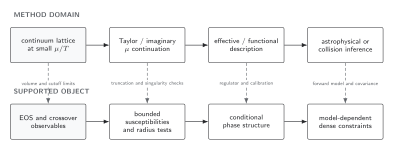
The leftmost pairing is the one used here: a specified lattice action, volumes, spacings, scale setting, and continuum limit determine equilibrium EOS observables at small . The arrows to the right organize increasingly indirect access; they are not an extrapolation rule from the zero-density curve. Each vertical dashed link names the validation needed in that method domain. The diagram is schematic and does not imply that an EOS determines real-time transport.
In text, continuum lattice data support the zero-density pressure, trace anomaly, entropy, and sound speed within their theory and temperature range. Finite-density series, model descriptions, and collision or stellar inferences require separate truncation, regulator, forward-model, and covariance checks.
Exercises
Section titled “Exercises”1. Reconstruct the pressure. Given for and , integrate the trace identity.
Solution
Since ,
The toy model illustrates why the integration anchor is part of the pressure definition.
2. Propagate a common scale shift. If every physical temperature has fractional calibration error , is it valid to add independent horizontal errors at each tabulated point?
Solution
No. A common scale-setting uncertainty is highly correlated across points. Treating it as independent permits unphysical point-to-point motion and distorts derivatives. It should enter through a nuisance parameter or the full covariance.
Continue to crossover thermodynamics for observable-dependent pseudo-critical temperatures.
References
Section titled “References”- Bazavov, A., et al. (HotQCD Collaboration). “Equation of State in (2+1)-Flavor QCD.” Physical Review D 90, no. 9 (2014): 094503. DOI.
- Borsányi, Szabolcs, et al. “Full Result for the QCD Equation of State with 2+1 Flavors.” Physics Letters B 730 (2014): 99–104. DOI.
- Bresciani, Matteo, Mattia Dalla Brida, Leonardo Giusti, and Michele Pepe. “QCD Equation of State with Flavors up to the Electroweak Scale.” Physical Review Letters 134, no. 20 (2025): 201904. DOI.
- Huovinen, Pasi, and Péter Petreczky. “QCD Equation of State and Hadron Resonance Gas.” Nuclear Physics A 837, no. 1–2 (2010): 26–53. DOI.