

Thermal Counterterms and Renormalization-Group Invariance
Finite temperature changes the state, not the local ultraviolet operator algebra. After zero-temperature subdivergences and composite-operator mixings are renormalized, the thermal occupation pieces introduce no new ultraviolet divergence. Thermal masses may be added and subtracted to reorganize infrared counting, but the subtraction vertex is part of the same theory. A truncated result is credible only when its explicit scale dependence cancels the running parameters through the claimed order.
The state-independent counterterm structure of self-consistent finite-temperature approximations is proved in van Hees and Knoll 2002, §§ II–IV.
Required background. Thermal Sum-Integrals and Vacuum Subtraction separates state-independent divergences. Local Counterterms and Subdivergence Structure supplies locality and forests. Helpful background. Scale Independence and the Callan–Symanzik Equation supplies the RG test.
Why the ultraviolet counterterms are state independent
Section titled “Why the ultraviolet counterterms are state independent”Thermal propagators can be decomposed schematically as
where contains occupation functions. At large real energy, decay exponentially. A subgraph containing at least one cut thermal line therefore has improved ultraviolet behavior; remaining divergent subgraphs are vacuum subgraphs and are removed by the ordinary local counterterms.
This argument assumes a renormalizable or properly matched EFT, a regulator compatible with the subtraction analysis, and all overlapping subdivergences included. Composite operators and background sources may require their own state-independent local counterterms. An initial-state singularity in nonequilibrium theory is a different boundary-renormalization issue.
Scalar one-loop example
Section titled “Scalar one-loop example”For Euclidean , the one-loop self-energy is
contains the dimensional pole and is canceled by the same mass counterterm fixed at . is finite. In the massless high-temperature limit,
This -dependent finite self-energy is a physical screening correction, not a temperature-dependent ultraviolet counterterm.
Resummation without changing the theory
Section titled “Resummation without changing the theory”In the site’s mostly-minus Minkowski convention, add and subtract a thermal mass :
The first bracket defines screened propagators and the second contains a compensating insertion. Power counting assigns the two pieces different perturbative orders, but omitting the compensating vertex changes the theory and double counts when self-energies are added again. Ordinary UV counterterms must also be expanded consistently in the reorganized counting.
The thermal renormalization table records this separation.
Renormalization-group check
Section titled “Renormalization-group check”For renormalized observable ,
up to anomalous dimensions and source terms appropriate to the observable. If is calculated through order , applying the RG operator should leave terms of the first omitted order, not terms already claimed.
Residual scale variation estimates sensitivity to missing terms only when all explicit logarithms, running parameters, matching coefficients, and resummed pieces are varied coherently. It is neither a statistical confidence interval nor a guaranteed bound.
Failure modes
Section titled “Failure modes”Thermal divergence misidentified. A divergence multiplying a thermal-looking diagram may be a vacuum subdivergence. Apply the forest subtraction before classifying it.
Resummation counterterm omitted. A screened propagator plus an unmodified interaction Lagrangian is not a consistent reorganization.
Scale variation performed piecemeal. Varying in logarithms while freezing exaggerates scale dependence; varying only can hide it.
The schematic below organizes the relationships used on this page. Inspect it with this question in mind: How does a thermal loop calculation pass from scale counting to a physical observable?
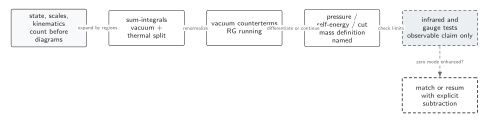
Thermal power counting chooses hard and soft regions; sum-integrals are split into vacuum and thermal parts, vacuum counterterms renormalize them, and mass, width, infrared, RG, and gauge checks bound the final observable. Solid connections show the primary relation; dashed outlines or arrows mark qualifications and failure boundaries. The diagram is schematic and not to scale.
The surrounding discussion supplies the relevant equations and checks in text form; the figure is a navigational summary.
Exercise
Section titled “Exercise”If and , at what order can running of cancel the explicit logarithm?
Solution
contains , while begins at . Therefore an explicit cannot be canceled by this beta function alone; another running parameter, lower-order coefficient, or a mistaken perturbative order is involved. RG counting diagnoses the inconsistency.
References
Section titled “References”- Collins, John C. Renormalization. Cambridge: Cambridge University Press, 1984. doi:10.1017/CBO9780511622656.
- van Hees, Hendrik, and Jörn Knoll. “Renormalization in Self-Consistent Approximation Schemes at Finite Temperature. I.” Physical Review D 65 (2002): 025010. doi:10.1103/PhysRevD.65.025010.