

Electromagnetic Probes and Thermal Radiation
Real and virtual photons couple to the electromagnetic current and escape the strongly interacting medium with little final-state rescattering. Their spectra integrate radiation over the entire collision history, so this apparent cleanliness creates a hard inverse problem: prompt production, pre-equilibrium emission, thermal QGP and hadronic rates, decays, geometry, flow, and detector acceptance all overlap.
Required background. Thermal spectral representations supplies the current correlator, thermal cuts and damping supplies rate calculations, and bulk evolution supplies the spacetime history. Helpful background. Hard probes supplies prompt baselines, and inverse-problem error budgets supplies the inference boundary.
Evidence status on this page was checked through 10 August 2026.
Rates from the electromagnetic current
Section titled “Rates from the electromagnetic current”Let
Current conservation requires the Ward identity . A regulated rate calculation that violates this identity has not consistently combined its diagrams, counterterms, or resummation.
In local equilibrium, the real-photon rate is proportional to the lightlike spectral function:
with current-charge normalization included in . For a dilepton pair with timelike momentum ,
times the lepton phase-space factor. The virtuality adds a scale and lets dileptons separate low-mass hadronic, intermediate-mass thermal, and high-mass perturbative regions imperfectly.
These formulas follow from the Wightman correlator plus KMS. Away from local equilibrium, replacing by the same equilibrium expression at an “effective temperature” is a model assumption.
Complete leading-order emission
Section titled “Complete leading-order emission”At high temperature and weak coupling, Compton/annihilation graphs are not the whole leading-order photon rate. Nearly collinear bremsstrahlung and inelastic annihilation, with multiple soft scatterings during formation, contribute at the same order and require LPM resummation Arnold, Moore, and Yaffe 2001. Matching hard and soft regions removes arbitrary separators.
At lower temperatures, hadronic many-body interactions and vector spectral functions govern important channels. Near the crossover, stitching hadronic and partonic rates must avoid double counting. Viscous corrections depend on the nonequilibrium distribution and can alter both yield and anisotropic flow.
From local rates to observables
Section titled “From local rates to observables”For a hydrodynamic history,
The local energy is . Late cells are cooler but have larger volume and stronger flow; early cells are hotter but have less developed anisotropy. This competition makes simultaneous yield and more discriminating than either alone, while also increasing sensitivity to initialization, viscosity, and switching.
The measured direct-photon sample subtracts decay photons from . Prompt photons from initial hard scattering, fragmentation photons, jet–medium photons, pre-equilibrium radiation, and thermal radiation share parts of phase space. Dileptons add correlated heavy-flavor decays, Drell–Yan, and cocktail backgrounds. Each baseline needs its own normalization and covariance.
What can be inferred
Section titled “What can be inferred”Hydrodynamic calculations that combine prompt, QGP, and hadronic sources can describe substantial parts of photon spectra and flow, but rates and bulk histories remain correlated Paquet et al. 2016. Low-mass dileptons can constrain in-medium vector spectral strength; intermediate-mass pairs can act as a thermometer only after heavy-flavor and pre-equilibrium contributions are controlled.
The defensible claim is source- and model-specific. An excess above the decay cocktail establishes additional radiation under the subtraction model. Calling that excess “thermal” requires prompt/pre-equilibrium/jet-related alternatives to be included. Extracting a temperature requires a rate, flow history, acceptance, mass window, and uncertainty propagation.
The typed electromagnetic entry in the heavy-ion global-inference provenance table requires the rate version, equilibrium/viscous validity domain, prompt and decay baselines, spacetime model, acceptance, covariance, and evidence cutoff.
The six-branch probe map isolates electromagnetic radiation as a spacetime integral of a current correlator rather than a late-time bulk observable.
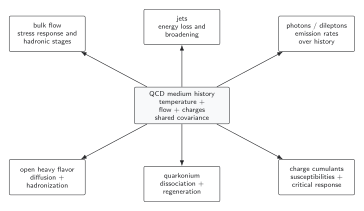
Photons and dileptons sample the evolving medium through momentum- and temperature-dependent emission rates, including viscous corrections where controlled. Prompt production, pre-equilibrium radiation, hadronic emission, and decay backgrounds are competing sources rather than interchangeable normalizations. The other five branches have distinct operators and kernels, although all share medium-history uncertainty and cross-observable covariance. The diagram is schematic and not to scale.
In text, convolve each declared rate with the same spacetime evolution, propagate acceptance and source uncertainties, and compare spectra and anisotropies with their covariance. A fitted inverse slope or yield is not a direct thermometer unless competing sources and flow are controlled.
Exercises
Section titled “Exercises”1. Flow blue shift. A massless photon with laboratory energy is emitted parallel to a fluid velocity . Find .
Solution
With and , for parallel emission. A thermal factor therefore enhances photons emitted along the flow relative to a static cell.
2. Evidence classification. A direct-photon excess agrees with a thermal calculation but pre-equilibrium radiation was omitted. What is established?
Solution
The measured excess is compatible with that thermal model. Thermal dominance is not established because an omitted source can occupy the same kinematics. Its plausible range must be added before assigning a source fraction.
Continue to open heavy flavor or global inference.
References
Section titled “References”- Arnold, Peter, Guy D. Moore, and Laurence G. Yaffe. “Photon Emission from Ultrarelativistic Plasmas.” Journal of High Energy Physics 2001, no. 11 (2001): 057. DOI.
- Ghiglieri, Jacopo, Juhee Hong, Aleksi Kurkela, Egang Lu, Guy D. Moore, and Derek Teaney. “Next-to-Leading Order Thermal Photon Production in a Weakly Coupled Quark-Gluon Plasma.” Journal of High Energy Physics 2013, no. 5 (2013): 010. DOI.
- McLerran, Larry D., and T. Toimela. “Photon and Dilepton Emission from the Quark-Gluon Plasma: Some General Considerations.” Physical Review D 31, no. 3 (1985): 545–563. DOI.
- Paquet, Jean-François, et al. “Production of Photons in Relativistic Heavy-Ion Collisions.” Physical Review C 93, no. 4 (2016): 044906. DOI.