

Long-Time Tails and Fluctuation Renormalization
Nonlinear hydrodynamic fluctuations decay only by transporting conserved quantities over ever larger distances. Their mode coupling produces algebraic long-time tails, nonanalytic frequency dependence, and cutoff-dependent renormalization of transport. The nonanalytic infrared term is a robust hydrodynamic prediction; the analytic constant absorbed into a “bare” coefficient is regulator dependent.
Required background. Hydrodynamic Fluctuations and Noise supplies equilibrium covariances. Schwinger–Keldysh Effective Actions for Fluids supplies the nonlinear loop expansion.
Helpful background. Spectral Functions and Transport Peaks translates the frequency nonanalyticity into spectral weight.
A one-loop tail from two diffusive modes
Section titled “A one-loop tail from two diffusive modes”Take two independent conserved densities in spatial dimensions. Their equilibrium correlators are
Suppose an observable contains the nonlinear constitutive term
At zero external momentum, Wick contraction of the leading Gaussian theory gives
Thus
The loop integral has a simple physical interpretation: at time , diffusion explores a volume of order , so the probability for two fluctuations to overlap falls as its inverse.
Frequency nonanalyticity
Section titled “Frequency nonanalyticity”The symmetric Fourier spectrum of the tail contains
The classical fluctuation–dissipation relation adds one power of frequency to the dissipative retarded part. After ultraviolet-local subtractions,
with logarithms at the dimensions where the Gamma-function continuation has a pole. If a transport coefficient is obtained by dividing this response by , its correction scales as . In three spatial dimensions the time tail is , the stress response has an term, and the frequency-dependent viscosity has an term. No Taylor series in integer powers of can reproduce them.
In a fluid stress correlator, the actual coefficient is a sum over shear–shear, shear–sound, heat, and charge pairs weighted by nonlinear constitutive vertices. Kovtun and Yaffe derive the universal stress tail for relativistic thermal theories, including its large- suppression Kovtun and Yaffe 2003, §§II–IV, Open PDF.
Bare and renormalized transport
Section titled “Bare and renormalized transport”The same loop includes analytic ultraviolet-sensitive terms. With a momentum cutoff , write schematically
Only their matched sum can be compared across regulators. Raising while holding the bare coefficient fixed double counts modes already encoded in microscopic transport. The nonanalytic low- coefficient, expressed in terms of renormalized susceptibilities and transport at scale , is the infrared prediction.
Hydrodynamic fluctuations also limit second-order constitutive descriptions. In three dimensions a square-root correction can dominate a nominal analytic or term sufficiently near the origin. Kovtun, Moore, and Romatschke compute this effect in relativistic hydrodynamics and derive the associated lower-consistency scale for viscosity Kovtun, Moore, and Romatschke 2011, §§II–IV, Open PDF. It is an EFT consistency statement, not a universal microscopic viscosity bound.
Dimension, volume, and quantum regime
Section titled “Dimension, volume, and quantum regime”Dimension changes the infrared severity. In , logarithms make transport run with scale; in lower dimensions nonlinear hydrodynamics can require a different universality class rather than perturbation theory. A finite box of size cuts off the tail at the diffusion time and replaces the continuum integral by discrete modes.
The calculation above is classical-statistical: supplies thermal occupation and white noise. At quantum frequencies the KMS kernel is colored. At strictly zero temperature, the exponent and coefficient cannot be imported from the classical thermal loop without a fresh microscopic and scaling analysis. The evidence review through 10 August 2026 supports the stated thermal infrared structure; it does not license a universal coefficient outside the declared dimension, slow-mode content, and regulator matching.
The fluctuating-hydrodynamics and SK consistency reference lists the regulator, matching, and power-counting declarations required before quoting a tail.
The fluctuation/SK branch also supplies the loops responsible for long-time tails. Inspect where that branch attaches to the ordinary hydrodynamic core: the nonanalyticity comes from nonlinear propagation of its existing slow modes, not from adding an integrable, Goldstone, flux, spin, or critical variable.
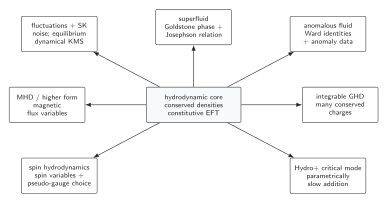
Mode-coupling loops in fluctuating hydrodynamics turn products of diffusive or sound propagators into algebraic late-time decay and nonanalytic low-frequency response. That is a fluctuation correction within a declared slow-mode set; a critical mode or integrable charge family changes the set itself. The diagram is schematic and does not display loop order, cutoff dependence, or spatial dimension.
In text: contract two regulated hydrodynamic propagators, obtain the tail, Fourier transform it with the retarded prescription, and match cutoff-dependent analytic pieces into local transport coefficients. Add another branch’s variables only if their relaxation scale is also inside the hydrodynamic window.
Exercise
Section titled “Exercise”Evaluate the tail for , , and . Estimate the finite-volume cutoff time.
Solution
Substitution gives
In a periodic cube the smallest nonzero wave number is . Its decay time is
up to the chosen definition of when the lowest mode dominates. Beyond that time the infinite-volume power law crosses to discrete exponential decay.
Common pitfalls
Section titled “Common pitfalls”Fitting the cutoff-dependent constant as a universal correction. It renormalizes a bare transport coefficient; only a matched observable is regulator independent.
Ignoring finite volume. A numerical box cannot exhibit the infinite-volume tail indefinitely.
Calling every microscopic spectral tail hydrodynamic. The hydrodynamic exponent follows from specified slow modes and vertices; unrelated thresholds can produce other power laws.
Where this leads
Section titled “Where this leads”Spectral Functions and Transport Peaks incorporates pole, delta, and branch-cut structures without forcing a Lorentzian ansatz. Hydro+ and Parametrically Slow Critical Modes treats the stronger failure caused by a new slow mode.
References
Section titled “References”-
Kovtun, Pavel, Guy D. Moore, and Paul Romatschke. 2011. “The Stickiness of Sound: An Absolute Lower Limit on Viscosity and the Breakdown of Second-Order Relativistic Hydrodynamics.” Physical Review D 84: 025006. DOI. Open PDF.
-
Kovtun, Pavel, and Laurence G. Yaffe. 2003. “Hydrodynamic Fluctuations, Long-Time Tails, and Supersymmetry.” Physical Review D 68: 025007. DOI. Open PDF.