

Dimensional Reduction and Static Effective Theories
Dimensional reduction describes static long-distance observables by integrating out every mode with a thermal frequency gap and retaining the bosonic zero modes in a lower-dimensional Euclidean theory. It is a matching statement, not the assertion that a hot quantum system literally becomes a classical theory at all frequencies. Its expansion parameter is set jointly by , the coupling, and the infrared dynamics of the reduced theory.
The general matching rules for high-temperature dimensional reduction are developed by Kajantie et al. 1996, §§ 2–4, pp. 96–117.
Required background. Thermal Modes, Matching, and EFT Power Counting supplies the mode and coefficient record. Imaginary Time and Matsubara Frequencies supplies the thermal frequency gaps. Helpful background. EQCD, MQCD, and Dimensional Reduction specializes the construction to hot non-Abelian gauge theory.
Why a three-dimensional local theory emerges
Section titled “Why a three-dimensional local theory emerges”A bosonic field has Matsubara frequencies . For a static correlator with external momentum , every propagator is analytic in away from additional thresholds. Its contribution can therefore be expanded in local operators. Fermions, whose frequencies are , have no zero mode and are also matched out.
The resulting partition function has the form
where contains the unit-operator contribution of the removed modes. Omitting it loses the hard part of the pressure even if the reduced correlators are correct.
For four-dimensional theory, define . The local action is
At leading order, and . Higher operators are suppressed by powers of and coupling-dependent matching coefficients until a critical or strong-coupling regime changes the counting.
Matching parameters and fields
Section titled “Matching parameters and fields”Match renormalized static one-particle-irreducible functions rather than equating bare Lagrangians. For example,
The momentum-independent term fixes , the coefficient of fixes field normalization, and a four-point function fixes . Full-theory diagrams containing a zero-mode subgraph must be expanded and subtracted consistently, because that infrared contribution is generated again by the reduced theory.
Introduce a factorization scale when a parametric window exists. Hard coefficients and soft matrix elements separately depend on ; their sum does not through the matched order. In practice the window can be narrow, so residual variation and higher-operator estimates are both needed.
What the reduced theory can predict
Section titled “What the reduced theory can predict”The theory directly describes static spatial correlators, screening masses, equilibrium order-parameter fluctuations, and soft contributions to thermodynamic quantities. It does not determine a retarded damping rate, noise kernel, or transport coefficient without a separate real-time matching construction.
Because has mass dimension one, the scalar reduced theory is superrenormalizable. Its effective interaction strength at momentum is . As a screening mass tends to zero, perturbation theory within the correctly matched EFT can still fail. That failure is valuable: it localizes the nonperturbative problem in a simpler theory and allows lattice or critical-RG input without recomputing the hard scale.
Validity checks
Section titled “Validity checks”- Static full- and reduced-theory correlators agree at several low momenta through the declared order.
- Field normalization and the unit operator are included, not only masses and couplings.
- The hard/soft split is independent of to the first omitted order.
- Gauge theories are matched using a gauge-consistent operator basis and physical observables.
- Higher operators remain suppressed in the momentum and parameter range used.
- No real-time conclusion is inferred from the Euclidean action alone.
Use the shared matching and double-counting table to record these checks.
The schematic below organizes the relationships used on this page. Inspect it with this question in mind: How do static and real-time thermal EFTs partition hard, soft, electric, magnetic, and dissipative modes?
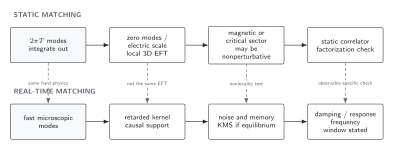
Static reduction integrates frequency-gapped modes into local Euclidean coefficients, while real-time matching fixes retarded, noise, and memory kernels; electric and magnetic sectors can require different retained theories. Solid connections show the primary relation; dashed outlines or arrows mark qualifications and failure boundaries. The diagram is schematic and not to scale.
The surrounding discussion supplies the relevant equations and checks in text form; the figure is a navigational summary.
Exercise
Section titled “Exercise”Why does a three-dimensional scalar loop scale as rather than near the screening scale, and what happens as ?
Solution
At momentum , one additional quartic loop contributes schematically . Since , the ratio can be large even for small microscopic when is sufficiently small. At criticality the reduced theory becomes nonperturbative and must be treated by critical RG, lattice methods, or another controlled nonperturbative approach.
References
Section titled “References”- Appelquist, Thomas, and Robert D. Pisarski. “High-Temperature Yang–Mills Theories and Three-Dimensional Quantum Chromodynamics.” Physical Review D 23, no. 10 (1981): 2305–2317. doi:10.1103/PhysRevD.23.2305.
- Braaten, Eric, and Agustín Nieto. “Effective Field Theory Approach to High Temperature Thermodynamics.” Physical Review D 51, no. 12 (1995): 6990–7006. doi:10.1103/PhysRevD.51.6990.
- Ginsparg, Paul. “First- and Second-Order Phase Transitions in Gauge Theories at Finite Temperature.” Nuclear Physics B 170 (1980): 388–408. doi:10.1016/0550-3213(80)90418-6.
- Kajantie, Keijo, Mikko Laine, Kari Rummukainen, and Mikhail Shaposhnikov. “Generic Rules for High Temperature Dimensional Reduction and Their Application to the Standard Model.” Nuclear Physics B 458, no. 1–2 (1996): 90–136. doi:10.1016/0550-3213(95)00549-8.