

Generalized Hydrodynamics of Integrable Systems
Generalized hydrodynamics describes Euler-scale transport in one-dimensional integrable systems whose local state requires an entire rapidity distribution rather than finitely many densities. Thermodynamic Bethe ansatz supplies state and quasiparticle densities; scattering dresses charges and velocities; a continuity equation then transports each quasiparticle species. The construction is exact at Euler scale only under integrability, completeness, and local-stationarity hypotheses.
Required background. The Hydrodynamic Limit and Slow Variables supplies the slow-variable criterion. Generalized Gibbs Ensembles and Integrable Charges supplies the local ensemble. Thermodynamic Bethe Ansatz and Finite Size supplies Bethe root densities.
Helpful background. Noncommuting Charges and Generalized Gibbs States explains why the commuting Bethe-charge setting is a special closure.
Root densities and dressing
Section titled “Root densities and dressing”For one quasiparticle species with rapidity , let be the occupied root density, the available-state density, and
the filling. For fermionic-type Bethe statistics, ; strings and other statistics require the model’s own species and entropy formula.
Write the differential scattering kernel as
The dressing of a one-particle quantity is the integral equation
This sign defines on this page. A source using the opposite scattering-phase sign must change both equations. The Bethe equation is equivalently
For a conserved charge with one-particle eigenvalue ,
The infinite set of , or equivalently the filling function under a completeness assumption, specifies the local stationary state.
Effective velocity and Euler equation
Section titled “Effective velocity and Euler equation”In an interacting gas, a tagged quasiparticle is delayed by collisions with every occupied rapidity. Dressing resums those phase shifts. Its state-dependent effective velocity is
The Euler-scale generalized hydrodynamic equation is
Multiplying by and integrating gives
In the free limit , dressing disappears and . This is the indispensable normalization check. Castro-Alvaredo, Doyon, and Yoshimura and, independently, Bertini et al. derived the Euler equation from local Bethe states and inhomogeneous transport Castro-Alvaredo, Doyon, and Yoshimura 2016, §§2–4, Open PDF and Bertini et al. 2016, pp. 1–5, Open PDF.
Partitioning protocol
Section titled “Partitioning protocol”Join two homogeneous generalized Gibbs states at and seek a self-similar solution with ray . The filling obeys the implicit rule
It is implicit because is dressed by the very filling being solved for. A reproducible calculation iterates the dressing and ray selection until both converge, resolves every string species, and checks conserved-charge fluxes.
For scattering kernel—the free-quasiparticle limit—the solution is explicit: particles faster than the ray originate on the left, and slower particles originate on the right. The interacting rule is the dressed version of that ballistic sorting.
Entropy and corrections beyond Euler scale
Section titled “Entropy and corrections beyond Euler scale”For fermionic-type filling, the Yang–Yang entropy density is
Smooth Euler evolution advects its entropy current. Diffusive corrections arise from quasiparticle scattering fluctuations and require a diffusion kernel in rapidity/species space. Their form is now well developed for many models, but it is not obtained by inserting one scalar diffusion constant into the Euler equation.
Weak integrability breaking gives charges finite lifetimes and adds collision terms. GHD may then describe a prethermal window, not the ultimate hydrodynamic limit. Incomplete string content, singular fillings, shocks in ray space, and model-dependent bound states are further failure modes. Doyon reviews the universal Euler interface and the assumptions behind extensions Doyon 2020, §§2–6. A later perspective surveys diffusion, integrability breaking, experiments, and open problems without making every extension exact Doyon et al. 2025, §§I–V, Open PDF.
The evidence cutoff for those evolving extensions is 10 August 2026. The Euler equation derived above is the established core; claims about diffusive, anomalous, experimental, or weakly broken regimes must be tied to their model and scale window.
The right-hand integrable-GHD branch displays the decisive enlargement: a rapidity-resolved family of conserved charges replaces closure by finitely many densities. Inspect its separation from spin hydrodynamics, where “spin” is a slow variable rather than an integrable charge label.
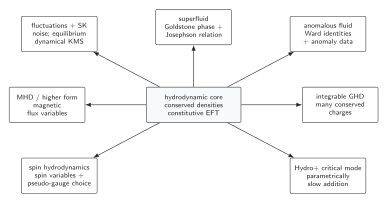
Integrability promotes the quasiparticle occupation , or equivalent charge distribution, to the Euler-scale state variable. Dressing then fixes the state-dependent effective velocity. The diagram is schematic and does not imply that diffusive corrections, anomalous superdiffusion, or weak integrability breaking follow from the Euler closure alone.
In text: specify the scattering kernel and species, solve the dressing equations, construct , and evolve each rapidity occupation by advection. When integrability-breaking rates enter the observation window, the many-charge branch crosses over to quasihydrodynamics and eventually ordinary hydrodynamics.
Exercise
Section titled “Exercise”Solve the free partitioning protocol for a right-moving species with constant velocity and fillings .
Solution
Because dressing is absent and ,
The discontinuity moves ballistically at . For several free rapidities the same rule applies to each velocity, producing a continuous fan when spans an interval.
Common pitfalls
Section titled “Common pitfalls”Using bare instead of dressed velocity. Interactions change propagation through the local filling.
Truncating strings without a convergence check. Missing species violate charge and entropy accounting.
Applying Euler GHD to a generic nonintegrable late-time state. Weak breaking supplies a finite prethermal window and new collision terms.
Where this leads
Section titled “Where this leads”Memory Functions and Slow-Mode Projection treats a finite nearly conserved basis when integrability is weakly broken. The model-specific Bethe realizations belong with their many-body systems rather than in this universal interface.
References
Section titled “References”-
Bertini, Bruno, Mario Collura, Jacopo De Nardis, and Maurizio Fagotti. 2016. “Transport in Out-of-Equilibrium XXZ Chains: Exact Profiles of Charges and Currents.” Physical Review Letters 117: 207201. DOI. Open PDF.
-
Castro-Alvaredo, Olalla A., Benjamin Doyon, and Takato Yoshimura. 2016. “Emergent Hydrodynamics in Integrable Quantum Systems Out of Equilibrium.” Physical Review X 6: 041065. DOI. Open PDF.
-
Doyon, Benjamin. 2020. “Lecture Notes on Generalised Hydrodynamics.” SciPost Physics Lecture Notes 18. DOI. Open PDF.
-
Doyon, Benjamin, Sarang Gopalakrishnan, Frederik Møller, Jörg Schmiedmayer, and Romain Vasseur. 2025. “Generalized Hydrodynamics: A Perspective.” Physical Review X 15: 010501. DOI. Open PDF.