

Landau–Ginzburg Functional Landscapes and Order Parameters
A Landau–Ginzburg functional is a scale-dependent free-energy model for long-wavelength order-parameter configurations. It organizes symmetries, phases, correlation lengths, interfaces, and defects, but it is neither automatically the exact 1PI effective action nor a gauge-invariant observable.
Required background. Use Gaussian fluctuations and effective free energy for the quadratic kernel and symmetry realization and order parameters for what an order parameter can establish.
Helpful background. Universality classes and scaling functions explain which microscopic coefficients become irrelevant near a critical point.
Symmetry-allowed coarse-grained functional
Section titled “Symmetry-allowed coarse-grained functional”For real order-parameter components coarse grained below a momentum scale , the derivative expansion begins
contains every invariant allowed by the microscopic symmetries and explicit sources . The field representation, transformation law, and residual symmetry of each candidate minimum must be stated. Omitting an allowed cubic invariant can turn a first-order transition into an apparent continuous one; adding a forbidden term can manufacture a barrier.
The Hessian of at a homogeneous stationary point tests local stability. With constant , a small eigenvalue gives a mean-field correlation length . This identification fails when higher gradients compete, changes sign, anomalous scaling dominates, or the chosen field is not the physical correlator being measured.
The coarse-graining label matters. Integrating additional fluctuations changes , , and the apparent barrier. A Wilsonian action integrates out modes above ; a constrained free energy conditions an averaged order parameter; a 1PI Legendre effective action includes all fluctuations and is convex in finite volume. The scale-dependent logic is developed in Wilson and Kogut 1974, §§ 2–4. These objects answer different questions and must not be denoted by the same unqualified “potential.”
The diagram locates a Landau–Ginzburg functional within the chain from a declared order parameter to a physical phase claim. Inspect the dashed lower branch: a local barrier signals metastability, but it does not supply a nucleation rate.
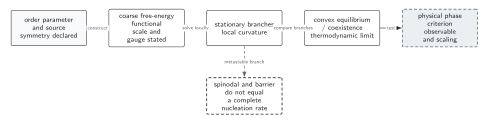
A coarse-grained functional classifies candidate stationary branches only after its fields, symmetry, scale, and any gauge choice are declared. Convex equilibrium and observable finite-volume or scaling criteria are separate tests; the dashed branch marks a metastable construction, not a decay calculation. The diagram is schematic and not to scale.
The sections Symmetry-allowed coarse-grained functional, Order-parameter completeness and defects, and Failure tests give the text and equation equivalent of this chain.
Checked interface solution
Section titled “Checked interface solution”Consider one scalar with
The planar interface between and obeys . Multiplying by and using the boundary conditions gives , hence
The surface tension is
Dimensions provide an immediate check: in three spatial dimensions is energy per area. The profile is a mean-field result for a planar, static interface; capillary fluctuations, curvature, additional fields, and scale dependence correct it.
Order-parameter completeness and defects
Section titled “Order-parameter completeness and defects”A scalar expectation value can distinguish phases only when its symmetry and observability are appropriate. Gauge-variant background fields are coordinates on a calculation, not physical order parameters. Nonlocal operators, higher-form symmetries, topological sectors, or density matrices may be needed. For a multicomponent field, the vacuum manifold determines candidate defects through its homotopy groups, but finite energy and dynamical stability require the gradient and gauge sectors as well.
A robust construction records:
- the microscopic symmetry and all explicit breakings;
- the transformation and normalization of each field;
- the coarse-graining scale and retained invariants;
- the range in which the gradient expansion is controlled;
- the fluctuation criterion, such as the Ginzburg region; and
- which statement is about a branch of a coarse-grained functional rather than the exact equilibrium free energy.
Failure tests
Section titled “Failure tests”Vary while matching long-distance observables; add the first omitted invariant and derivative operator; test the Hessian and boundedness in every field direction; compare predicted phase labels with gauge-invariant or operational observables; and estimate when fluctuations invalidate mean field. A barrier that disappears under a controlled change of description cannot by itself support a nucleation claim.
Exercise
Section titled “Exercise”For with , find the homogeneous minima and curvature masses on both sides of .
Solution
For , the only minimum is with curvature . For , is unstable and the minima are . There . This mean-field bifurcation does not determine the true critical exponents inside the fluctuation-dominated region.
Continue
Section titled “Continue”Construct loop- and ring-improved landscapes on thermal effective potentials, then decide which features survive as physical criteria on convexity and gauge dependence.
References
Section titled “References”- Ginzburg, V. L., and Landau, L. D. (1950). “On the Theory of Superconductivity.” Zhurnal Eksperimental’noi i Teoreticheskoi Fiziki 20, 1064–1082. English translation.
- Wilson, K. G., and Kogut, J. (1974). “The Renormalization Group and the Expansion.” Physics Reports 12, 75–199. DOI.