

Noise, Dissipation, and Fluctuation Relations
Noise and dissipation are two orderings of the same environment correlation function. In thermal equilibrium the KMS condition relates them at every frequency; outside equilibrium, stationarity and positivity survive but the thermal relation generally does not. A frequency-dependent “effective temperature” is therefore a diagnostic of a chosen operator and frequency range, not a thermodynamic temperature unless additional equilibration tests succeed.
Required background. Influence functionals identify the retarded and noise kernels in the reduced action. KMS relations and fluctuation–dissipation derive the equilibrium contour identity. Helpful background. Generalized noise develops colored, multiplicative, and conserved stochastic sectors.
One correlator, three kernels
Section titled “One correlator, three kernels”For a stationary environment and a Hermitian coupling operator , define
Using the site’s Fourier convention, introduce the spectral and symmetrized functions
The retarded function is
Thus the commutator fixes absorption minus emission and the anticommutator fixes their sum. A field coupled linearly to inherits a retarded self-energy proportional to and a noise kernel proportional to . The dispersive real part of follows from its absorptive part by a subtracted dispersion relation once ultraviolet behavior and counterterms have been specified.
For a stationary positive state, is a positive spectral measure. Consequently,
for a scalar channel, with a positive-semidefinite matrix version for several operators. This is a quantum noise constraint independent of thermal equilibrium. It prevents arbitrary reduction of fluctuations at fixed absorption and emission asymmetry.
Thermal fluctuation–dissipation relation
Section titled “Thermal fluctuation–dissipation relation”For , the KMS condition gives
Solving for the symmetric combination yields
This is the quantum fluctuation–dissipation relation in the present normalization. At ,
so an Ohmic absorptive kernel gives white noise . At zero temperature the factor tends to : quantum vacuum noise remains even though thermal occupation vanishes.
The relation depends on operator ordering. A normally ordered detector spectrum, a symmetrized spectrum, and a Keldysh correlator have different zero-point terms. A quoted “noise temperature” is meaningless unless the ordering, Fourier normalization, and measured channel are stated. The foundational equilibrium derivations are Callen and Welton 1951 and Kubo 1957; modern quantum measurement conventions are compared in Clerk et al. 2010, §§II–IV.
Same damping, different noise
Section titled “Same damping, different noise”For positive frequency, write a bosonic bath spectrum as
Then
Two stationary baths can therefore have the same and hence the same linear damping, while different occupations give different noise. A thermal bath has with one . A driven distribution can have an arbitrary nonnegative frequency profile consistent with its preparation. Equal damping data cannot distinguish them.
One may define, where the ratio is admissible,
For equilibrium, for every coupled operator. Out of equilibrium it can depend on frequency, momentum, observable, and reservoir. A constant low-frequency limit can organize a universality class, but it does not establish a Gibbs state at higher frequencies.
Squeezed environments add anomalous correlators such as with phase-sensitive quadrature noise. Active baths can produce negative damping in a band, requiring saturation for stability. With multiple reservoirs,
and baths at different temperatures generally do not combine into a single KMS relation.
A reproducible comparison
Section titled “A reproducible comparison”To compare a thermal and driven bath with equal damping:
- Fix the same spectral function and regulator.
- Choose a thermal from KMS and a positive driven that differs over a stated band.
- Propagate the same field mode or compute in one convention.
- Confirm identical retarded poles and different equal-time variance or occupation.
- Vary the frequency band, cutoff, and mode to show where a fitted is constant.
This comparison separates response from fluctuations without claiming that every positive pair has a microscopic realization. If a full reduced quantum dynamics is needed, test the corresponding rate or Kossakowski matrices as well.
Common failure modes
Section titled “Common failure modes”Applying FDT to every stationary state. Stationarity gives frequency conservation. KMS, not stationarity, gives the thermal ratio.
Discarding vacuum noise. The zero-temperature symmetrized spectrum contains the commutator contribution required by quantum uncertainty.
Using one-number effective temperature. Report its frequency, momentum, and operator dependence and compare more than one channel.
Taking white noise without a bandwidth. A local delta kernel is an approximation to a spectrum over the system frequencies; it is not a literal ultraviolet-complete bath.
The diagram shows where noise and dissipation enter before any white-noise, Markov, or fluctuation–dissipation approximation is imposed.
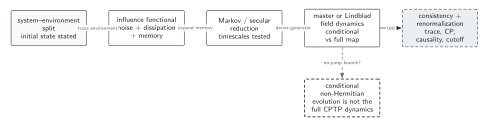
Noise and retarded response are already paired in the influence functional, but their equilibrium fluctuation–dissipation relation does not follow merely from tracing out an environment. The solid path marks the additional memory and secular reductions needed for a local master equation, and the final node requires positivity, causality, and ultraviolet control. The diagram is schematic; it does not make colored noise white or assign an effective temperature out of equilibrium.
In text, the symmetric kernel fixes fluctuations and the retarded kernel fixes response. KMS symmetry relates them only in equilibrium; a delta-correlated kernel further requires a declared frequency window in which the bath spectrum is effectively flat.
Exercises
Section titled “Exercises”Derive the thermal relation from KMS.
Solution
KMS gives . Hence and . Their ratio is .
Can two equilibrium baths at temperatures generally be assigned one effective temperature after their kernels are added?
Solution
No. Their summed ratio is a spectral-weighted combination of and . Unless one bath dominates, the temperatures coincide, or a restricted low-frequency limit collapses the ratio, it is frequency dependent and fails a single KMS condition.
Continue to memory and driven steady states
Section titled “Continue to memory and driven steady states”Non-Markovian dynamics retains the temporal structure of these kernels. Driven steady states and criticality asks whether long-distance dynamics develops an emergent thermal relation or remains genuinely nonequilibrium.
References
Section titled “References”- Callen, Herbert B., and Theodore A. Welton. “Irreversibility and Generalized Noise.” Physical Review 83 (1951): 34–40. doi:10.1103/PhysRev.83.34.
- Clerk, Aashish A., Michel H. Devoret, Steven M. Girvin, Florian Marquardt, and Robert J. Schoelkopf. “Introduction to Quantum Noise, Measurement, and Amplification.” Reviews of Modern Physics 82 (2010): 1155–1208. doi:10.1103/RevModPhys.82.1155. Open preprint.
- Feynman, Richard P., and Frank L. Vernon Jr. “The Theory of a General Quantum System Interacting with a Linear Dissipative System.” Annals of Physics 24 (1963): 118–173. doi:10.1016/0003-4916(63)90068-X.
- Kubo, Ryogo. “Statistical-Mechanical Theory of Irreversible Processes. I. General Theory and Simple Applications to Magnetic and Conduction Problems.” Journal of the Physical Society of Japan 12 (1957): 570–586. doi:10.1143/JPSJ.12.570.