

QCD Phase Structure and Crossover Thermodynamics
At physical quark masses and zero baryon chemical potential, thermal QCD undergoes a crossover rather than a thermodynamic phase transition. Chiral, deconfinement-related, and screening observables change rapidly over an overlapping temperature interval, but no single observable-independent critical temperature exists. At small baryon density the crossover line can be expanded; a critical endpoint at larger density remains unresolved.
Required background. The QCD equation of state supplies continuum thermodynamics, and Wilson and Polyakov loops supplies static confinement diagnostics. Helpful background. Thermodynamic limits, phases, and ensemble equivalence explains how a true singularity differs from a finite-volume crossover.
Evidence status on this page was checked through 10 August 2026.
Crossover rather than transition
Section titled “Crossover rather than transition”A phase transition requires nonanalyticity of the infinite-volume free-energy density. With physical up, down, and strange quark masses at , continuum lattice studies find smooth volume behavior and no such singularity Aoki et al. 2006. Different response functions therefore define different pseudo-critical temperatures:
for a susceptibility-like diagnostic, or an inflection point for an order-parameter-like diagnostic. The superscript is part of the result.
For chiral symmetry, useful observables include a renormalized light-quark condensate and chiral susceptibility,
Additive and multiplicative renormalizations must be specified. HotQCD’s continuum analysis of chiral observables reported a pseudo-critical temperature near 156 MeV with a few-MeV total uncertainty under its stated definition Bazavov et al. 2019. This is not “the” temperature at which every QCD observable changes.
The renormalized Polyakov loop is an exact order parameter only in the infinitely heavy-quark limit, where center symmetry is exact. With dynamical physical quarks, center symmetry is explicitly broken; the loop and related static-energy observables remain useful deconfinement diagnostics but do not define a unique transition. Chiral and deconfinement observables can also have different volume and chemical-potential dependence, as continuum-informed 2025 comparisons emphasized Borsányi et al. 2025.
Scaling toward the chiral limit
Section titled “Scaling toward the chiral limit”Near a second-order chiral transition in the light-quark-mass limit, the singular free energy is organized by scaling variables
and an order parameter has the form
For two light flavors with an effectively restored/non-restored axial anomaly under the appropriate assumptions, the expected universality class requires care; staggered lattice actions at finite spacing can exhibit rather than continuum symmetry. A scaling fit must include regular terms, cutoff effects, mass range, and the assumed universality class. Good collapse over a finite window supports the scaling hypothesis; it does not prove the order of a remote finite-density transition.
Small-density crossover line
Section titled “Small-density crossover line”Charge-conjugation symmetry makes the leading baryon-chemical-potential correction even:
Taylor expansion around and analytic continuation from imaginary chemical potential give continuum constraints on in a limited domain Borsányi et al. 2020. The domain is set by truncation, analytic structure, and statistical precision; the polynomial is not a license to extrapolate to arbitrarily large .
A 2025 continuum-improved analysis used zero-density EOS data and imaginary-chemical-potential simulations to constrain possible critical behavior Borsányi et al. 2025. Its exclusion regions are conditional on the explored domain, entropy-contour method, strangeness-neutral trajectory, and statistical construction. They narrow possibilities; they do not prove that a critical point exists elsewhere.
QCD phase and charge provenance table
Section titled “QCD phase and charge provenance table”This table defines the record shared with conserved-charge fluctuations and dense-QCD access.
| Field | Phase/crossover calculation must record | Collision-cumulant or dense-QCD calculation must record |
|---|---|---|
| Version and evidence status | Immutable analysis version, cutoff date, superseded results | Dataset/reconstruction/model release and cutoff date |
| Theory and observable | Action, flavors, masses, renormalized chiral/Polyakov/screening definition | Conserved charge or proxy, cumulant/factorial cumulant; dense matter degrees of freedom |
| Temperature and chemical potentials | Scale setting; ; neutrality constraints | Freeze-out/evolution map or cold beta-equilibrium and charge-neutrality conditions |
| Continuum control | Lattice spacings, fit ansatz, cutoff stability | Continuum/UV regulator where applicable; otherwise explicit “not available” |
| Volume control | Aspect ratios and finite-size scaling or bound | Geometric volume fluctuations, centrality resolution, global conservation; finite stellar/collision system |
| Pseudo-critical definition | Peak, inflection point, scaling estimator, observable label | Criterion used to map data/model to a phase-region statement |
| Expansion or continuation | Taylor order, imaginary- range, Padé/analytic ansatz, convergence tests | Beam-energy/density interpolation and method-validity range |
| Acceptance and efficiency | Not applicable for equilibrium lattice data | Rapidity and momentum cuts, species, efficiency response, unfolding/closure |
| Critical scaling and dynamics | Universality hypothesis, exponents, regular terms, scaling window | Dynamic universality, relaxation time, finite-time/size evolution, noncritical baseline |
| Centrality and event selection | Not applicable | Estimator, autocorrelation removal, bin-width correction, pileup and volume model |
| Covariance | Cross-temperature, cross-observable, scale and fit covariance | Statistical and correlated systematic covariance across orders, energies, and acceptances |
| Source and claim | Primary record, complete citation, strongest supported crossover/exclusion statement | Collaboration/source identity and explicit “measurement,” “constraint,” “indication,” or “discovery” status |
No null entry should be silently dropped: “not applicable” and “not evaluated” have different meanings. In particular, a measured net-proton cumulant without acceptance, efficiency, centrality, and covariance fields cannot be directly compared to a grand-canonical baryon susceptibility.
Limitations
Section titled “Limitations”The physical-mass crossover at small is established. Its pseudo-critical temperatures and curvature are observable- and trajectory-dependent. Neither a crossover curve nor an apparent nonmonotonic collision observable establishes a critical endpoint. Dense-QCD access and dynamical fluctuation transport are separate problems.
The map separates the established small-density crossover from progressively more conditional statements about finite-density structure.
On a narrow screen, swipe or use the Left and Right arrow keys to pan across the figure. Home and End move to its edges. A full-size link is also available.
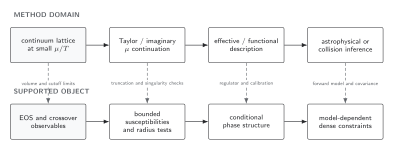
EOS and crossover observables occupy the controlled small- domain, where different susceptibilities define different pseudo-critical markers. Taylor and imaginary- continuations support bounded curvature and susceptibility statements after truncation and singularity tests. Farther-right phase and dense-matter claims are conditional on their functional, effective, astrophysical, or collision framework. The diagram is schematic and is not a phase diagram.
The textual boundary is decisive: a crossover line does not entail a critical endpoint, and an exclusion within a tested finite-density region does not establish one outside it. Every phase claim must retain its trajectory, observable, regulator, uncertainty, and evidence date.
Exercises
Section titled “Exercises”1. Definition dependence. Let . Find its inflection-point pseudo-critical temperature and compare it with the maximum of .
Solution
The second derivative vanishes at , and is maximal there. For this symmetric toy curve the two definitions agree. Generic QCD observables contain regular and asymmetric contributions, so the agreement is not universal.
2. Truncation test. At what parametric size does the quartic term compete with the quadratic term?
Solution
Writing , the terms are comparable when , or . Before that point, uncertainties in both coefficients still need propagation; after it, a quadratic extrapolation is not controlled.
Continue to conserved-charge fluctuations.
References
Section titled “References”- Aoki, Y., G. Endrődi, Z. Fodor, S. D. Katz, and K. K. Szabó. “The Order of the Quantum Chromodynamics Transition Predicted by the Standard Model of Particle Physics.” Nature 443 (2006): 675–678. DOI.
- Bazavov, A., et al. (HotQCD Collaboration). “Chiral Crossover in QCD at Zero and Non-Zero Chemical Potentials.” Physics Letters B 795 (2019): 15–21. DOI.
- Borsányi, Szabolcs, et al. “QCD Crossover at Finite Chemical Potential from Lattice Simulations.” Physical Review Letters 125, no. 5 (2020): 052001. DOI.
- Borsányi, Szabolcs, et al. “Chiral versus Deconfinement Properties of the QCD Crossover: Differences in the Volume and Chemical Potential Dependence from the Lattice.” Physical Review D 111, no. 1 (2025): 014506. DOI.
- Borsányi, Szabolcs, et al. “Lattice QCD Constraints on the Critical Point from an Improved Precision Equation of State.” Physical Review D 112 (2025): L111505. DOI.