

Finite-Density Correlators and Charge Susceptibilities
Finite density modifies correlators through the state, charged detailed balance, operator mixing, and background-field contact terms. The thermodynamic susceptibility is the Hessian of the pressure and equals a static density correlator only after those terms and the order of limits are matched. Conservation produces a hydrodynamic pole whose static and uniform dynamic limits do not commute; a negative susceptibility eigenvalue diagnoses instability of the assumed homogeneous branch.
The relation among conserved densities, susceptibilities, and hydrodynamic correlators is developed in Forster 1990, chs. 2–4.
Required background. Chemical Potentials and Finite-Density Ensembles derives the grand-potential Hessian. Spurions, Local Counterterms, and Symmetry Response supplies contact-term and scheme control. Helpful background. Contact Terms, Magnetization Currents, and Order of Limits gives the full transport treatment.
Thermodynamic Hessian
Section titled “Thermodynamic Hessian”For pressure ,
At finite volume with commuting Hermitian charges,
The matrix is positive semidefinite in a stable unconstrained ensemble. A fixed-charge ensemble removes the corresponding zero mode, so comparing its fluctuation directly with grand-canonical is a constraint mismatch.
When a background source changes the current operator explicitly, the second derivative of has both a connected correlator and a local contact term:
Omitting the second term can violate a Ward identity or produce the wrong static susceptibility.
Charged spectral weights
Section titled “Charged spectral weights”Let lower charge by , , and use physical- evolution. Then
For , the relevant spectral pair is and . Oddness and positive-frequency positivity of a neutral Hermitian channel do not transfer unchanged. Instability appears when the grand energy reaches zero for an eligible excitation or collective mode.
Diffusive pole and noncommuting limits
Section titled “Diffusive pole and noncommuting limits”For one conserved density with constitutive relation
linearized conservation gives . With source convention , the site convention gives the retarded density correlator
up to local contact conventions. The corresponding nonlocal physical response to is , so
whereas
The static order takes before making the perturbation spatially uniform. Reversing the order asks a strictly conserved total charge to respond dynamically at nonzero frequency. Writing simply both misses the site’s response sign and hides this physical distinction.
Mixed energy, charge, and electric-current responses form matrices. Magnetization currents can contribute at finite momentum without transporting charge through the sample. The transport chapter separates these from conduction response.
Stability and validation
Section titled “Stability and validation”- Diagonalize the full susceptibility matrix in a fixed charge basis.
- Include source dependence of the operators and renormalized local counterterms.
- Verify Ward identities before taking zero-frequency or zero-momentum limits.
- Keep fixed-density and fixed-chemical-potential ensembles distinct.
- For charged operators, state the adjoint and physical versus modular frequency.
- Test the same from thermodynamic derivatives, integrated Euclidean correlations, and the static retarded limit.
A disagreement can reveal a contact-term error, poor equilibration, noncommuting limits, or an unstable branch. It is not automatically a failure of fluctuation–dissipation.
The schematic below organizes the relationships used on this page. Inspect it with this question in mind: Which charge structures license chemical potentials or generalized equilibrium states?
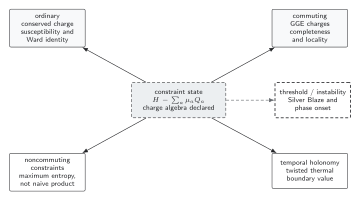
A grand-canonical state requires conserved charges and a declared algebra; commuting integrable charges, noncommuting constraints, temporal holonomies, and density thresholds demand distinct constructions and checks. Connections classify the charge structure and required construction; their direction is organizational, not a causal-time ordering. Dashed marks show qualifications and failure boundaries. The diagram is schematic and not to scale.
The surrounding discussion supplies the relevant equations and checks in text form; the figure is a navigational summary.
Exercise
Section titled “Exercise”Using the diffusive form above, locate the pole and show that its residue vanishes at .
Solution
The pole is at , in the lower half-plane for . The numerator is , so the response of a strictly uniform density vanishes at nonzero frequency. This is required by conservation of total charge.
References
Section titled “References”- Forster, Dieter. Hydrodynamic Fluctuations, Broken Symmetry, and Correlation Functions. Boca Raton: CRC Press, 1990. doi:10.1201/9780429493683.
- Kubo, Ryogo. “Statistical-Mechanical Theory of Irreversible Processes. I.” Journal of the Physical Society of Japan 12, no. 6 (1957): 570–586. doi:10.1143/JPSJ.12.570.