

Spin Hydrodynamics, Polarization, and Pseudo-Gauge Dependence
Spin hydrodynamics is required only when a spin density relaxes on the same scale as conserved energy, momentum, and charge. The split of total angular momentum into orbital and spin currents is pseudo-gauge dependent, while integrated total angular momentum and consistently defined asymptotic polarization observables are invariant. A local spin tensor or spin chemical potential is therefore not an observable until its pseudo-gauge, closure, and measurement map are specified.
Required background. Matrix-Valued Kinetics and Coherent Transport supplies spin-coherence dynamics. Conservation Laws and Hydrodynamic Fields supplies stress-tensor conservation.
Helpful background. Viscous Hydrodynamics, Particlization, and Hadronic Afterburners supplies the freeze-out interface where polarization predictions become particle observables.
Angular-momentum conservation
Section titled “Angular-momentum conservation”Let be a not-necessarily symmetric stress tensor and a spin current. The total angular-momentum current is
With , total conservation requires
The antisymmetric stress is thus the local exchange rate between orbital and spin angular momentum. Choosing a symmetric Belinfante stress moves that exchange into an improvement and can set the explicit spin tensor to zero; it does not remove the spin carried by asymptotic particles.
Pseudo-gauge transformation
Section titled “Pseudo-gauge transformation”For a local superpotential , define
Substitution shows that differs from by a total divergence. If the surface term vanishes, the integrated four-momentum and total angular momentum agree. Local energy, spin, and orbital densities generally do not. Speranza and Weickgenannt review the canonical, Belinfante, de Groot–van Leeuwen–van Weert, and Hilgevoord–Wouthuysen choices and their physical qualifications Speranza and Weickgenannt 2021, §§2–4, Open PDF.
The transformation must be applied to the density operator, sources, constitutive tensors, and observable map together. Transforming only and while holding a local-equilibrium ansatz or freeze-out formula fixed compares different models, not two conventions.
Is spin an independent slow variable?
Section titled “Is spin an independent slow variable?”Let be the spin density and its thermodynamic conjugate. A minimal linear relaxation equation is
If , spin is not hydrodynamic and can be integrated out, leaving higher-derivative constitutive terms. If is parametrically small, spin is quasihydrodynamic and must be retained. The decision depends on the interaction, mass, temperature, and wave-number window; angular-momentum conservation alone does not force an independently slow spin mode.
Linear response to torsion or an independent spin connection provides Kubo formulae for and spin transport. Hongo et al. formulate this source method and show how spin relaxation enters a controlled derivative counting Hongo et al. 2021, §§2–5, Open PDF.
From fluid spin to measured polarization
Section titled “From fluid spin to measured polarization”Experiments measure an asymptotic particle spin density matrix or a decay-angular distribution, not directly. A prediction requires:
- a pseudo-gauge and hydrodynamic frame;
- a local distribution or Wigner function with spin and side-jump convention;
- a freeze-out hypersurface and nonequilibrium correction;
- resonance decays and final-state interactions;
- detector acceptance and event-plane definitions.
The Pauli–Lubanski spin vector of an asymptotic particle is invariant under a consistent reorganization of local orbital and spin contributions. A difference between two pseudo-gauge calculations is physical only after both use the transformed density operator and measurement map; otherwise it is a convention or closure discrepancy.
Current spin-hydrodynamic formulations do not yet supply one universally accepted nonlinear causal closure with a unique freeze-out prescription. Results should therefore be reported with their pseudo-gauge, relaxation hierarchy, and observable map rather than as universal polarization coefficients. This assessment was checked through 10 August 2026 against a recent pedagogical review, which likewise treats pseudo-gauge choice, constitutive closure, strong rotation, and freeze-out as active qualifications Huang 2024, §§3–6, Open PDF.
The lower-left spin branch records both requirements emphasized here: spin must be slow enough to retain as a field, and a pseudo-gauge convention must be declared before local spin and orbital densities are compared.
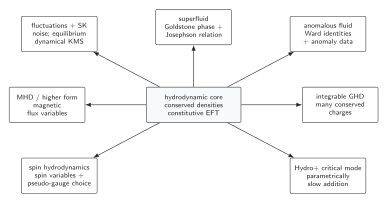
Spin hydrodynamics extends the slow set only when spin–orbital equilibration is parametrically slow. Local spin density, antisymmetric stress, and polarization maps depend on pseudo-gauge and closure, although integrated conserved charges remain invariant under admissible transformations. The diagram is schematic and does not choose a causal nonlinear closure or freeze-out prescription.
In text: compare the spin-relaxation rate with the frequencies of interest, retain spin density only when required, state the pseudo-gauge transformation of and , and map to the measured polarization observable in that same convention.
Exercise
Section titled “Exercise”Show directly that the integrated four-momentum is unchanged by the pseudo-gauge transformation for fields that decay at spatial infinity.
Solution
On a constant-time slice,
Gauss’s theorem converts this to a surface integral. It vanishes when decays sufficiently rapidly or under compatible periodic boundary conditions. With a physical boundary, the surface term must be retained and can be measurable.
Common pitfalls
Section titled “Common pitfalls”Promoting spin because particles have spin. The hydrodynamic criterion is a parametrically slow relaxation rate.
Calling a local spin density pseudo-gauge invariant. Only consistently transformed charges and observables have that status.
Comparing freeze-out formulas after transforming only the currents. The density operator, Wigner function, and boundary terms must transform too.
Where this leads
Section titled “Where this leads”Hydro+ and Parametrically Slow Critical Modes applies the same slow-mode logic to a critical nonconserved variable. Nonlinear Response and Higher-Order Kubo Relations supplies the multipoint response needed for polarization couplings beyond linear order.
References
Section titled “References”-
Hongo, Masaru, Xu-Guang Huang, Matthias Kaminski, Mikhail Stephanov, and Ho-Ung Yee. 2021. “Relativistic Spin Hydrodynamics with Torsion and Linear Response Theory for Spin Relaxation.” Journal of High Energy Physics 2021 (11): 150. DOI. Open PDF.
-
Huang, Xu-Guang. 2024. “An Introduction to Relativistic Spin Hydrodynamics.” arXiv:2411.11753 [hep-ph]. Abstract. Open PDF.
-
Speranza, Enrico, and Nora Weickgenannt. 2021. “Spin Tensor and Pseudo-Gauges: From Nuclear Collisions to Gravitational Physics.” European Physical Journal A 57: 155. DOI. Open PDF.