

Dense QCD Regimes, Access, and Evidence Boundaries
Dense QCD contains both controlled limits and a broad region where first-principles access is incomplete. Low-density matter can be treated with nuclear effective theories within their breakdown scales; asymptotically large quark chemical potential is perturbative and supports color superconductivity; between them, lattice Monte Carlo faces the sign problem and astrophysical or collision conclusions require explicit interpolation, functional, or model assumptions. No QCD critical point or quark core has been established model independently.
Required background. Finite-density access and the sign problem supplies the measure problem, and crossover thermodynamics supplies the small-density boundary and shared phase-and-charge provenance table. Helpful background. QCD fields and scales supplies asymptotic freedom.
Evidence status on this page was checked through 10 August 2026.
Why direct lattice sampling fails at real density
Section titled “Why direct lattice sampling fails at real density”After integrating out quarks, the Euclidean weight contains
For real baryon chemical potential, -Hermiticity implies
so the determinant is generally complex at . Importance sampling requires a nonnegative probability measure. Reweighting from the phase-quenched ensemble introduces the average phase
which becomes exponentially small with volume when the free-energy densities differ. This is a signal-to-noise obstruction, not merely insufficient computer speed.
Taylor expansion around , analytic continuation from imaginary chemical potential, canonical methods, density of states, complex Langevin, and Lefschetz-thimble ideas each reach particular regimes. Their agreement where domains overlap is powerful. None currently provides unrestricted, continuum, physical-mass QCD over the entire plane de Forcrand 2010.
Controlled limits
Section titled “Controlled limits”At asymptotically large quark chemical potential, the running coupling is small. The pressure has a perturbative expansion with sensitivity to soft screening, and BCS pairing is favored near the Fermi surface. For three sufficiently light flavors, color–flavor locking is the weak-coupling ground state. The gap is exponentially small in at asymptotic density, making its derivation controlled there Alford, Schmitt, Rajagopal, and Schäfer 2008.
This does not determine the phase at neutron-star core densities. Strange-quark mass, neutrality, beta equilibrium, pairing stress, and nonperturbative coupling can change the pattern. “Color superconductivity exists asymptotically” and “a particular star contains a CFL core” are claims with very different evidence.
At low baryon density and temperature, chiral and nuclear EFTs organize nucleons, pions, and many-body interactions below a regulator and density-dependent breakdown scale. Extrapolating them well beyond that range is no more first-principles than extrapolating high-density pQCD downward.
Method-validity matrix
Section titled “Method-validity matrix”| Method | Controlled input | Reach | Mandatory failure test | Strongest defensible output |
|---|---|---|---|---|
| Taylor expansion at | Continuum susceptibilities through finite order | Small inside convergence domain | Order stability, coefficient covariance, singularity diagnostics | Truncated EOS/crossover curvature |
| Imaginary- continuation | Positive measure at imaginary chemical potential | Analytic domain connected to | Ansatz/order variation and overlap with Taylor data | Continued coefficients or line within fitted domain |
| Reweighting/canonical/density methods | Exact reformulation at finite regulator | Volumes/densities where overlap is measurable | Average phase, volume scaling, continuum control | Finite-domain result with quantified overlap |
| Complexified stochastic/contour methods | Formal complex path integral | Cases satisfying convergence and correctness criteria | Boundary terms, stepsize, multiple initial conditions, benchmark overlap | Validated result only in tested domain |
| Functional equations | Exact hierarchy before truncation | Broad in a chosen truncation | Regulator, vertex, closure, and observable stability | Truncation-conditional phase/EOS prediction |
| Nuclear EFT | Symmetries and low-energy constants | Low-density hadronic matter below breakdown | Order-by-order and regulator convergence | EFT posterior for hadronic EOS |
| High-density pQCD | Asymptotic freedom and resummation | Very large chemical potential | Scale/order variation and soft-sector matching | Perturbative quark-matter EOS band |
| Astrophysical inference | Relativity plus mass/radius/tidal data and EOS prior | Stellar-density integral constraints | Prior/model sensitivity, phase-transition alternatives | Conditional EOS/core-composition constraints |
The matrix complements the phase-and-charge provenance table: method names alone do not carry a validity range.
Interfaces and limits of interpretation
Section titled “Interfaces and limits of interpretation”Interpolations between nuclear EFT and pQCD, constrained by causality and stability, can limit allowed equations of state. Some analyses find that massive-star data favor substantial changes in degrees of freedom or allow quark-matter cores Annala et al. 2020. The conclusion is conditional on interpolation prior, low/high-density anchors, stellar assumptions, and the operational definition of “quark matter.” It is not direct detection of deconfined quarks.
Likewise, model phase diagrams from functional, perturbative, or holographic approaches may contain critical endpoints. They demonstrate the consequence of their dynamics and truncations. Continuum lattice work in 2025 excluded a critical point only within a stated region and confidence construction; it did not establish one outside that region Borsányi et al. 2025.
The current evidence supports a crossover near zero density and controlled limiting descriptions. The existence and location of a QCD critical point, the order of transitions at neutron-star densities, and the realized pairing pattern remain unresolved.
Dense QCD is a patchwork of method domains rather than a single continuation of zero-density lattice data.
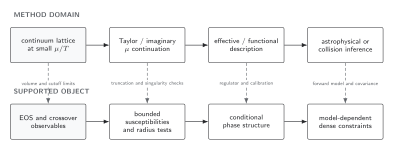
Moving right in the top row means changing the method of access, generally with greater extrapolation or model dependence; it is not a controlled chain of deductions. The lower row correspondingly moves from EOS observables through bounded susceptibility information to conditional phase structure and model-dependent dense constraints. Vertical dashed links identify the required continuum, truncation, regulator, calibration, covariance, and forward-model tests. The diagram is schematic and not a quantitative phase boundary.
In text, no present method controls the full phenomenologically relevant plane. Combine complementary constraints only after retaining their distinct theory content and uncertainties; neither a model critical endpoint nor a stellar EOS interpolation is direct evidence that QCD realizes that microscopic phase.
Exercises
Section titled “Exercises”1. Exponential overlap. If , compare the average phase at volumes and .
Solution
. The values are and . A tenfold volume increase makes phase reweighting exponentially harder.
2. A star with a soft core. Does an inferred softening of the EOS uniquely imply deconfinement?
Solution
No. Hyperons, condensates, strong hadronic correlations, mixed phases, or a first-order quark transition can produce similar integral stellar observables. The data constrain an EOS band under a prior; composition requires additional model discrimination.
Continue to initial conditions and pre-equilibrium evolution for the collision evidence chain.
References
Section titled “References”- Alford, Mark G., Andreas Schmitt, Krishna Rajagopal, and Thomas Schäfer. “Color Superconductivity in Dense Quark Matter.” Reviews of Modern Physics 80, no. 4 (2008): 1455–1515. DOI.
- Annala, Eemeli, Tyler Gorda, Aleksi Kurkela, Joonas Nättilä, and Aleksi Vuorinen. “Evidence for Quark-Matter Cores in Massive Neutron Stars.” Nature Physics 16 (2020): 907–910. DOI.
- Borsányi, Szabolcs, et al. “Lattice QCD Constraints on the Critical Point from an Improved Precision Equation of State.” Physical Review D 112 (2025): L111505. DOI.
- de Forcrand, Philippe. “Simulating QCD at Finite Density.” Proceedings of Science LAT2009 (2010): 010. DOI.
- Kurkela, Aleksi, Eduardo S. Fraga, Jürgen Schaffner-Bielich, and Aleksi Vuorinen. “Constraining Neutron Star Matter with Quantum Chromodynamics.” Astrophysical Journal 789, no. 2 (2014): 127. DOI.