

Ring and Daisy Resummation
Ring resummation repairs the nonuniform expansion of static bosonic propagators by keeping their leading screening self-energy in the zero-mode determinant. The resulting free energy is nonanalytic in the microscopic coupling because the soft scale itself is nonanalytic. The method is controlled only when the fixed-order terms already present are subtracted and the resummed sector is identified precisely.
The order-consistent thermal ring organization used here is developed by Arnold and Espinosa 1993, §§ II–III, pp. 3549–3560.
Required background. Bosonic Zero Modes and Infrared Breakdown identifies the enhanced diagrams. Screening and Infrared Scale Separation defines the relevant static mass. Helpful background. Free Energy and Pressure in Loop Expansion fixes the thermodynamic signs and strict expansion.
Why every ring matters
Section titled “Why every ring matters”Let a bosonic zero mode have a hard contribution . Expanding its determinant about a massless propagator gives powers of . For , no power is small, even when the microscopic coupling is. The infinite series must be summed before the soft momentum integral is expanded.
In dimensional regularization, a no-double-counting form for one real zero mode is
The linear term is subtracted because the one-insertion diagram belongs to the strict loop expansion used to determine . Differentiating with respect to gives
and hence
If , this term is . Its fractional power is a physical consequence of the emergent soft scale, not a failure of algebra.
What “daisy improvement” must specify
Section titled “What “daisy improvement” must specify”For field-dependent masses and thermal self-energies , a common one-loop organization replaces the cubic zero-mode term by
while subtracting the unresummed cubic contribution already contained in the one-loop thermal function. Equivalent organizations distribute the subtraction differently. They agree only through the order to which all masses, counterterms, and hard contributions are treated consistently.
“Ring,” “daisy,” and “superdaisy” are sometimes used with different diagram sets. A reproducible statement names
- which zero modes are dressed;
- which self-energy and momentum limit define each insertion;
- the order at which that self-energy is computed;
- which strict-expansion terms are subtracted; and
- whether the target is pressure, a static correlator, or a field-dependent approximation.
Without these declarations, comparing two prescriptions is not meaningful.
Limits of the method
Section titled “Limits of the method”Ring resummation captures a specific leading static enhancement. It does not by itself
- generate the complete EFT operator basis;
- control a critical point where becomes large;
- cure the non-Abelian magnetostatic sector;
- determine real-time damping or transport;
- guarantee gauge-independent extrema or nucleation rates; or
- justify taking a fractional power of a negative approximate mass squared as a physical imaginary decay rate.
When , the Gaussian expansion is probing an unstable direction. The imaginary part flags that the assumed homogeneous saddle is not a stable equilibrium expansion point; it is not, by itself, the full thermal decay rate.
The resummation record makes the required subtraction and claim boundary explicit.
The schematic below organizes the relationships used on this page. Inspect it with this question in mind: How do ring, daisy, screened, variational, and EFT reorganizations differ?
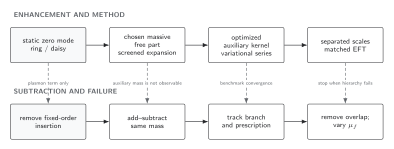
Each reorganization targets a named enhanced sector and must include its compensating subtraction; optimization, factorization-scale, gauge, and strong-soft-sector tests decide whether apparent convergence is meaningful. The method columns are alternatives or partially overlapping reorganizations, not a mandatory sequence: horizontal arrows organize increasing structural scope, while vertical dashed arrows pair each method with its subtraction or failure check. The diagram is schematic and not to scale.
The surrounding discussion supplies the relevant equations and checks in text form; the figure is a navigational summary.
Exercise
Section titled “Exercise”Verify the coefficient by differentiating the subtracted determinant and integrating back with the condition .
Solution
Dimensional regularization gives after the scaleless massless integral vanishes. Thus the derivative is . Since , integration yields .
References
Section titled “References”- Arnold, Peter B., and Olivier Espinosa. “The Effective Potential and First-Order Phase Transitions: Beyond Leading Order.” Physical Review D 47, no. 8 (1993): 3546–3579; erratum 50 (1994): 6662. doi:10.1103/PhysRevD.47.3546.
- Dolan, L., and R. Jackiw. “Symmetry Behavior at Finite Temperature.” Physical Review D 9, no. 12 (1974): 3320–3341. doi:10.1103/PhysRevD.9.3320.
- Parwani, Rajesh R. “Resummation in a Hot Scalar Field Theory.” Physical Review D 45, no. 12 (1992): 4695–4705. doi:10.1103/PhysRevD.45.4695.