

Gauge Dependence and Thermal Observables
Gauge fixing makes propagators, self-energies, background fields, and effective potentials depend on a gauge parameter; physical observables do not when computed exactly with a gauge-invariant definition. Nielsen identities show how gauge variation is proportional to equations of motion, so the value of the exact effective action at an exact stationary point is invariant even though the field location is not. A truncated thermal or resummed calculation preserves this cancellation only when orders, field shifts, and all required diagrams are treated consistently.
The identity controlling gauge-parameter dependence of the effective action was derived by Nielsen 1975, pp. 173–188.
Required background. BRST Cohomology and Physical Observables defines the physical sector. Thermal Counterterms and Renormalization-Group Invariance fixes perturbative consistency. Helpful background. Gauge and Renormalization-Scale Dependence of Decay Rates develops the metastable specialization.
Nielsen identity
Section titled “Nielsen identity”For background fields and gauge parameter , the effective action satisfies schematically
At an exact stationary configuration , the value of is gauge independent. The coordinates of that configuration change with according to . Therefore:
- the value of an exact thermodynamic potential at a physical stationary state can be invariant;
- the field value of a gauge-variant order parameter is not itself observable; and
- evaluating a truncated potential at an unexpanded numerical minimum can mix perturbative orders and leave gauge dependence larger than the claimed error.
At finite temperature the identity still constrains the effective action, but resummation changes power counting. The Nielsen coefficient, thermal masses, and field shift must all be expanded in the same scheme.
Physical mass and screening definitions
Section titled “Physical mass and screening definitions”A complex pole associated with a physical excitation can be gauge independent under the hypotheses ensuring BRST control and an isolated pole. A self-energy evaluated at an arbitrary real momentum is generally gauge dependent. Similarly, a screening length extracted from a gauge-invariant operator is physical; the zero of a gauge-fixed elementary-field propagator need not be.
Hard-thermal-loop self-energies form a gauge-consistent effective structure because vertices and propagators satisfy Ward identities together. Inserting only a Debye-like mass into one propagator can violate those identities even if it improves an infrared denominator.
Checking a thermal phase claim
Section titled “Checking a thermal phase claim”Suppose a truncated gauge-fixed effective potential predicts two minima and a critical temperature. Test it in this order:
- Identify a gauge-invariant phase criterion or observable—pressure equality, latent heat, a gauge-invariant screening channel, or a properly matched EFT quantity.
- State loop, coupling, and resummation counting for and for the field locations.
- Use the Nielsen identity to track gauge variation through the same order.
- Vary as a diagnostic, not as the definition of uncertainty.
- Compare with a gauge-invariant EFT or operator calculation where available.
- Separate gauge dependence from renormalization-scale, matching, and truncation dependence.
A gauge-stable numerical curve over a small range does not prove gauge invariance. Conversely, gauge variation in a gauge-dependent intermediate field does not invalidate a gauge-invariant final observable if the identity’s cancellation is demonstrated.
Common failures
Section titled “Common failures”Minimum location reported as physical. can be gauge dependent. Translate to an invariant criterion.
Partial resummation. Resumming propagators but not the vertices or counterterms required at the same order breaks Ward or Nielsen cancellations.
Pole and curvature mass conflated. A curvature of in a gauge-variant coordinate is not automatically a real-time pole.
Gauge variation called a confidence interval. It probes one inconsistency direction and has no calibrated probabilistic meaning.
The chapter renormalization table keeps resummation, counterterms, and physical interpretation distinct.
The schematic below organizes the relationships used on this page. Inspect it with this question in mind: How does a thermal loop calculation pass from scale counting to a physical observable?
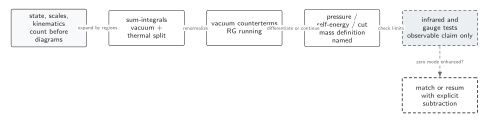
Thermal power counting chooses hard and soft regions; sum-integrals are split into vacuum and thermal parts, vacuum counterterms renormalize them, and mass, width, infrared, RG, and gauge checks bound the final observable. Solid connections show the primary relation; dashed outlines or arrows mark qualifications and failure boundaries. The diagram is schematic and not to scale.
The surrounding discussion supplies the relevant equations and checks in text form; the figure is a navigational summary.
Exercise
Section titled “Exercise”If and , show why evaluating at a numerically exact minimum of the truncated function mixes orders.
Solution
Consistent expansion gives because . Solving the truncated derivative nonperturbatively feeds uncontrolled powers of into and . Gauge cancellations established order by order need not survive that mixing.
References
Section titled “References”- Fukuda, Reijiro, and Taichiro Kugo. “Gauge Invariance in the Effective Action and Potential.” Physical Review D 13, no. 12 (1976): 3469–3479. doi:10.1103/PhysRevD.13.3469.
- Nielsen, N. K. “On the Gauge Dependence of Spontaneous Symmetry Breaking in Gauge Theories.” Nuclear Physics B 101, no. 1 (1975): 173–188. doi:10.1016/0550-3213(75)90301-6.
- Patel, Hiren H., and Michael J. Ramsey-Musolf. “Baryon Washout, Electroweak Phase Transition, and Perturbation Theory.” Journal of High Energy Physics 2011, no. 7 (2011): 029. doi:10.1007/JHEP07(2011)029; Open PDF.