

Derivative Expansion and Tensor Decomposition
At a fixed derivative order, constitutive data must be expanded in a complete set of irreducible scalars, transverse vectors, and transverse traceless tensors. Equations of motion and hydrodynamic field redefinitions remove redundant structures; discrete symmetries, dimension, curvature, sources, and anomalies determine which structures are actually allowed.
Required background. Hydrodynamic Frames and Constitutive Data supplies the field-redefinition quotient. Representations, Intertwiners, Invariants, and Tensor Decomposition explains the irreducible-representation logic.
Helpful background. Relativistic Dissipative Hydrodynamics applies the basis to physical transport.
Kinematic building blocks
Section titled “Kinematic building blocks”For a normal charged fluid in four spacetime dimensions, define
The velocity gradient decomposes into expansion, shear, vorticity, and acceleration. With the positive rest-space tensor ,
The shear is transverse and traceless; the vorticity is transverse and antisymmetric. The background field supplies
with . is a pseudovector, so parity determines whether it can enter an ordinary transport term.
The covariant derivative basis and its on-shell reductions are reviewed in Kovtun 2012, §2.2, pp. 21–25, Open PDF and Romatschke and Romatschke 2019, chs. 2–3.
Raw first-derivative list
Section titled “Raw first-derivative list”Before using equations of motion, the parity-even candidates include
- scalars: , , and ;
- transverse vectors: , , , and ;
- symmetric traceless tensor: .
Vorticity is antisymmetric and cannot directly supply the symmetric traceless viscous stress at first order. Curvature begins at two derivatives in the ordinary counting. In four dimensions is parity odd; anomalous or parity-violating fluids require a separate enlarged basis.
This raw list is overcomplete.
Reduction with ideal equations
Section titled “Reduction with ideal equations”The ideal conservation equations, including a background electric field counted at first derivative order, imply
If the susceptibility matrix
is nonsingular, the first two equations express and in terms of . The momentum equation expresses as a combination of spatial thermodynamic gradients and ; for vanishing sources its right-hand side is zero. A convenient gauge-invariant transverse force is
Thus a parity-even isotropic charged fluid has one independent first-order scalar, vector, and tensor channel:
The hydrodynamic frame and tensor reference fixes their signs and invariant interpretation.
Using lower-order equations inside an constitutive relation changes the stress and current only at . At second order the same replacement generates definite new terms and must be performed consistently. Near a thermodynamic singularity the susceptibility matrix may fail to be invertible; then the reduction itself signals that an additional slow mode may be required.
First-order charged fluid
Section titled “First-order charged fluid”In Landau frame, the reduced parity-even constitutive relation can be written
In the local rest frame, equals minus the conventional shear-gradient stress, so damps velocity gradients. controls expansion, and controls charge flow relative to energy flow. The tensor counting determines that these coefficients exist; it does not compute their values.
For multiple charges, and carry charge-space indices and conductivity becomes a matrix. With broken parity, rotation, or anomalies, vorticity and magnetic-field pseudovectors can contribute nondissipative terms. A superfluid adds a Goldstone gradient and changes the representation content rather than merely adding coefficients.
Independence checks
Section titled “Independence checks”A proposed basis should pass five tests:
- Rest-frame representation. Scalars, vectors, and tensors must transform irreducibly under the unbroken spatial rotations.
- Transversality and trace. Contract every vector or tensor with and trace every tensor.
- Equation-of-motion quotient. State which lower-order equations removed each convective derivative.
- Frame quotient. Reconstruct and after a general field redefinition.
- Source completeness. Include , curvature, boundary, and anomaly structures whenever the declared background permits them.
These checks are dimension sensitive. In two spatial dimensions, identities involving the Levi-Civita tensor reduce the parity-odd basis. In curved spacetime, commuting derivatives generates curvature. A flat-space list cannot simply be declared complete on a general background.
The constitutive box in the schematic is where this page operates. Inspect the incoming hydrostatic constraints and the outgoing frame branch: a complete derivative basis must incorporate the former and quotient the latter before its coefficients are interpreted as transport data.
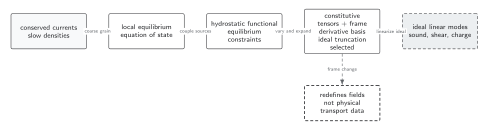
The derivative basis is constrained by equilibrium variation, symmetries, equations of motion, and order-by-order frame redundancy. For the parity-even charged fluid considered here, those reductions leave one first-order scalar, vector, and transverse-traceless tensor channel. The diagram is schematic; it does not display dimension-specific identities, parity-odd sectors, anomalies, or curvature terms.
In text: enumerate all covariant first-derivative structures, decompose them into irreducible rotational sectors, eliminate ideal-equation and algebraic redundancies, and then remove frame-redefinition directions. Only after those steps may the surviving coefficients be matched to , , and .
Exercise
Section titled “Exercise”Verify that is transverse and gauge invariant, and evaluate it in a static rest frame with no electric field.
Solution
Both and are transverse, so . is gauge invariant and are gauge-invariant local thermodynamic variables once the thermal twist is used, so is gauge invariant. In a static rest frame with ,
The current flows down the electrochemical-potential gradient when , with the sign fixed by the constitutive convention above.
Common pitfalls
Section titled “Common pitfalls”Counting before declaring symmetry. Parity, time reversal, dimensionality, anomalies, and background fields change the basis.
Using first-order equations as exact identities. Equation-of-motion elimination is an order-by-order field-basis choice. It changes the omitted higher-order completion.
Calling vorticity dissipative because it contains a derivative. Derivative order and entropy production are distinct classifications.
Where this leads
Section titled “Where this leads”Ideal Relativistic Hydrodynamics first solves the zeroth-order nonlinear system. Relativistic Dissipative Hydrodynamics then derives attenuation and diffusion from the reduced first-order basis.