

Frame-Invariant Dissipative Data
Hydrodynamic field redefinitions change the components called energy correction, heat flow, or charge diffusion, but they do not change the physical stress tensor, currents, or retarded poles through the consistently retained order. The comparable dissipative data are irreducible tensor stress, relative charge flow, scalar stress normal to the equation-of-state surface, and response functions of fixed operators.
Required background. Hydrodynamic Frames and Constitutive Data derives first-order field transformations. Relativistic Dissipative Hydrodynamics fixes the transport normalization.
Helpful background. BDNK First-Order Causal Hydrodynamics uses non-Landau frame terms to alter the exact principal symbol while preserving infrared transport.
First-order invariant basis
Section titled “First-order invariant basis”For the general decomposition
an redefinition of gives
Hence
is invariant. It is charge flow relative to energy flow; in Landau frame it equals , and in Eckart frame it equals .
Likewise,
is invariant under scalar redefinitions, and is invariant because it is the transverse traceless irreducible component. These formulas appear with all sign and projector conventions in the canonical hydrodynamic frame and tensor reference.
Linear dissipative observables
Section titled “Linear dissipative observables”For a neutral isotropic fluid, the invariant first-order data can be read from pole locations:
At zero-density charge-conjugation symmetry,
The poles belong to retarded correlators of fixed physical operators. If two frames give different coefficients at an intermediate step but the same reconstructed , their determinants must agree through the retained power of . This is a stringent translation test.
Kubo formulae provide an equivalent invariant characterization. For example, shear viscosity is the low-frequency absorptive response of the transverse traceless stress. Frame redefinitions of cannot change a correlator of with itself, though local contact terms and operator improvements must be matched.
Explicit two-frame map
Section titled “Explicit two-frame map”Start from a frame with vector corrections
Landau matching uses , giving
Eckart matching uses , giving
Both descriptions contain the same coefficient
The map becomes singular at only because Eckart velocity ceases to be a good coordinate; the invariant Landau current remains regular.
Finite-order qualification
Section titled “Finite-order qualification”Suppose two formulations are related by
Matching through second order requires:
The first-order shift contributes at second order when inserted into first-order tensors, thermodynamic coefficients, and derivatives. Dropping those induced terms can change a sound coefficient or a shear coefficient and then falsely attribute the difference to physics.
Exact PDE properties are subtler. Treating a truncated constitutive relation nonperturbatively resums some terms and discards others. Two frames equivalent through may therefore define inequivalent high-frequency completions. BDNK exploits an admissible general frame to obtain a causal principal part; conventional Landau first order gives a parabolic one. Their shared low- stress response is compatible with different exact principal symbols.
Pole-versus-coefficient comparison
Section titled “Pole-versus-coefficient comparison”When comparing papers or codes:
- translate metric, Fourier, and shear-tensor conventions;
- identify the hydrodynamic fields and matching conditions;
- reconstruct and ;
- transform every term through the claimed order;
- compare retarded poles or Kubo response, not same-named coefficients alone;
- separately compare the exact PDE completion and its coefficient domain.
Kovtun’s general-frame linear analysis demonstrates explicitly that stable and unstable frame choices can share the same infrared transport data Kovtun 2019, §§2–4, pp. 5–18, Open PDF.
The need to distinguish entropy-compatible transport data from frame- and formulation-dependent linear stability persists beyond Lorentz-invariant fluids Poovuttikul and Sybesma 2020, §§2–5, Open PDF.
The lower row of the schematic separates the quantities that can and cannot be compared directly across frames. Inspect how invariant low-frequency transport is common input, whereas relaxation variables, closure coefficients, and hyperbolicity belong to a specified formulation.
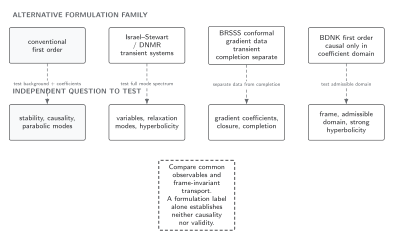
Shear and bulk attenuation, conductivity combinations, and hydrodynamic pole locations are invariant after a consistent order-by-order field redefinition. Raw frame coefficients and the high-frequency structure of an exact truncation are not. The diagram is schematic and compares diagnostic categories; its horizontal ordering should not be interpreted as a map between theories.
In text: translate the constitutive tensors, reduce by lower-order equations, and compare invariant combinations and low- poles. Then test stability and hyperbolicity anew for each exact completion instead of transporting those properties through a perturbative frame redefinition.
Exercise
Section titled “Exercise”Show that the sound attenuation coefficient is unchanged by a first-order scalar redefinition.
Solution
A scalar redefinition shifts along the equilibrium tangent plane. The normal combination
is unchanged. Longitudinal conservation depends on this invariant stress plus the invariant shear tensor. Therefore the imaginary part of the sound poles, obtained from the determinant of physical energy and momentum conservation, is unchanged. A direct matrix calculation gives the same result after consistently transforming the perturbation variables and susceptibilities.
Common pitfalls
Section titled “Common pitfalls”Calling every transport coefficient frame invariant. The invariant object may be a combination such as , not an individual heat- or charge-current coefficient.
Comparing poles at inconsistent order. A first-order map guarantees the displayed hydrodynamic data, not every higher- root of an exact truncation.
Using a singular frame map as evidence of singular physics. Eckart variables fail at even when and Landau variables are regular.
Where this leads
Section titled “Where this leads”Conventional Relativistic Navier–Stokes Instability and Acausality contrasts infrared invariance with exact-PDE pathologies. BDNK First-Order Causal Hydrodynamics shows how frame terms can furnish a causal completion under explicit inequalities.
References
Section titled “References”-
Kovtun, Pavel. 2019. “First-Order Relativistic Hydrodynamics Is Stable.” Journal of High Energy Physics 2019 (10): 034. DOI. Open PDF.
-
Poovuttikul, Navid, and Watse Sybesma. 2020. “First Order Non-Lorentzian Fluids, Entropy Production, and Linear Instabilities.” Physical Review D 102: 065007. DOI. Open PDF.