

BDNK First-Order Causal Hydrodynamics
BDNK hydrodynamics shows that a relativistic theory can be first order in constitutive gradients, use only the ordinary temperature/energy, chemical-potential/charge, and velocity fields, and nevertheless be causal, stable, and strongly hyperbolic. The result holds only in admissible general frames and explicit coefficient domains; it does not rescue conventional Landau or Eckart first-order equations and does not say that every frame is causal.
Required background. Conventional Relativistic Navier–Stokes Instability and Acausality isolates the conventional-frame failures. Frame-Invariant Dissipative Data explains why a general-frame completion can preserve infrared observables while changing the exact principal symbol.
Helpful background. Weak Solutions, Sobolev Spaces, and Well-Posedness supplies the function-space and initial-value distinctions.
General-frame terms are off-shell data
Section titled “General-frame terms are off-shell data”Consider a neutral conformal fluid, and . In the site’s convention write
where
and
Both and vanish upon using the ideal conformal equations. Therefore and are legitimate first-order frame terms: perturbatively removing them changes only higher-order terms, while remains the physical shear viscosity.
Kept inside the exact conservation equation , these time-derivative terms alter the principal part. The resulting PDE is second order in the hydrodynamic fields even though the constitutive tensor contains only one derivative. Bemfica, Disconzi, and Noronha derive this conformal tensor and its characteristic determinant Bemfica, Disconzi, and Noronha 2018, §§III–IV, pp. 9–15, Open PDF.
An explicit admissible conformal choice
Section titled “An explicit admissible conformal choice”Let
A sufficient causal and stable family is
Choose, for example,
The inequality check is explicit:
For the isolated shear channel, the high-frequency characteristic speed is
so its characteristic lies strictly inside the metric light cone. The sound-channel characteristic polynomial supplies the stronger coupled inequality displayed above. Rest-frame Routh–Hurwitz conditions give damped modes; causality plus a complete principal eigensystem then controls boosted stability in the theorem domain.
The strict condition is useful because the Sobolev local-existence theorem assumes it. The earlier Gevrey result also discusses the boundary value under additional technical qualifications. These are sufficient domains, not claims that every point outside them is acausal.
Strong hyperbolicity and local existence
Section titled “Strong hyperbolicity and local existence”A first-order reduction is strongly hyperbolic when its principal symbol has real eigenvalues and a complete, uniformly controlled eigenbasis for every spatial covector. For the conformal system above, the coefficient inequalities make the reduced symbol diagonalizable; the initial-value problem admits a unique local solution for suitable Sobolev data.
One precise fixed-background statement assumes:
- Minkowski spacetime with periodic spatial domain ;
- initial and in , their first time derivatives in , with ;
- bounded strictly away from zero;
- positive analytic ;
- , with and .
Under those hypotheses, local existence and uniqueness hold in the stated Sobolev classes Bemfica et al. 2021, Theorem 1.1, pp. 2281–2283. The domain-of-dependence result extends the local statement from a torus to appropriate regions of .
This theorem does not include a vacuum free boundary, arbitrary rough coefficients, arbitrary physical boundaries, shock continuation, or stochastic noise. Each requires additional analysis.
General charged BDNK theory
Section titled “General charged BDNK theory”The general construction includes shear viscosity, bulk viscosity, conductivity, nonzero charge density, and coupling to dynamical gravity. Its constitutive tensor contains several frame timescales. The necessary and sufficient nonlinear causal conditions are coupled inequalities involving:
and thermodynamic derivatives. Strict versions make the first-order reduction strongly hyperbolic; with coefficient regularity and admissible initial data they yield local well-posedness. Bemfica, Disconzi, and Noronha state the full inequalities and prove causality, diagonalizability, local well-posedness, and the rest-to-boosted stability theorem Bemfica, Disconzi, and Noronha 2022, Theorems I–III and §§IV–VII, pp. 18–32, Open PDF.
The conformal choice above is an explicitly checkable example, not a substitute for those charged inequalities. A code with a nonconformal equation of state must test the full state-dependent coefficient domain at every evolved state.
Relation to Landau frame
Section titled “Relation to Landau frame”The BDNK is generally neither Landau nor Eckart velocity. One can reconstruct the Landau variables perturbatively from the physical tensor:
and the transformation agrees with ordinary first-order transport on shell. Performing that transformation exactly on the truncated BDNK equations chooses a different tower of higher-order terms and can destroy the hyperbolic completion. Frame invariance of hydrodynamic poles therefore coexists with frame dependence of an exact truncation’s high-frequency PDE structure.
The relativistic hydrodynamic consistency reference keeps this order-by-order equivalence separate from theorem status.
Adversarial checks
Section titled “Adversarial checks”An asserted BDNK model should fail review unless it records:
- the frame coefficients and equation of state;
- positivity and regularity throughout the evolved state domain;
- every characteristic speed and eigenvector, not only shear;
- rest and boosted linear spectra;
- boundary and constraint compatibility;
- the function space of any nonlinear theorem invoked;
- sensitivity as a coefficient approaches the boundary of the causal domain;
- a comparison of invariant low- poles with Landau-frame transport.
Noise is another open condition. Adding a white-noise stress to deterministic BDNK equations does not automatically preserve causal support, positivity, or the deterministic theorem. The fluctuating extension requires its own Schwinger–Keldysh and regulator analysis.
The rightmost column is the relevant one here. Its formulation box says “causal only in coefficient domain,” and its vertical test requires the frame, admissible domain, and strong hyperbolicity: first-order derivative counting alone proves none of these.
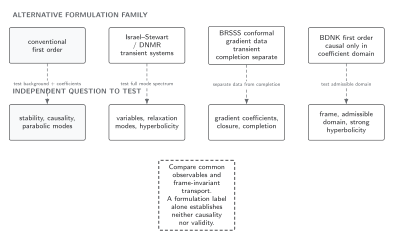
BDNK uses general-frame first-order terms that vanish on the ideal equations but change the exact principal symbol of the truncation. Causality, stability, and strong hyperbolicity hold only on explicit coefficient and thermodynamic domains such as the conformal example derived above. The diagram is schematic; its framework columns are alternatives rather than successive approximations.
In text: retain the frame terms inside , compute all principal characteristics, verify a uniformly complete eigenbasis, and impose the full inequality and regularity set. Perturbative translation to Landau variables preserves infrared observables but need not preserve the exact truncated principal symbol.
Exercise
Section titled “Exercise”For , determine the minimum , and compare the shear characteristic speed at the minimum and at .
Solution
The bound is
Since ,
at the boundary, while gives . Both isolated shear characteristics are subluminal. The sound inequality and eigenvector check remain necessary for the full system; the shear result alone is not the theorem.
Common pitfalls
Section titled “Common pitfalls”Saying BDNK proves every first-order theory causal. It identifies admissible general frames and coefficient domains. Landau and Eckart remain outside them.
Equating causal characteristics with a complete nonlinear result. Strong hyperbolicity, coefficient regularity, initial data, boundaries, and function space still matter.
Transforming to Landau frame exactly and expecting the same principal symbol. The perturbative transformation preserves the derivative expansion, not an arbitrarily resummed truncation.
Where this leads
Section titled “Where this leads”Strong Hyperbolicity, Stability, and Causal Propagation places BDNK’s results in the full hierarchy of PDE claims. A reproducible calculation can test the displayed coefficient choice numerically, but it cannot replace the characteristic theorem.
References
Section titled “References”-
Bemfica, Fábio S., Marcelo M. Disconzi, and Jorge Noronha. 2018. “Causality and Existence of Solutions of Relativistic Viscous Fluid Dynamics with Gravity.” Physical Review D 98: 104064. DOI. Open PDF.
-
Bemfica, Fábio S., Marcelo M. Disconzi, and Jorge Noronha. 2022. “First-Order General-Relativistic Viscous Fluid Dynamics.” Physical Review X 12: 021044. DOI. Open PDF.
-
Bemfica, Fábio S., Marcelo M. Disconzi, Casey Rodriguez, and Yuanzhen Shao. 2021. “Local Existence and Uniqueness in Sobolev Spaces for First-Order Conformal Causal Relativistic Viscous Hydrodynamics.” Communications on Pure and Applied Analysis 20: 2279–2290. DOI. Open PDF.