

Thermal Bounces, Determinants, and Nucleation Rates
A thermal bounce determines the leading exponential suppression of critical-droplet formation. It is not a nucleation rate. A rate per volume also requires collective-coordinate Jacobians, a renormalized fluctuation determinant, treatment of the unique negative mode, and a real-time dynamical prefactor that carries probability away from the critical surface.
Required background. Use metastability and spinodals to establish a barrier-controlled regime and validity limits, thermal effects, and gravity for the zero-temperature boundary.
Helpful background. Decay rates and the negative mode derives the false-vacuum saddle structure, while thermal EFT double counting prevents re-integrating modes already matched into a three-dimensional action.
O(3), O(4), and periodic saddles
Section titled “O(3), O(4), and periodic saddles”At temperatures high compared with the inverse critical-bubble size, nonzero Matsubara modes are heavy and the dominant static saddle is often O(3) symmetric. For one canonically normalized field,
with
The exponential is with when is computed from a four-dimensional free-energy functional; in a dimensionally reduced normalization the factor of may already be absorbed, so dimensions must be checked.
At low temperature the nearly O(4)-symmetric quantum bounce has
and friction term . The suppression is with . At intermediate temperature the true saddle is periodic in Euclidean time and need not be exactly O(3) or O(4). Comparing only and can miss a less symmetric periodic solution or a change of saddle. The crossover must be tested against the full periodic boundary-value problem when the scales are comparable.
The complete rate factorization
Section titled “The complete rate factorization”Langer’s construction separates equilibrium probability near the critical configuration from its real-time escape. Schematically,
is the saddle action relative to the metastable background. is the collective-coordinate measure from translational and any internal zero modes, divided by spacetime volume as appropriate. is the regulated determinant ratio with zero and negative modes removed and with counterterms matched to the action. is the positive real-time growth rate of the unstable collective coordinate in the actual dynamical theory. The product’s dimensions must be energy to the fourth power for in four-dimensional natural units.
For an O(3) thermal bubble there are three translational zero modes, giving a factor proportional to after collective-coordinate normalization. An O(4) bounce has four translations and the familiar factor. Additional exact symmetries require additional collective coordinates; approximate zero modes require uniform treatment rather than simply deleting a small eigenvalue.
The fluctuation operator
must have exactly one physical negative mode for an ordinary decay saddle. Its contour rotation produces the imaginary part or flux associated with metastable decay. Zero modes generate integration over the bubble center. All remaining modes form the determinant ratio against the false phase. More than one negative mode usually means the configuration is not the relevant codimension-one transition state; no negative mode means it does not mediate decay.
The Euclidean negative eigenvalue is not automatically . In an overdamped plasma, depends on damping, conserved hydrodynamic modes, and transport coefficients; in inertial dynamics it is obtained from the real-time linearized equations. Ekstedt’s all-orders organization makes the statistical and dynamical factors explicit for thermal nucleation Ekstedt 2022, §§ 2–4.
The diagram summarizes why the bounce exponent is not a rate. Read the first three boxes as separate obligations: select the thermally appropriate saddle, verify its mode structure, and assemble the fluctuation and dynamical factors before writing .
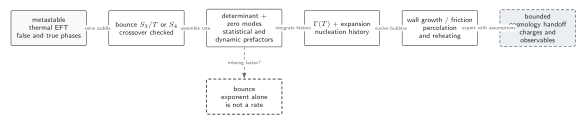
The exponent or is only the saddle contribution. A licensed rate also requires the correct single unstable direction, collective treatment of zero modes, the renormalized determinant, and statistical and dynamical prefactors; the dominant O(3), O(4), or genuinely periodic saddle must be checked in its regime. Later boxes require the expansion history, wall dynamics, and completion calculation. The diagram is schematic and not to scale.
The sections The complete rate factorization, Gauge and EFT consistency, and Dilute gas and dynamical boundaries provide the text and equation equivalent of the rate-building part of the chain.
Checked thin-wall result
Section titled “Checked thin-wall result”For pressure difference favoring the bubble interior and surface tension , the O(3) thin-wall free energy is
Stationarity gives
The radial second derivative is , identifying the single dilation instability. Translations do not change and give three zero modes. This calculation supplies but no determinant or ; quoting merely assumes a dimensional prefactor.
Gauge and EFT consistency
Section titled “Gauge and EFT consistency”In a gauge theory, background profiles are gauge dependent. Gauge invariance of a physical rate is recovered only after the effective potential, kinetic terms, higher derivatives, determinant, and parameter expansion are treated at a common order. Nielsen identities can organize cancellations, but evaluating a tree kinetic term on an all-orders minimum of a truncated gauge-fixed potential does not satisfy them.
Thermal scale separation is equally important. A three-dimensional EFT should be matched using hard and soft modes once; the bounce and its determinant then integrate only the retained EFT modes. Adding four-dimensional ring terms or hard-mode determinants again is double counting. The bounce radius and wall thickness must remain longer than the EFT cutoff length, and field values must remain within the matched operator expansion. Gauge-invariant perturbative frameworks based on dimensional reduction make these requirements explicit Gould and Hirvonen 2021 and Löfgren et al. 2021.
Dilute gas and dynamical boundaries
Section titled “Dilute gas and dynamical boundaries”Independent-nucleation formulas assume critical bubbles are rare and well separated on the correlation scale. The small parameter is not just ; bubble interactions, depletion of the false phase, and rapidly varying temperature must be negligible during formation. Near a spinodal the saddle expands, the barrier shrinks, multiple soft modes appear, and the dilute-bounce expansion fails.
Once a bubble is supercritical, its later wall velocity is not determined by or . Plasma friction and hydrodynamic matching belong to the wall-growth calculation. Percolation and completion require the entire time-dependent rate, not one “nucleation temperature.”
Record each ingredient and uncertainty in the thermal transition validity table.
Failure tests
Section titled “Failure tests”- Solve for all relevant periodic saddles and compare actions through the O(3)/O(4) crossover.
- Count negative and zero modes numerically and test stability against box size and resolution.
- Renormalize the determinant in the same scheme as the effective action and vary the scale.
- Derive or match from real-time dynamics; never replace it silently by the Euclidean eigenvalue.
- Check EFT momenta, derivative expansion, gauge variation, and double counting.
- Verify the dilute-bubble and quasistatic-temperature assumptions.
Exercise
Section titled “Exercise”In the thin-wall model, how does a fractional uncertainty and propagate to at first order?
Solution
Since , at fixed , . Because the rate contains , even a modest fractional error in can dominate prefactor uncertainties; this makes consistent matching and gauge control essential.
Continue
Section titled “Continue”Pass the rate—not merely —to bubble growth and wall friction, then integrate the full history on percolation and completion.
References
Section titled “References”- Affleck, I. (1981). “Quantum-Statistical Metastability.” Physical Review Letters 46, 388–391. DOI.
- Callan, C. G., Jr., and Coleman, S. (1977). “Fate of the False Vacuum. II. First Quantum Corrections.” Physical Review D 16, 1762–1768. DOI.
- Ekstedt, A. (2022). “Bubble Nucleation to All Orders.” Journal of High Energy Physics 2022(08), 115. arXiv:2201.07331; DOI.
- Gould, O., and Hirvonen, J. (2021). “Effective Field Theory Approach to Thermal Bubble Nucleation.” Physical Review D 104, 096015. arXiv:2108.04377; DOI.
- Langer, J. S. (1969). “Statistical Theory of the Decay of Metastable States.” Annals of Physics 54, 258–275. DOI.
- Linde, A. D. (1983). “Decay of the False Vacuum at Finite Temperature.” Nuclear Physics B 216, 421–445; erratum 223, 544. DOI.
- Löfgren, J., Ramsey-Musolf, M. J., Schicho, P., and Tenkanen, T. V. I. (2023). “Nucleation at Finite Temperature: A Gauge-Invariant Perturbative Framework.” Physical Review Letters 130, 251801. arXiv:2112.05472; DOI.