

Hard-Thermal-Loop Effective Theory
Hard-thermal-loop (HTL) theory is the gauge-invariant response of hard plasma particles to soft gauge fields. When external momenta satisfy and internal thermal momenta satisfy , an infinite family of one-loop amplitudes contributes at leading order. Their resummation produces collective poles, Landau damping, screened interactions, and the vertices required by non-Abelian Ward identities.
Required background. Scale hierarchies supplies the separation , and thermal self-energies distinguishes pole, screening, and asymptotic masses. Helpful background. Soft and collinear singularities supplies the real-time infrared logic used in later kinetic applications.
Induced current from hard particles
Section titled “Induced current from hard particles”Let with . A color perturbation of an isotropic hard distribution obeys the collisionless gauge-covariant Vlasov equation
The induced current is
Together with , these local equations are equivalent to the nonlocal HTL effective action. Covariant current conservation follows directly:
The final equality uses angular isotropy. It is the kinetic origin of the Ward identities. Keeping an HTL-resummed propagator while dropping the corresponding HTL vertices generally violates this structure.
Linearization gives the retarded polarization tensor
up to the metric/index convention implicit in the displayed components. Direct contraction verifies . The is essential: it fixes retarded response and generates an imaginary part when .
Longitudinal and transverse response
Section titled “Longitudinal and transverse response”Rotational invariance decomposes the spatial tensor into projectors longitudinal and transverse to . With ,
and
With the scalar convention displayed here, the physical resummed sectors are
Gauge fixing supplies an additional longitudinal four-dimensional component; it is not a new plasma mode. Poles and cuts of the two denominators above give the collective response.
Conventions for the scalar functions vary; physical denominators must be checked rather than formulas compared by name. In the static limit while at leading perturbative order. For , the logarithm crosses a branch cut and describes collisionless Landau damping. For timelike kinematics, zeros of the resummed inverse propagator yield longitudinal and transverse plasmons, developed on the collective-modes page.
HTL vertices and power counting
Section titled “HTL vertices and power counting”Gauge invariance ties the -point HTL vertices together. Formally, the gluonic action can be written
Expanding generates vertices of all orders. For soft fields , the covariant derivative term competes with , so the entire series can matter. Braaten and Pisarski showed that HTL-resummed perturbation theory restores a systematic leading-order expansion for soft amplitudes Braaten and Pisarski 1990, §§ 2–4; Frenkel and Taylor established the gauge-invariant generating functional Frenkel and Taylor 1990.
For fermions, an analogous angular integral produces the thermal self-energy with asymptotic mass parameter . In kinetic applications, asymptotic masses regulate collinear energy denominators, whereas screens soft longitudinal exchange. Treating them as a single “thermal mass” loses essential physics.
Controlled domain and checks
Section titled “Controlled domain and checks”Equilibrium HTL assumes an isotropic, homogeneous hard distribution and soft external momentum. It is collisionless at the scale . Widths that are parametrically smaller, ultrasoft color relaxation, and LPM interference require collision kernels or further matching. An anisotropic distribution admits a hard-loop generalization but may be unstable; it cannot be obtained by substituting a direction-dependent into the isotropic formulas.
A trustworthy HTL calculation should pass:
- transversality of every self-energy and the associated vertex Ward identities;
- the static limits and at leading order;
- retarded analyticity in the upper half plane and the correct sign of spectral weight;
- cancellation of the separation scale when hard and soft momentum regions are combined;
- independence of the final gauge-invariant observable from gauge-fixing parameters.
These tests and the scope of the approximation are recorded in the hot-gauge plasma validity table.
The branching structure shows both the reach of HTL matching and the observables it does not contain.
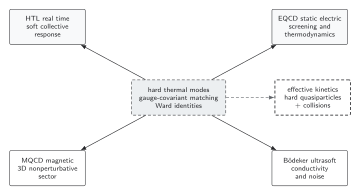
HTL amplitudes are fixed by hard-particle response and satisfy non-Abelian Ward identities, making them the appropriate branch for soft collisionless real-time correlators. The static, magnetostatic, ultrasoft, and quasiparticle branches require additional reductions or collision kernels and cannot be substituted without matching. The diagram is schematic and not to scale.
The text equivalent is to identify the external frequency and momentum before resumming: use HTL for soft real-time response, avoid double counting hard contributions already encoded in its vertices, and change effective theory when static, magnetic, collisional, or ultrasoft physics dominates.
Exercises
Section titled “Exercises”1. Ward identity. Contract the linearized polarization tensor with , using .
Solution
The integral term becomes after cancellation of the denominator. Its only nonzero angular average is the component, equal to , which cancels the contracted local term. Hence .
2. Landau cut. For real , determine the imaginary part of the logarithm in with the retarded prescription.
Solution
The denominator lies just above the negative real axis, while . Therefore . Because contains minus one half of this logarithm, the displayed convention gives . Damping is determined from the full retarded propagator and its spectral convention, not from this scalar sign in isolation.
Continue to collective modes and dynamical screening or to effective kinetic theory.
References
Section titled “References”- Braaten, Eric, and Robert D. Pisarski. “Soft Amplitudes in Hot Gauge Theories: A General Analysis.” Nuclear Physics B 337, no. 3 (1990): 569–634. DOI.
- Frenkel, Jean, and John C. Taylor. “High Temperature Limit of Thermal QCD.” Nuclear Physics B 334, no. 1 (1990): 199–216. DOI.
- Le Bellac, Michel. Thermal Field Theory. Cambridge Monographs on Mathematical Physics. Cambridge: Cambridge University Press, 1996. DOI.
- Taylor, John C., and S. M. H. Wong. “The Effective Action of Hard Thermal Loops in QCD.” Nuclear Physics B 346, no. 1 (1990): 115–128. DOI.